What is it?
A solution is a uniform mixture. The substance present in the larger amount is the solvent (usually water); the dissolved substance is the solute.
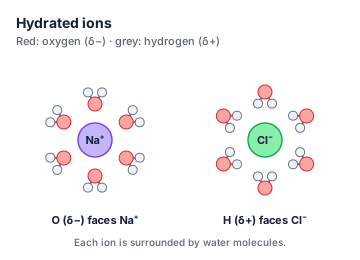
When a substance dissolves, its particles separate and become surrounded by solvent molecules. Water is a polar molecule, with a slightly negative oxygen and slightly positive hydrogens, so:
- Ionic compounds split into separate ions: . Each ion is surrounded by water molecules (it is hydrated): the oxygen side faces positive ions and the hydrogen side faces negative ions.
- Polar molecular compounds such as sugar and ethanol dissolve as whole molecules, held by hydrogen bonds and dipole attractions.
A solution that conducts electricity contains ions that can move. Solutes are classified by how many ions they give:
| Type | In water | Conducts? | Examples |
|---|---|---|---|
| Strong electrolyte | Completely split into ions | Strongly | Soluble ionic compounds (NaCl, CaCl₂), strong acids (HCl, HNO₃), strong bases (NaOH) |
| Weak electrolyte | Only a small fraction forms ions | Weakly | Weak acids (ethanoic acid), weak bases (ammonia) |
| Non-electrolyte | Stays as molecules | No | Sugar, ethanol, urea |
Key idea
Electrical conductivity in solution comes from moving ions. The more ions a solution contains, the better it conducts. That is why salt water conducts, sugar water doesn’t, and vinegar conducts only weakly.
Why does it matter?
- Your body runs on electrolytes. Nerve signals and heartbeats depend on , and ions; sports drinks replace the ions lost in sweat.
- Counting particles. One mole of gives three moles of ions. This matters for reactions, for colligative properties and for net ionic equations.
- Hot and cold packs. Some substances absorb heat as they dissolve, others release it.
How does it work?
1. Writing dissociation equations
For a strong electrolyte, show every ion with its coefficient:
A weak electrolyte is shown with an equilibrium arrow, because most of it stays as molecules:
2. Ion concentrations
Multiply the concentration of the compound by the number of each ion in its formula. In 0.150 mol/L : mol/L and mol/L.
3. Energy changes on dissolving
Dissolving an ionic solid takes two steps:
- Breaking up the lattice (separating the ions): needs energy, endothermic.
- Hydrating the ions (attracting water molecules): releases energy, exothermic.
If hydration releases more energy than the lattice needs, dissolving is exothermic and the solution warms up (, ). If it releases less, dissolving is endothermic and the solution cools (, used in instant cold packs).
Think of it like this
Dissolving salt is like a crowd breaking up at a party. Each guest (ion) leaves their own group and is soon surrounded by a circle of new friends (water molecules). If the new friendships are stronger than the old ones, energy is released; if they are weaker, energy has to be put in.
More precisely
Even strong electrolytes are not perfectly “free” ions in concentrated solutions: oppositely charged ions attract each other and form ion pairs, so solutions behave as if they contain slightly fewer particles. The “strong” and “weak” labels describe the extent of ionization, not the concentration: a dilute strong acid can be less acidic than a concentrated weak one. Whether a substance dissolves also depends on entropy (the spreading out of particles), which favours dissolving even when it is slightly endothermic.
Visualise it
Worked example
Worked example: Classifying solutes
Question: Classify each as a strong, weak or non-electrolyte: (a) KNO₃ (b) glucose (c) HCl (d) NH₃ (e) ethanol
- (a) Soluble ionic compound: strong.
- (b) Molecular, does not ionize: non-electrolyte.
- (c) Strong acid, fully ionized: strong.
- (d) Weak base, only partly ionized: weak.
- (e) Molecular, does not ionize: non-electrolyte.
Worked example: Ion concentrations
Question: What are the ion concentrations in 0.0500 mol/L ?
- Total ions: mol/L, five times the concentration of the compound.
Worked example: Mixing two solutions
Question: 25.0 mL of 0.200 mol/L NaCl is mixed with 25.0 mL of 0.100 mol/L . What is in the mixture?
-
Moles of from NaCl:
-
From (2 Cl⁻ each):
-
Total volume 0.0500 L:
Worked example: A cold pack
Question: 10.0 g of dissolves in 100. g of water. ΔH(solution) = +25.7 kJ/mol. By how much does the temperature fall?
-
Moles:
-
Heat absorbed:
-
This heat comes from the 110. g of solution:
-
The solution cools by about 7 °C.
Common mistake
Common mistake: Thinking all dissolved substances conduct
Sugar dissolves completely but forms no ions, so sugar solution does not conduct. Dissolving and ionizing are different things.
Common mistake: Forgetting the subscripts
gives two chloride ions per formula unit, so is twice the concentration of the compound.
Common mistake: Splitting polyatomic ions
gives . The sulfate ion stays together; it does not break into S and O.
Notation note
- Square brackets mean concentration in mol/L: .
- (aq) means “dissolved in water” (aqueous).
Remember this
Remember this
- Solute dissolves in solvent; water is polar and hydrates ions.
- Strong electrolytes: soluble ionic compounds, strong acids and bases (fully ionized). Weak: weak acids and bases. Non-electrolytes: molecular solutes such as sugar.
- Ion concentration = compound concentration × number of that ion in the formula.
- Dissolving: lattice breaking (endothermic) + hydration (exothermic). The balance decides hot or cold.
Test yourself
Check your understanding before moving on.
Flashcards
Electrolytes and Dissolving: Flashcards
- QuestionWhat are the solute and the solvent in a solution?Answer
Solute: the substance dissolved. Solvent: the substance it dissolves in (usually present in larger amount, often water).
- QuestionWhat is an electrolyte?Answer
A substance that forms ions in water, so its solution conducts electricity.
- QuestionGive examples of strong, weak and non-electrolytes.Answer
Strong: NaCl, HCl, NaOH. Weak: ethanoic acid, ammonia. Non-electrolyte: sugar, ethanol.
- QuestionWhat does "hydrated" mean for an ion?Answer
The ion is surrounded by water molecules, with their oppositely charged ends facing it.
- QuestionWhich end of a water molecule faces a Na⁺ ion?Answer
The oxygen (δ−) end.
- QuestionWrite the dissociation equation for CaCl₂.Answer
- QuestionWhat is [Cl⁻] in 0.150 mol/L CaCl₂?Answer
2 × 0.150 mol/L = 0.300 mol/L
- QuestionWhy does sugar solution not conduct electricity?Answer
Sugar dissolves as whole molecules and forms no ions.
- QuestionWhat two energy steps occur when an ionic solid dissolves?Answer
Breaking the lattice (endothermic) and hydrating the ions (exothermic).
- QuestionWhy does dissolving NH₄NO₃ make water colder?Answer
Hydration releases less energy than breaking the lattice needs, so heat is taken from the water (ΔH positive).
Tip: press Space to flip and ← → to move between cards.
Quiz
Electrolytes and Dissolving: Quiz
7 questions
NaCl is a strong electrolyte, fully split into ions. Ethanoic acid is only partly ionized, sugar forms no ions and pure water has very few.
Show answer
Answer: 0.10 mol/L NaCl
NaCl is a strong electrolyte, fully split into ions. Ethanoic acid is only partly ionized, sugar forms no ions and pure water has very few.
Ethanol dissolves as molecules and does not ionize. The others are a strong base, a strong acid and a soluble salt.
Show answer
Answer: Ethanol
Ethanol dissolves as molecules and does not ionize. The others are a strong base, a strong acid and a soluble salt.
The hydrogen atoms carry a partial positive charge (δ+), attracted to the negative chloride ion.
Show answer
Answer: Hydrogen atoms
The hydrogen atoms carry a partial positive charge (δ+), attracted to the negative chloride ion.
Each FeCl₃ gives three Cl⁻ ions: 3 × 0.150 mol/L = 0.450 mol/L.
Show answer
Answer: 0.450 mol/L
Each FeCl₃ gives three Cl⁻ ions: 3 × 0.150 mol/L = 0.450 mol/L.
CaCl₂ gives 3 ions per formula unit (0.30 mol/L of ions); NaCl gives 2 (0.20 mol/L); ethanoic acid gives very few; glucose gives none.
Show answer
Answer: CaCl₂
CaCl₂ gives 3 ions per formula unit (0.30 mol/L of ions); NaCl gives 2 (0.20 mol/L); ethanoic acid gives very few; glucose gives none.
A warmer solution means dissolving is exothermic: the energy released by hydrating the ions exceeds the energy needed to separate them.
Show answer
Answer: Hydration releases more energy than breaking the lattice needs
A warmer solution means dissolving is exothermic: the energy released by hydrating the ions exceeds the energy needed to separate them.
n = 10.0 g ÷ 80.05 g/mol = 0.1249 mol; q = 0.1249 mol × 25.7 kJ/mol = 3.21 kJ.
Show answer
Answer: 3.21 kJ
n = 10.0 g ÷ 80.05 g/mol = 0.1249 mol; q = 0.1249 mol × 25.7 kJ/mol = 3.21 kJ.
Notes and downloads
Worksheet
Electrolytes and Dissolving Worksheet
8 questions on electrolytes, dissociation equations, ion concentrations, mixing solutions and energy changes on dissolving. Answer key included.
References
- Brown, T. L.; LeMay, H. E., Jr.; Bursten, B. E.; Murphy, C. J.; Woodward, P. M.; Stoltzfus, M. W. Chemistry: The Central Science, 15th ed.; Pearson, 2022.
Practise this topic with flashcards and a quiz at chemistryclarity.com/chemistry/electrolytes-and-dissolving/
Spotted a mistake? Let us know and we'll fix it.