What is it?
Intermolecular forces are the attractions between molecules. They are different from the covalent bonds within a molecule (intramolecular forces), and much weaker: boiling water needs 40.7 kJ/mol to separate the molecules, but breaking an O–H bond inside a water molecule needs about 463 kJ/mol.
When a liquid boils, only the intermolecular forces are overcome; the molecules themselves stay intact. So the stronger the intermolecular forces, the higher the boiling point.
There are three main types, from weakest to strongest (for molecules of similar size):
- London dispersion forces: present between all molecules. Electrons move constantly, creating brief, temporary dipoles that induce dipoles in neighbouring molecules. They grow with the number of electrons (larger molecules) and with surface contact (long, unbranched shapes).
- Dipole–dipole forces: between polar molecules, which have permanent dipoles. The δ+ end of one molecule attracts the δ− end of another.
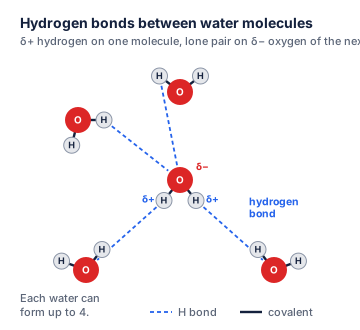
- Hydrogen bonds: a strong dipole–dipole attraction between an H atom bonded to N, O or F and a lone pair on an N, O or F atom of another molecule.
Key idea
To predict boiling points, ask three questions. Is there an H on N, O or F? Then hydrogen bonding. Is the molecule polar? Then dipole–dipole forces. How big is it? Larger molecules have stronger dispersion forces, which can outweigh the other two.
Why does it matter?
- States of matter. Intermolecular forces decide whether a substance is a gas, liquid or solid at room temperature, and its melting and boiling points.
- Water and life. Hydrogen bonding gives water its high boiling point, high heat capacity and surface tension, makes ice float, and holds the two strands of DNA together.
- Solubility and separation. “Like dissolves like” and chromatography both depend on matching intermolecular forces.
How does it work?
1. Dispersion forces and molecular size
The halogens are non-polar, so they have only dispersion forces. As the molecules get bigger and have more electrons, the dispersion forces grow and the boiling points rise:
| Halogen | Molar mass | Boiling point | State at 25 °C |
|---|---|---|---|
| 38.00 g/mol | −188 °C | gas | |
| 70.90 g/mol | −34 °C | gas | |
| 159.80 g/mol | 59 °C | liquid | |
| 253.80 g/mol | 184 °C | solid |
Shape matters too: unbranched pentane (36 °C) boils higher than compact 2,2-dimethylpropane (10 °C), because long molecules touch over a larger area.
2. Comparing molecules of similar size
When molar masses are similar, dispersion forces are similar, and the other forces decide:
| Compound | Molar mass | Strongest force | Boiling point |
|---|---|---|---|
| butane, | 58.12 g/mol | dispersion | about 0 °C |
| propanone, | 58.08 g/mol | dipole–dipole | 56 °C |
| propan-1-ol, | 60.10 g/mol | hydrogen bonding | 97 °C |
3. Hydrogen bonding
Hydrogen bonding is unusually strong because N, O and F are very electronegative and small, and the H atom has no inner electrons, so its nucleus is exposed. Each water molecule can form up to four hydrogen bonds (two through its H atoms and two through its lone pairs). That is why:
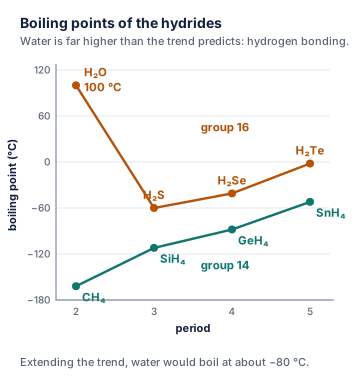
- water (18.02 g/mol) boils at 100 °C, while (34.08 g/mol) boils at −60 °C;
- ice floats: in ice, hydrogen bonds hold the molecules in an open hexagonal network, so ice is less dense than liquid water.
4. Effects on properties
Stronger intermolecular forces mean:
- higher melting and boiling points and a larger enthalpy of vaporization;
- lower vapour pressure (fewer molecules escape from the liquid);
- higher viscosity and surface tension.
For solubility, a solute dissolves best in a solvent with similar forces: polar and hydrogen-bonding substances (sugar, ethanol) dissolve in water; non-polar substances (oil, iodine) dissolve in non-polar solvents such as hexane. Ionic compounds dissolve in water through ion–dipole attractions.
Think of it like this
Think of molecules as people in a crowded room. Dispersion forces are a light brush of shoulders: weak, but they add up when people are big and pressed close together. Dipole–dipole forces are like people turning to face each other. Hydrogen bonds are firm handshakes. The more handshakes, the harder it is for anyone to leave the room, just as more hydrogen bonding makes a liquid harder to boil.
More precisely
Dispersion forces are not always the weakest overall: a large non-polar molecule can have stronger total attractions than a small polar one. Iodine (, 184 °C) boils far higher than water, despite having no dipole. A hydrogen bond is typically 10 to 40 kJ/mol, compared with roughly 150 to 1000 kJ/mol for covalent bonds. In proteins, hydrogen bonds between different parts of the chain hold the shapes (helices and sheets) that make the protein work.
Visualise it
Worked example
Worked example: Identifying intermolecular forces
Question: Name all the intermolecular forces in (a) (b) (c) (d) .
- (a) Non-polar: dispersion forces only.
- (b) Polar (Cl is more electronegative than H), but H is not on N, O or F: dispersion + dipole–dipole.
- (c) H bonded to N, and N has a lone pair: dispersion + dipole–dipole + hydrogen bonding.
- (d) The C=O bonds are polar, but the linear molecule is symmetrical, so the dipoles cancel: dispersion forces only.
Worked example: Ranking boiling points
Question: Put butane, propanone and propan-1-ol in order of increasing boiling point, and explain.
- Their molar masses are almost equal (58 to 60 g/mol), so their dispersion forces are similar.
- Butane is non-polar: dispersion only. Lowest.
- Propanone has a polar C=O group: dipole–dipole forces as well. Middle.
- Propan-1-ol has an O–H group: hydrogen bonding as well. Highest.
- Order, lowest first: butane (about 0 °C), propanone (56 °C), propan-1-ol (97 °C).
Worked example: Energy to boil water
Question: How much energy is needed to vaporize 25.0 g of water at 100 °C? ( = 40.7 kJ/mol; = 18.02 g/mol)
- 56.5 kJ
- This energy only separates the molecules (overcoming hydrogen bonds and other intermolecular forces); no O–H bonds are broken, and the steam is still .
Common mistake
Common mistake: Thinking boiling breaks covalent bonds
When water boils, the bubbles contain molecules, not hydrogen and oxygen. Boiling overcomes intermolecular forces; the covalent bonds inside the molecules are untouched.
Common mistake: Calling any H-containing molecule hydrogen-bonded
Hydrogen bonding needs H bonded directly to N, O or F. and the C–H hydrogens in ethanol do not form hydrogen bonds; only ethanol’s O–H hydrogen does.
Common mistake: Forgetting dispersion forces
Every molecule has dispersion forces, including polar ones. For large molecules they are often the largest contribution: that is why iodine is a solid and boils higher than .
Notation note
- London dispersion forces are also called London forces, dispersion forces or instantaneous dipole–induced dipole forces. Together with dipole–dipole forces they are often called van der Waals forces.
- A hydrogen bond is usually drawn as a dashed line: O–H⋯O.
- δ+ and δ− mean partial positive and partial negative charges.
Remember this
Remember this
- Intermolecular forces act between molecules; they are much weaker than covalent bonds. Boiling overcomes only these forces.
- For molecules of similar size, weakest to strongest: dispersion (all molecules; bigger and longer = stronger), dipole–dipole (polar molecules), hydrogen bonding (H on N, O or F).
- Stronger forces: higher boiling point, lower vapour pressure, higher viscosity and surface tension.
- Like dissolves like; hydrogen bonding explains water’s high boiling point and why ice floats.
Test yourself
Check your understanding before moving on.
Flashcards
Intermolecular Forces: Flashcards
- QuestionIntermolecular force vs covalent bond?Answer
Intermolecular forces act between molecules and are much weaker; covalent bonds hold atoms together within a molecule.
- QuestionWhat are London dispersion forces?Answer
Attractions between temporary dipoles caused by moving electrons. Present in all molecules; stronger for bigger, longer molecules.
- QuestionWhen do dipole–dipole forces occur?Answer
Between polar molecules: the δ+ end of one attracts the δ− end of another.
- QuestionWhat is needed for hydrogen bonding?Answer
An H atom bonded to N, O or F, and a lone pair on an N, O or F atom of another molecule.
- QuestionWhat is overcome when a molecular liquid boils?Answer
Only the intermolecular forces; covalent bonds inside the molecules stay intact.
- QuestionWhy does water (100 °C) boil so much higher than H₂S (−60 °C)?Answer
Water forms hydrogen bonds (O–H); H₂S does not, and has only weaker dipole–dipole and dispersion forces.
- QuestionWhy does pentane boil higher than 2,2-dimethylpropane?Answer
Unbranched pentane has more surface contact, so stronger dispersion forces (36 °C against 10 °C).
- QuestionWhy does ice float?Answer
Hydrogen bonds hold the molecules in an open network in ice, so ice is less dense than liquid water.
- QuestionHow do stronger intermolecular forces affect vapour pressure and viscosity?Answer
Vapour pressure is lower; viscosity and surface tension are higher.
- QuestionWhat does "like dissolves like" mean?Answer
Solutes dissolve best in solvents with similar forces: polar in polar (water), non-polar in non-polar (hexane).
Tip: press Space to flip and ← → to move between cards.
Quiz
Intermolecular Forces: Quiz
7 questions
Methane is non-polar and has no H on N, O or F, so only dispersion forces act.
Show answer
Answer: dispersion forces only
Methane is non-polar and has no H on N, O or F, so only dispersion forces act.
Methanol has an H bonded directly to O. In CH₃OCH₃ all H atoms are on carbon.
Show answer
Answer: CH₃OH
Methanol has an H bonded directly to O. In CH₃OCH₃ all H atoms are on carbon.
All are non-polar; I₂ has the most electrons and the strongest dispersion forces (184 °C).
Show answer
Answer: I₂
All are non-polar; I₂ has the most electrons and the strongest dispersion forces (184 °C).
With similar dispersion forces, propan-1-ol wins because it can hydrogen-bond (97 °C, against 56 °C and about 0 °C).
Show answer
Answer: propan-1-ol
With similar dispersion forces, propan-1-ol wins because it can hydrogen-bond (97 °C, against 56 °C and about 0 °C).
CO₂ is linear, so the two bond dipoles cancel and the molecule is non-polar.
Show answer
Answer: dispersion forces only
CO₂ is linear, so the two bond dipoles cancel and the molecule is non-polar.
Like dissolves like: non-polar iodine dissolves in non-polar hexane.
Show answer
Answer: I₂
Like dissolves like: non-polar iodine dissolves in non-polar hexane.
q = 2.00 mol × 40.7 kJ/mol = 81.4 kJ.
Show answer
Answer: 81.4 kJ
q = 2.00 mol × 40.7 kJ/mol = 81.4 kJ.
Notes and downloads
Worksheet
Intermolecular Forces Worksheet
9 questions on identifying intermolecular forces, explaining boiling points, ice and solubility, and enthalpy of vaporization. Answer key included.
References
- Brown, T. L.; LeMay, H. E., Jr.; Bursten, B. E.; Murphy, C. J.; Woodward, P. M.; Stoltzfus, M. W. Chemistry: The Central Science, 15th ed.; Pearson, 2022.
Practise this topic with flashcards and a quiz at chemistryclarity.com/chemistry/intermolecular-forces/
Spotted a mistake? Let us know and we'll fix it.