Worksheet
Electrolytes and Dissolving Worksheet
8 questions on electrolytes, dissociation equations, ion concentrations, mixing solutions and energy changes on dissolving. Answer key included.
- Type
- Worksheet
- Level
- Beginner
- Format
- PDF, ready to print
Preview the questions
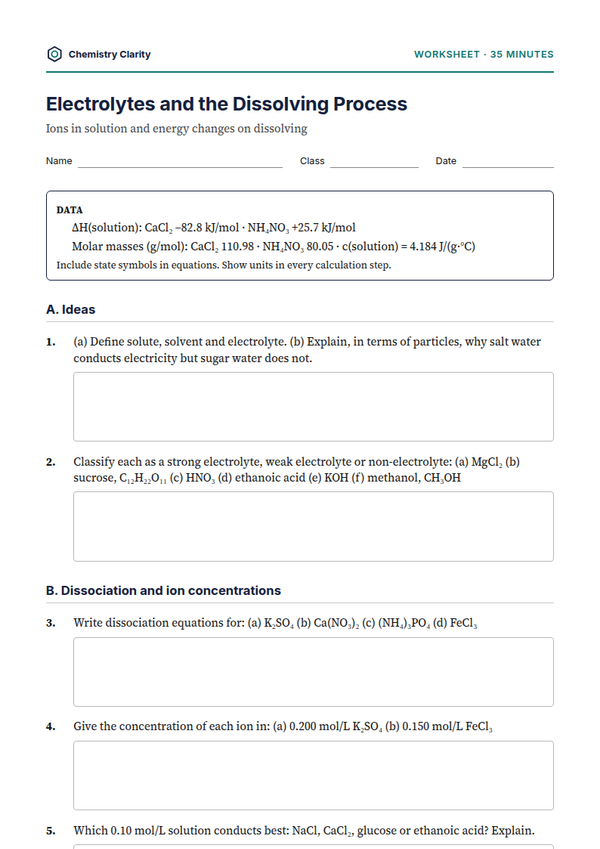
All the questions on this worksheet (about 35 minutes). Download the PDF to print it with space for working; the free answer key has full worked solutions.
A. Ideas
1.
(a) Define solute, solvent and electrolyte. (b) Explain, in terms of particles, why salt water conducts electricity but sugar water does not.
2.
Classify each as a strong electrolyte, weak electrolyte or non-electrolyte: (a) MgCl₂ (b) sucrose, C₁₂H₂₂O₁₁ (c) HNO₃ (d) ethanoic acid (e) KOH (f) methanol, CH₃OH
B. Dissociation and ion concentrations
3.
Write dissociation equations for: (a) K₂SO₄ (b) Ca(NO₃)₂ (c) (NH₄)₃PO₄ (d) FeCl₃
4.
Give the concentration of each ion in: (a) 0.200 mol/L K₂SO₄ (b) 0.150 mol/L FeCl₃
5.
Which 0.10 mol/L solution conducts best: NaCl, CaCl₂, glucose or ethanoic acid? Explain.
6.
50.0 mL of 0.100 mol/L CaCl₂ is mixed with 50.0 mL of 0.200 mol/L KCl. Calculate the concentration of each ion in the mixture.
C. Energy changes
7.
Explain why dissolving some salts makes the water warmer and others make it colder. Refer to the two energy steps.
D. Challenge
8.
A hand warmer contains 5.00 g of CaCl₂, which dissolves in 100. g of water. Calculate the temperature rise of the 105 g of solution.