What is it?
A chemical bond is the attraction that holds atoms together. Atoms bond because the bonded arrangement has lower energy than the separate atoms. There are two main types:
- Ionic bond: one atom transfers electrons to another, forming oppositely charged ions that attract each other. Typical between a metal and a non-metal, e.g. sodium chloride, NaCl.
- Covalent bond: two atoms share a pair of electrons. Typical between non-metals, e.g. the H–Cl bond in hydrogen chloride.
Key idea
Ionic bonding = electron transfer and attraction between ions. Covalent bonding = electron sharing. The difference in electronegativity between the two atoms tells you which is more likely.
Why does it matter?
- It explains properties. Salt melts at 801 °C, but sugar melts (and starts to caramelise) below 200 °C. The difference comes from the type of bonding.
- It predicts formulas. Knowing ion charges lets you write formulas such as and .
- It is the starting point for molecular structure. Lewis structures and molecular shapes build on covalent bonding.
How does it work?
1. Ionic bonding
Metals have low ionization energies and lose electrons easily; non-metals gain electrons. Each atom tends to reach a noble-gas configuration:
The ions and attract strongly. In a solid, each ion is surrounded by ions of the opposite charge in a repeating 3D lattice. There are no separate “molecules” of NaCl; the formula gives the ratio of ions.
Writing formulas: the total positive charge must equal the total negative charge.
| Ions | Formula |
|---|---|
| and | |
| and | |
| and |
2. Covalent bonding
Two non-metal atoms both attract electrons strongly, so neither gives one up. Instead they share a pair of electrons, and both nuclei attract the shared pair. Atoms can share one, two or three pairs: single, double and triple bonds. More shared pairs make a bond shorter and stronger.
3. Polar covalent bonds and electronegativity
Electronegativity (EN) is how strongly an atom attracts the shared electrons in a bond. When the two atoms have different electronegativities, the electrons are shared unequally: the more electronegative atom gets a partial negative charge (δ−), the other a partial positive charge (δ+). This is a polar covalent bond.
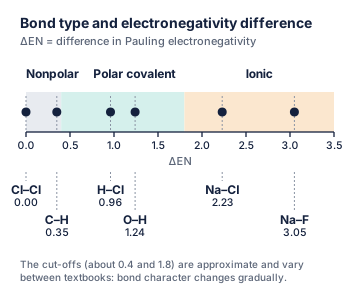
The electronegativity difference (ΔEN) gives a rough guide:
| ΔEN | Bond type | Example |
|---|---|---|
| less than about 0.4 | nonpolar covalent | C–H, 2.55 − 2.20 = 0.35 |
| about 0.4 to 1.8 | polar covalent | O–H, 3.44 − 2.20 = 1.24 |
| more than about 1.8 | ionic | Na–Cl, 3.16 − 0.93 = 2.23 |
Think of it like this
Think of a tug of war over a rope (the electron pair). Two equally strong players: the rope stays in the middle (nonpolar). One player a bit stronger: the rope moves towards them (polar). One player far stronger: they take the rope completely (ionic).
More precisely
Bonding is a continuum, not three separate boxes. Even NaCl has a little covalent character, and the cut-off values are only guides; textbooks use slightly different numbers. A third type, metallic bonding (metal cations in a “sea” of shared, delocalised electrons), holds metals together and is covered separately.
4. Properties compared
| Property | Ionic compounds | Covalent (molecular) substances |
|---|---|---|
| Melting point | high | usually low |
| State at room temperature | solid | often gas or liquid |
| Conducts electricity | when molten or dissolved | usually not |
| Solubility in water | often soluble | varies |
Ionic solids have high melting points because many strong attractions between ions must be overcome. Molecular substances melt easily because only the weak forces between molecules break; the covalent bonds inside the molecules stay intact.
Visualise it
Worked example
Worked example: Classifying bonds
Question: Classify the bonds in H–F, C–O and K–Br. (EN: H 2.20, F 3.98, C 2.55, O 3.44, K 0.82, Br 2.96)
- H–F: 3.98 − 2.20 = 1.78, polar covalent (close to the boundary)
- C–O: 3.44 − 2.55 = 0.89, polar covalent, with O δ− and C δ+
- K–Br: 2.96 − 0.82 = 2.14, ionic
Worked example: Writing an ionic formula
Question: Write the formula of the compound formed by aluminium and sulfur.
- Al is in group 13 and forms ; S is in group 16 and forms .
- Lowest common multiple of 3 and 2 is 6: 2 × (+3) = +6 and 3 × (−2) = −6.
- Formula:
Common mistake
Common mistake: Calling NaCl a molecule
Ionic compounds form lattices, not molecules. is a formula unit showing a 1 : 1 ratio of ions.
Common mistake: Thinking melting breaks covalent bonds
When ice or wax melts, the covalent bonds inside the molecules don’t break; only the attractions between molecules are overcome.
Common mistake: Using metal/non-metal as an absolute rule
The metal + non-metal rule is a good first guess, but it has exceptions. For example, has considerable covalent character. Use ΔEN when the values are given.
Notation note
- δ+ and δ− (“delta plus”, “delta minus”) mean partial charges, smaller than a full charge.
- ΔEN is always taken as a positive number (larger EN minus smaller EN).
Remember this
Remember this
- Ionic: electrons transferred, ions in a lattice, usually metal + non-metal.
- Covalent: electron pairs shared, usually non-metal + non-metal.
- ΔEN below about 0.4: nonpolar; 0.4 to 1.8: polar covalent; above about 1.8: ionic.
- Ionic compounds have high melting points and conduct when molten or dissolved.
Test yourself
Check your understanding before moving on.
Flashcards
Ionic and Covalent Bonds: Flashcards
- QuestionWhat is an ionic bond?Answer
The attraction between oppositely charged ions, formed when electrons are transferred from one atom to another.
- QuestionWhat is a covalent bond?Answer
A shared pair of electrons between two atoms.
- QuestionWhat is electronegativity?Answer
How strongly an atom attracts the shared electrons in a bond.
- QuestionWhat is a polar covalent bond?Answer
A covalent bond in which the electrons are shared unequally, giving partial charges δ+ and δ−.
- QuestionRoughly which ΔEN values give nonpolar, polar covalent and ionic bonds?Answer
Below about 0.4: nonpolar; about 0.4 to 1.8: polar covalent; above about 1.8: ionic (cut-offs vary).
- QuestionWrite the formula of the compound of and .Answer
(3 × +2 = +6; 2 × −3 = −6)
- QuestionWhy do ionic compounds have high melting points?Answer
Many strong attractions between oppositely charged ions in the lattice must be overcome.
- QuestionWhen do ionic compounds conduct electricity?Answer
When molten or dissolved in water, because the ions are then free to move.
- QuestionWhich is shorter and stronger: a C–C single bond or a C≡C triple bond?Answer
The triple bond: more shared pairs make bonds shorter and stronger.
- QuestionIn an O–H bond, which atom carries the partial negative charge?Answer
Oxygen, because it is more electronegative (3.44 vs 2.20).
Tip: press Space to flip and ← → to move between cards.
Quiz
Ionic and Covalent Bonds: Quiz
7 questions
A metal (K) and a non-metal (Cl) with a large electronegativity difference (3.16 − 0.82 = 2.34). The others are non-metal pairs, which bond covalently.
Show answer
Answer: Potassium and chlorine
A metal (K) and a non-metal (Cl) with a large electronegativity difference (3.16 − 0.82 = 2.34). The others are non-metal pairs, which bond covalently.
A covalent bond is a shared pair of electrons. Transfer gives ionic bonding; delocalised electrons describe metallic bonding.
Show answer
Answer: shared between two atoms
A covalent bond is a shared pair of electrons. Transfer gives ionic bonding; delocalised electrons describe metallic bonding.
ΔEN = 3.44 − 2.55 = 0.89, between about 0.4 and 1.8, so polar covalent with O δ−.
Show answer
Answer: polar covalent
ΔEN = 3.44 − 2.55 = 0.89, between about 0.4 and 1.8, so polar covalent with O δ−.
and : 2 × (+3) = +6 balances 3 × (−2) = −6.
Show answer
Answer:
and : 2 × (+3) = +6 balances 3 × (−2) = −6.
Dissolved (or molten) ions are free to move and carry charge. In the solid the ions are fixed in the lattice, so it does not conduct.
Show answer
Answer: Conducts electricity when dissolved in water
Dissolved (or molten) ions are free to move and carry charge. In the solid the ions are fixed in the lattice, so it does not conduct.
Boiling separates whole molecules; the covalent O–H bonds inside each molecule stay intact.
Show answer
Answer: The attractions between water molecules
Boiling separates whole molecules; the covalent O–H bonds inside each molecule stay intact.
ΔEN: C–H 0.35, N–H 0.84, O–H 1.24, F–H 1.78. The largest difference gives the most polar bond.
Show answer
Answer: F–H
ΔEN: C–H 0.35, N–H 0.84, O–H 1.24, F–H 1.78. The largest difference gives the most polar bond.
Notes and downloads
Worksheet
Ionic and Covalent Bonds Worksheet
9 questions on bond types, electronegativity difference, ionic formulas and properties. Answer key included.
References
- Brown, T. L.; LeMay, H. E., Jr.; Bursten, B. E.; Murphy, C. J.; Woodward, P. M.; Stoltzfus, M. W. Chemistry: The Central Science, 15th ed.; Pearson, 2022.
Practise this topic with flashcards and a quiz at chemistryclarity.com/chemistry/ionic-and-covalent-bonds/
Spotted a mistake? Let us know and we'll fix it.