What is it?
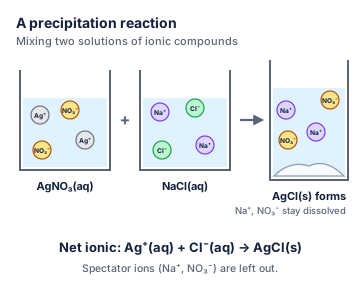
When two solutions of ionic compounds are mixed, the ions move around freely. If a positive ion and a negative ion can form an insoluble compound, they come together as a solid that settles out: a precipitate. This is a precipitation reaction.
Mixing silver nitrate and sodium chloride solutions gives a white precipitate of silver chloride:
Only the and ions actually react. The and ions stay dissolved, unchanged: they are spectator ions. The net ionic equation shows only the change that happens:
Key idea
Soluble ionic compounds exist in water as separate ions. A net ionic equation removes the spectator ions to show the real reaction. The same net ionic equation applies to any soluble silver compound mixed with any soluble chloride.
Why does it matter?
- Testing for ions. Silver nitrate tests for halides; barium chloride tests for sulfate. The colour of the precipitate identifies the ion.
- Water treatment and analysis. Precipitation removes phosphates and heavy metals from water, and gravimetric analysis finds how much of an ion is present by weighing the precipitate.
- Health and nature. Kidney stones (calcium oxalate), limescale (calcium carbonate) and stalactites are precipitates.
How does it work?
1. Solubility rules
| Usually soluble | Exceptions (insoluble) |
|---|---|
| All compounds of Group 1 ions (, , …) and | none |
| All nitrates () and ethanoates () | none |
| Chlorides, bromides, iodides | with and |
| Sulfates () | with , ; only slightly soluble |
| Usually insoluble | Exceptions (soluble) |
|---|---|
| Carbonates, phosphates | with Group 1 ions and |
| Hydroxides | with Group 1 ions; soluble, slightly |
| Most oxides and sulfides | with Group 1 ions and |
2. Predicting a precipitate
- Write the ions present in each solution.
- Swap partners to find the two possible new compounds.
- Check each with the solubility rules. If one is insoluble, it precipitates. If both are soluble, no reaction.
3. Writing the three equations
- Molecular equation: balanced, with all compounds written as formulas and state symbols.
- Complete ionic equation: split every soluble (aq) ionic compound into its ions. Keep solids, liquids, gases and weak electrolytes (such as ) as formulas.
- Net ionic equation: cross out ions that appear unchanged on both sides (spectators). Check that atoms and charge balance.
Think of it like this
Think of a dance floor. When two groups of dancers mix, most keep dancing alone (spectator ions), but some pairs lock together and leave the floor (the precipitate). The net ionic equation only reports the pairs that left.
More precisely
“Insoluble” really means very slightly soluble: a tiny amount always dissolves, described quantitatively by the solubility product, . Solubility also depends on temperature. Strong acids, strong bases and soluble salts are written as ions because they are fully dissociated; weak acids, such as ethanoic acid, are written as molecules because they are mostly undissociated. The neutralization of any strong acid by any strong base has the same net ionic equation: .
Visualise it
Worked example
Worked example: Does a precipitate form?
Question: Predict whether a precipitate forms when solutions of (a) barium chloride and sodium sulfate, (b) potassium nitrate and ammonium chloride are mixed.
- (a) Possible new compounds: and . Barium sulfate is insoluble: a white precipitate forms.
- (b) Possible new compounds: and . Both are soluble: no reaction.
Worked example: Molecular, complete ionic and net ionic equations
Question: Write the three equations for the reaction of lead(II) nitrate with potassium iodide.
-
Molecular:
-
Complete ionic:
-
Cancel the spectators ( and ). Net ionic:
-
Check: 1 Pb and 2 I on each side; charge on the left and 0 on the right. Lead(II) iodide is a bright yellow precipitate.
Worked example: A gravimetric calculation
Question: Excess silver nitrate is added to 25.0 mL of 0.100 mol/L sodium chloride. What mass of silver chloride precipitates? (: 143.32 g/mol)
-
Moles of chloride:
-
: 1 mol gives 1 mol AgCl.
Common mistake
Common mistake: Splitting a precipitate into ions
A solid (s) stays as a formula in the ionic equations. Only dissolved (aq) ionic compounds are split into ions.
Common mistake: Forgetting coefficients when splitting
gives , and gives two nitrate ions. Polyatomic ions stay together: nitrate is , not N and O.
Common mistake: An unbalanced net equation
A net ionic equation must balance in charge as well as atoms. is balanced: (+2) + (−2) = 0.
Notation note
- (aq) means dissolved in water; (s) marks the precipitate.
- Spectator ions can be shown struck through in the complete ionic equation before they are removed.
Remember this
Remember this
- Group 1, and nitrate compounds are always soluble.
- Chlorides are soluble except with , ; sulfates except with , (and , slightly).
- Carbonates, phosphates and hydroxides are mostly insoluble.
- Molecular → complete ionic (split aq ionic compounds) → net ionic (remove spectators).
- Check atoms and charge balance in the net equation.
Test yourself
Check your understanding before moving on.
Flashcards
Precipitation and Net Ionic Equations: Flashcards
- QuestionWhat is a precipitate?Answer
An insoluble solid that forms when two solutions are mixed.
- QuestionWhich ionic compounds are always soluble?Answer
Compounds of Group 1 ions and NH₄⁺, and all nitrates (and ethanoates).
- QuestionWhich chlorides are insoluble?Answer
AgCl and PbCl₂.
- QuestionWhich sulfates are insoluble?Answer
BaSO₄ and PbSO₄ (CaSO₄ only slightly soluble).
- QuestionAre carbonates and hydroxides usually soluble?Answer
No: mostly insoluble, except with Group 1 ions and NH₄⁺ (Ba(OH)₂ is soluble).
- QuestionWhat is a spectator ion?Answer
An ion present on both sides of the equation, unchanged: it does not take part in the reaction.
- QuestionWrite the net ionic equation for AgNO₃(aq) + NaCl(aq).Answer
- QuestionWhich compounds are split into ions in a complete ionic equation?Answer
Only soluble (aq) ionic compounds, strong acids and strong bases. Solids, liquids and gases stay as formulas.
- QuestionWhat is the net ionic equation for a strong acid reacting with a strong base?Answer
- QuestionWhat two things must balance in a net ionic equation?Answer
Atoms and charge.
Tip: press Space to flip and ← → to move between cards.
Quiz
Precipitation and Net Ionic Equations: Quiz
7 questions
Sulfates are usually soluble, but barium sulfate is an exception. Sodium, potassium and ammonium compounds, and all nitrates, are soluble.
Show answer
Answer: BaSO₄
Sulfates are usually soluble, but barium sulfate is an exception. Sodium, potassium and ammonium compounds, and all nitrates, are soluble.
Silver bromide (AgBr) is insoluble and precipitates (cream colour). In the other mixtures all possible products are soluble.
Show answer
Answer: AgNO₃ + KBr
Silver bromide (AgBr) is insoluble and precipitates (cream colour). In the other mixtures all possible products are soluble.
Ba²⁺ and SO₄²⁻ form the BaSO₄ precipitate. Na⁺ and Cl⁻ stay dissolved, unchanged: they are spectator ions.
Show answer
Answer: Na⁺ and Cl⁻
Ba²⁺ and SO₄²⁻ form the BaSO₄ precipitate. Na⁺ and Cl⁻ stay dissolved, unchanged: they are spectator ions.
K⁺ and NO₃⁻ are spectators. The net reaction is lead(II) ions combining with two iodide ions; atoms and charge both balance.
Show answer
Answer: Pb²⁺(aq) + 2I⁻(aq) → PbI₂(s)
K⁺ and NO₃⁻ are spectators. The net reaction is lead(II) ions combining with two iodide ions; atoms and charge both balance.
AgCl is a solid precipitate, so it is written as a formula. Soluble salts and strong acids in solution are written as ions.
Show answer
Answer: AgCl(s)
AgCl is a solid precipitate, so it is written as a formula. Soluble salts and strong acids in solution are written as ions.
Hydroxides are mostly insoluble, except those of Group 1 metals (and Ba(OH)₂). Potassium hydroxide is soluble.
Show answer
Answer: KOH
Hydroxides are mostly insoluble, except those of Group 1 metals (and Ba(OH)₂). Potassium hydroxide is soluble.
n(Cl⁻) = 0.100 mol/L × 0.0250 L = 2.50 × 10⁻³ mol; mass = 2.50 × 10⁻³ mol × 143.32 g/mol = 0.358 g. 358 g comes from using 25.0 L.
Show answer
Answer: 0.358 g
n(Cl⁻) = 0.100 mol/L × 0.0250 L = 2.50 × 10⁻³ mol; mass = 2.50 × 10⁻³ mol × 143.32 g/mol = 0.358 g. 358 g comes from using 25.0 L.
Notes and downloads
Worksheet
Precipitation and Net Ionic Equations Worksheet
8 questions on solubility rules, predicting precipitates, writing complete and net ionic equations, and gravimetric calculations. Answer key included.
References
- Brown, T. L.; LeMay, H. E., Jr.; Bursten, B. E.; Murphy, C. J.; Woodward, P. M.; Stoltzfus, M. W. Chemistry: The Central Science, 15th ed.; Pearson, 2022.
Practise this topic with flashcards and a quiz at chemistryclarity.com/chemistry/precipitation-and-net-ionic-equations/
Spotted a mistake? Let us know and we'll fix it.