What is it?
A solution is a mixture in which one substance, the solute, is dissolved in another, the solvent (often water).
Molarity tells you how concentrated a solution is: the number of moles of solute per litre of solution.
Its unit is mol/L, written M (read “molar”). A 0.500 M solution contains 0.500 mol of solute in every litre.
Key idea
Molarity turns a volume of solution into moles: moles = molarity × volume (in litres). That makes reactions in solution work just like the stoichiometry you already know.
Why does it matter?
Most chemistry in the lab, in medicine and in living things happens in solution. Chemists can’t weigh a substance once it’s dissolved, but they can measure volumes very accurately. Molarity connects the volume measured with a pipette or burette to the number of moles that react, for example in a titration, where an acid is measured against a base to find an unknown concentration.
How does it work?
1. Calculating molarity
Find the moles of solute, convert the volume of solution to litres (mL ÷ 1000), then divide.
2. Making a solution
Rearranging gives moles = molarity × volume. Convert those moles into a mass with the molar mass, weigh it out, dissolve it in some water, then add water up to the final volume (usually in a volumetric flask).
3. Diluting a solution
Adding water spreads the same number of moles through a bigger volume. The moles of solute don’t change, so:
where are the concentration and volume before dilution and after. The volumes can be in any unit, as long as both use the same one.
4. Solution stoichiometry
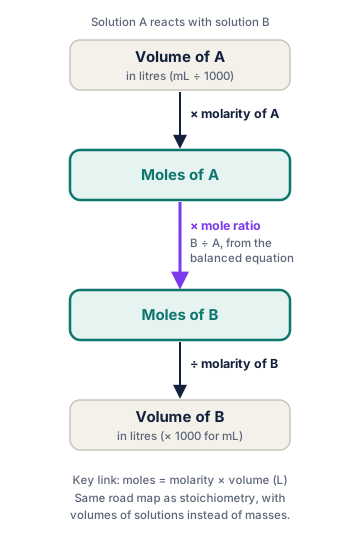
Use the same road map as before, with volumes in place of masses: volume → moles → (mole ratio) → moles → volume.
Think of it like this
Think of fruit squash. Adding more water doesn’t change the amount of sugar in the jug; it only spreads it out, so each glass tastes weaker. That’s dilution: same moles of solute, bigger volume, lower molarity.
More precisely
Molarity depends slightly on temperature, because the volume of a solution expands or contracts as it warms or cools. For work where that matters, chemists sometimes use molality (moles of solute per kilogram of solvent), which doesn’t change with temperature.
Visualise it
Worked example
Worked example: Calculating molarity
Question: 5.85 g of sodium chloride is dissolved in water to make 250.0 mL of solution. What is the molarity? (Na = 22.99, Cl = 35.45)
- Moles: g/mol, so mol
- Volume in litres: 250.0 mL ÷ 1000 = 0.2500 L
- Molarity = M
Worked example: Making a solution
Question: What mass of sodium hydroxide is needed to make 500.0 mL of 0.200 M NaOH solution? (Na = 22.99, O = 16.00, H = 1.008)
- Moles needed: mol
- Molar mass of : 22.99 + 16.00 + 1.008 = 40.00 g/mol
- Mass: g
Answer: dissolve 4.00 g of NaOH and make the solution up to 500.0 mL.
Worked example: Dilution
Question: 25.0 mL of 6.00 M HCl is diluted with water to 150.0 mL. What is the new concentration?
M
Worked example: Titration
Question: What volume of 0.100 M NaOH exactly neutralizes 25.00 mL of 0.150 M HCl?
- Moles of HCl: mol
- Mole ratio 1 : 1, so moles of NaOH = 0.003750 mol
- Volume of NaOH: L = 37.5 mL
Common mistake
Common mistake: Forgetting to convert mL to litres
Molarity uses litres. Using 250.0 instead of 0.2500 in the first example gives 0.000400 M, a thousand times too small.
Common mistake: Volume of solvent instead of volume of solution
“Make 250.0 mL of solution” means the final volume is 250.0 mL. Dissolving the solid in 250.0 mL of water gives a slightly different volume, and therefore a slightly different molarity.
Common mistake: Ignoring the mole ratio in titrations
Sulfuric acid, , has two protons: . It needs twice as many moles of NaOH as HCl does. Always use the balanced equation.
Notation note
- The letter M is used for two different things: molar mass (g/mol, often italic M) and the unit molar (mol/L). Read the context and the units carefully.
- IUPAC calls molarity the amount concentration, with symbol and unit mol/L, also written mol dm⁻³ (1 dm³ = 1 L), especially in UK courses.
- Square brackets show a concentration: [NaCl] = 0.400 M.
Remember this
Remember this
- Molarity (M) = moles of solute ÷ litres of solution.
- moles = molarity × volume (L).
- Dilution: (moles stay the same).
- Solutions in reactions: volume → moles → mole ratio → moles → volume.
Test yourself
Check your understanding before moving on.
Flashcards
Molarity: Flashcards
- QuestionWhat is molarity?Answer
Moles of solute per litre of solution (unit mol/L, written M).
- QuestionHow do you find moles from molarity and volume?Answer
moles = molarity × volume (in litres)
- QuestionWhat does 0.250 M mean?Answer
0.250 mol of solute in every litre of solution.
- QuestionWhat is the dilution equation?Answer
, because the moles of solute stay the same.
- QuestionHow many moles of solute are in 250.0 mL of 0.400 M solution?Answer
mol
- Question10.0 mL of 12.0 M HCl is diluted to 250.0 mL. What is the new concentration?Answer
M
- QuestionWhy must you convert mL to L in molarity calculations?Answer
Molarity is per litre. Using mL makes the answer 1000 times wrong.
- QuestionWhat is the difference between the solute and the solvent?Answer
The solute is the substance dissolved; the solvent is what it dissolves in (often water).
- QuestionWhat is a titration?Answer
A method that measures the exact volume of one solution needed to react with another, used to find an unknown concentration.
- QuestionWhat does the symbol [NaCl] mean?Answer
The concentration of NaCl, in mol/L.
Tip: press Space to flip and ← → to move between cards.
Quiz
Molarity: Quiz
7 questions
moles = molarity × volume = 0.400 mol/L × 0.2500 L = 0.100 mol. The answer 100. mol forgets to convert mL to L.
Show answer
Answer: 0.100 mol
moles = molarity × volume = 0.400 mol/L × 0.2500 L = 0.100 mol. The answer 100. mol forgets to convert mL to L.
Moles = 7.46 ÷ 74.55 = 0.1001 mol. Molarity = 0.1001 ÷ 0.5000 L = 0.200 M.
Show answer
Answer: 0.200 M
Moles = 7.46 ÷ 74.55 = 0.1001 mol. Molarity = 0.1001 ÷ 0.5000 L = 0.200 M.
M. Dilution keeps the moles the same but spreads them through a larger volume.
Show answer
Answer: 0.480 M
M. Dilution keeps the moles the same but spreads them through a larger volume.
Adding water changes the volume and lowers the molarity, but no solute is added or removed, so the moles of solute are unchanged. That is why .
Show answer
Answer: The moles of solute
Adding water changes the volume and lowers the molarity, but no solute is added or removed, so the moles of solute are unchanged. That is why .
Moles of HCl = 0.250 × 0.02000 = 0.005000 mol. The ratio is 1 : 1, so NaOH needed = 0.005000 mol, and volume = 0.005000 ÷ 0.125 = 0.0400 L = 40.0 mL. The answer 10.0 mL puts the concentrations the wrong way round.
Show answer
Answer: 40.0 mL
Moles of HCl = 0.250 × 0.02000 = 0.005000 mol. The ratio is 1 : 1, so NaOH needed = 0.005000 mol, and volume = 0.005000 ÷ 0.125 = 0.0400 L = 40.0 mL. The answer 10.0 mL puts the concentrations the wrong way round.
Moles of = 0.100 × 0.02000 = 0.00200 mol. The ratio is 2 : 1, so NaOH needed = 0.00400 mol, and volume = 0.00400 ÷ 0.200 = 0.0200 L = 20.0 mL. The answer 10.0 mL ignores the 2 : 1 ratio.
Show answer
Answer: 20.0 mL
Moles of = 0.100 × 0.02000 = 0.00200 mol. The ratio is 2 : 1, so NaOH needed = 0.00400 mol, and volume = 0.00400 ÷ 0.200 = 0.0200 L = 20.0 mL. The answer 10.0 mL ignores the 2 : 1 ratio.
Dissolving a solid changes the total volume slightly. To make exactly 0.400 M, dissolve the solid and then add water up to a final volume of 250.0 mL.
Show answer
Answer: Molarity uses the volume of solution, not of water added
Dissolving a solid changes the total volume slightly. To make exactly 0.400 M, dissolve the solid and then add water up to a final volume of 250.0 mL.
Notes and downloads
Worksheet
Molarity Worksheet
9 questions on molarity, making and diluting solutions, and titration calculations. Answer key included.
References
- Brown, T. L.; LeMay, H. E., Jr.; Bursten, B. E.; Murphy, C. J.; Woodward, P. M.; Stoltzfus, M. W. Chemistry: The Central Science, 15th ed.; Pearson, 2022.
Practise this topic with flashcards and a quiz at chemistryclarity.com/chemistry/molarity/
Spotted a mistake? Let us know and we'll fix it.