What is it?
A solution forms when a solute dissolves in a solvent. How much dissolves depends on the forces between the particles: a solute dissolves well when its attractions to the solvent are similar to the attractions it replaces. In short, like dissolves like:
- polar and ionic solutes (salt, sugar, ethanol) dissolve in polar solvents such as water;
- non-polar solutes (oils, waxes, iodine) dissolve in non-polar solvents such as hexane.
A saturated solution holds the maximum amount of solute at that temperature; an unsaturated solution can dissolve more.
Once a solute has dissolved, it changes some properties of the solvent. Colligative properties depend only on the number of dissolved particles, not on what they are:
- vapour-pressure lowering;
- boiling-point elevation;
- freezing-point depression;
- osmotic pressure.
Key idea
Dissolved particles get in the way of solvent molecules escaping (boiling) or locking into a crystal (freezing). So a solution boils higher and freezes lower than the pure solvent, by an amount proportional to the concentration of particles:
Why does it matter?
- Winter and cars. Salt melts ice on roads, and antifreeze (ethane-1,2-diol) stops car radiators freezing and boiling over.
- Medicine and biology. Intravenous drips must have the same osmotic pressure as blood; cells swell or shrink in solutions that do not match.
- Analysis. Freezing-point depression and osmotic pressure are used to find the molar mass of new compounds, including proteins.
How does it work?
1. Temperature and pressure
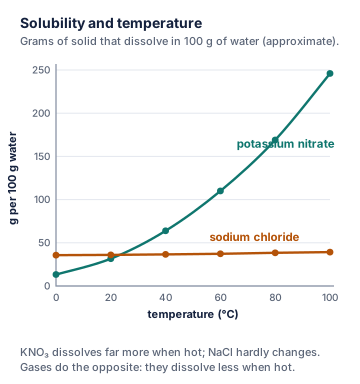
- Most solids become more soluble as temperature rises, some dramatically (potassium nitrate), some hardly at all (sodium chloride).
- Gases become less soluble as temperature rises: warm water holds less oxygen, which is why fish struggle in warm rivers.
- The solubility of a gas is proportional to its pressure above the liquid (Henry’s law, ). A fizzy drink is bottled under high pressure; opening it lowers the pressure, and the gas comes out as bubbles.
2. Molality
Colligative calculations use molality, : moles of solute per kilogram of solvent (mol/kg). Unlike molarity, it does not change with temperature, because masses do not expand.
3. The van ‘t Hoff factor, i
is the number of particles each formula unit gives in solution:
- molecular solutes (glucose, ethane-1,2-diol, sucrose): ;
- : ;
- : .
4. Freezing point and boiling point
For water, = 1.86 °C kg/mol and = 0.512 °C kg/mol. The units check: . Subtract from the normal freezing point; add to the normal boiling point.
5. Osmotic pressure
Osmosis is the flow of solvent through a semipermeable membrane from a dilute solution into a more concentrated one. The pressure needed to stop it is the osmotic pressure:
with in mol/L, = 0.08206 L atm mol⁻¹ K⁻¹ and in kelvin. Even dilute solutions have large osmotic pressures, which makes it a sensitive way to measure the molar mass of large molecules.
Think of it like this
Imagine a dance floor (the liquid surface) with people trying to leave through the doors (evaporating). If some of the spaces near the doors are taken up by people who never leave (solute particles), fewer dancers escape each minute. To get the same number out, you need to turn the music up (heat it more): the boiling point rises.
More precisely
Real ionic solutions often have a little below the ideal value, because some oppositely charged ions stay associated as ion pairs, especially at higher concentrations; 0.100 mol/kg NaCl behaves as if were about 1.9. The equations also assume a dilute, non-volatile solute. Vapour-pressure lowering follows Raoult’s law: the vapour pressure of the solvent equals its mole fraction times the vapour pressure of the pure solvent.
Visualise it
Worked example
Worked example: Antifreeze
Question: 250. g of ethane-1,2-diol (, 62.07 g/mol) is dissolved in 1.00 kg of water. Find the freezing point. ( = 1.86 °C kg/mol; = 1)
- Freezing point −7.49 °C
Worked example: Salt water boiling
Question: 5.00 g of NaCl (58.44 g/mol) is dissolved in 500. g of water. By how much is the boiling point raised? ( = 0.512 °C kg/mol; = 2)
- 0.175 °C
- The solution boils at 100.175 °C: adding salt to cooking water hardly changes its boiling point.
Worked example: Molar mass from a freezing point
Question: 2.00 g of an unknown molecular compound dissolved in 25.0 g of water lowers the freezing point by 0.930 °C. Find its molar mass.
- 160. g/mol
Worked example: Osmotic pressure
Question: Find the osmotic pressure of 0.100 mol/L glucose at 25.0 °C. ( = 1)
-
-
Substitute:
-
The mol, L and K cancel, leaving atm: a pressure about 2.5 times that of the atmosphere, from a dilute sugar solution.
Common mistake
Common mistake: Using the mass of solution instead of solvent
Molality uses the mass of the solvent only, in kilograms. For 5.00 g of NaCl in 500. g of water, use 0.500 kg, not 0.505 kg, and not 500.
Common mistake: Forgetting the van 't Hoff factor
NaCl gives two particles per formula unit, so its effect is about twice that of the same molality of sugar. Leaving out underestimates the change for every ionic solute.
Common mistake: Adding the freezing-point change
is a lowering: subtract it from the normal freezing point. A solution with = 7.49 °C freezes at −7.49 °C, not +7.49 °C.
Notation note
- Molality (lower-case , mol/kg) and molarity ( or , mol/L) are different quantities; take care not to confuse with mass.
- and are sometimes written in K kg mol⁻¹; a change of 1 K equals a change of 1 °C, so the values are the same.
- Π (capital pi) is the symbol for osmotic pressure.
Remember this
Remember this
- Like dissolves like. Solids usually dissolve more when hot; gases dissolve less when hot and more under pressure.
- Colligative properties depend on the number of particles: , , .
- Molality = mol solute ÷ kg solvent. = 1 (molecular), 2 (NaCl), 3 ().
- Water: = 1.86 °C kg/mol, = 0.512 °C kg/mol; use in K and = 0.08206 L atm mol⁻¹ K⁻¹ for Π.
Test yourself
Check your understanding before moving on.
Flashcards
Solubility and Colligative Properties: Flashcards
- QuestionHow does temperature affect the solubility of solids and gases?Answer
Most solids dissolve more when hot; gases dissolve less when hot.
- QuestionState Henry's law.Answer
The solubility of a gas is proportional to its pressure above the liquid: c = k(H) × P.
- QuestionWhat is a colligative property?Answer
A property that depends only on the number of dissolved particles, not their identity.
- QuestionDefine molality.Answer
Moles of solute per kilogram of solvent (mol/kg).
- Questionvan 't Hoff factor for glucose, NaCl and CaCl₂?Answer
1, 2 and 3 (ideal values).
- QuestionFreezing-point depression equation?Answer
ΔTf = i Kf m; for water Kf = 1.86 °C kg/mol. Subtract from the normal freezing point.
- QuestionBoiling-point elevation equation?Answer
ΔTb = i Kb m; for water Kb = 0.512 °C kg/mol. Add to the normal boiling point.
- QuestionOsmotic pressure equation?Answer
Π = iMRT, with M in mol/L, R = 0.08206 L atm mol⁻¹ K⁻¹, T in K.
- QuestionWhat is osmosis?Answer
Flow of solvent through a semipermeable membrane from a dilute solution into a more concentrated one.
- QuestionWhy does salt melt ice on roads?Answer
Dissolved ions lower the freezing point of water (freezing-point depression), so the ice melts below 0 °C.
Tip: press Space to flip and ← → to move between cards.
Quiz
Solubility and Colligative Properties: Quiz
7 questions
Gas solubility falls as temperature rises, so CO₂ escapes faster from a warm drink.
Show answer
Answer: gases are less soluble when warm
Gas solubility falls as temperature rises, so CO₂ escapes faster from a warm drink.
m = 0.500 mol ÷ 0.250 kg = 2.00 mol/kg. Remember to convert grams to kilograms.
Show answer
Answer: 2.00 mol/kg
m = 0.500 mol ÷ 0.250 kg = 2.00 mol/kg. Remember to convert grams to kilograms.
CaCl₂ gives 3 ions (i = 3), the most particles, so the largest freezing-point depression.
Show answer
Answer: CaCl₂
CaCl₂ gives 3 ions (i = 3), the most particles, so the largest freezing-point depression.
ΔTf = 1 × 1.86 °C kg/mol × 1.00 mol/kg = 1.86 °C; 0.00 °C − 1.86 °C = −1.86 °C.
Show answer
Answer: −1.86 °C
ΔTf = 1 × 1.86 °C kg/mol × 1.00 mol/kg = 1.86 °C; 0.00 °C − 1.86 °C = −1.86 °C.
Na₂SO₄ → 2Na⁺ + SO₄²⁻: three ions. The sulfate ion stays together.
Show answer
Answer: 3
Na₂SO₄ → 2Na⁺ + SO₄²⁻: three ions. The sulfate ion stays together.
R = 0.08206 L atm mol⁻¹ K⁻¹ contains kelvin, so T must be in kelvin for the units to cancel.
Show answer
Answer: K
R = 0.08206 L atm mol⁻¹ K⁻¹ contains kelvin, so T must be in kelvin for the units to cancel.
Molality uses mass of solvent, which does not change on heating; volumes expand, so molarity changes.
Show answer
Answer: molality does not change with temperature
Molality uses mass of solvent, which does not change on heating; volumes expand, so molarity changes.
Notes and downloads
Worksheet
Solubility and Colligative Properties Worksheet
9 questions on solubility, molality, freezing-point depression, boiling-point elevation, osmotic pressure and molar mass. Answer key included.
References
- Brown, T. L.; LeMay, H. E., Jr.; Bursten, B. E.; Murphy, C. J.; Woodward, P. M.; Stoltzfus, M. W. Chemistry: The Central Science, 15th ed.; Pearson, 2022.
Practise this topic with flashcards and a quiz at chemistryclarity.com/chemistry/colligative-properties/
Spotted a mistake? Let us know and we'll fix it.