What is it?
A concentration tells you how much solute is in a given amount of solution or solvent. Different jobs use different units:
| Unit | Definition | Typical use |
|---|---|---|
| Molarity, (mol/L) | Reactions and titrations in the lab | |
| Mass percent, % (m/m) | Labels, concentrated reagents, alloys | |
| Parts per million, ppm | Traces: pollutants, fluoride in water | |
| Mole fraction, | Gas mixtures, vapour pressure | |
| Molality, (mol/kg) | Colligative properties |
Key idea
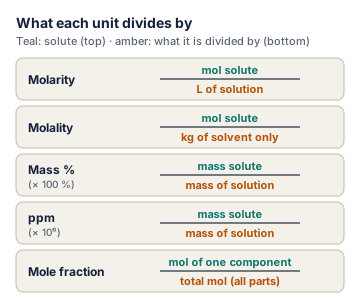
Watch the denominator. Molarity divides by the volume of solution; molality divides by the mass of solvent; mass percent and ppm divide by the mass of solution. Converting between them is a matter of finding the missing amount, often with the density of the solution.
Why does it matter?
- Safety and health. Drinking-water limits are given in ppm or ppb (for example, fluoride is added at about 0.7 ppm); a 3 % hydrogen peroxide solution is safe on skin, but 30 % is corrosive.
- Temperature independence. Molarity changes slightly as a solution expands when warmed; molality, mass percent and mole fraction do not, because they use masses.
- Reading labels. Concentrated acids are sold as mass percent with a density; to use them in a reaction you need their molarity.
How does it work?
1. Mass percent and ppm
Both compare the mass of solute with the mass of the whole solution (solute + solvent). For very small amounts, ppm (and ppb, ) avoid tiny percentages. In dilute water solutions, 1 L has a mass of about 1 kg, so 1 ppm ≈ 1 mg/L.
2. Mole fraction
Convert every component to moles and divide each by the total. Mole fractions have no unit and always add up to 1.
3. Molality
Divide the moles of solute by the mass of solvent in kilograms. Because it doesn’t depend on volume, molality is used for boiling-point and freezing-point calculations.
4. Converting with density
To go from a “per volume” unit to a “per mass” unit, take a convenient amount of solution (for example 1 L) and use the density to find its mass. Then split that mass into solute and solvent.
Think of it like this
Concentration units are like describing a fruit salad. You can say “one in five pieces is a strawberry” (mole fraction), “20 % of the weight is strawberry” (mass percent) or “three strawberries per bowl” (molarity). All describe the same salad; you just need to know how big the pieces and the bowl are to convert.
More precisely
Mass percent is sometimes written % (w/w); volume percent, % (v/v), is used for liquid mixtures such as alcoholic drinks, and % (w/v) (grams per 100 mL) in medicine. For very dilute aqueous solutions, molarity and molality are almost equal, because 1 L of solution contains almost exactly 1 kg of water. The approximation 1 ppm ≈ 1 mg/L also holds only when the density is close to 1.00 g/mL.
Visualise it
Worked example
Worked example: Mass percent
Question: 5.00 g of NaCl is dissolved in 95.0 g of water. What is the mass percent of NaCl?
Worked example: Parts per million
Question: A 2.50 kg sample of water contains 3.5 mg of lead. Express the lead concentration in ppm.
-
Convert to the same unit: 3.5 mg = 0.0035 g and 2.50 kg = 2500 g.
-
Concentration:
Worked example: Mole fraction
Question: 23.0 g of ethanol is mixed with 54.0 g of water. Find the mole fraction of ethanol.
-
Moles: ethanol ; water .
-
Mole fraction:
Worked example: From molarity to molality
Question: A 2.00 mol/L NaCl solution has a density of 1.08 g/mL. What is its molality?
-
Take 1.000 L of solution. Its mass is .
-
Mass of NaCl: .
-
Mass of water: .
-
Molality:
Worked example: From mass percent to molarity
Question: Concentrated hydrochloric acid is 37.0 % HCl by mass, with a density of 1.19 g/mL. What is its molarity?
-
Take 1.000 L: mass of solution .
-
Mass of HCl .
-
Moles and molarity:
Common mistake
Common mistake: Dividing by the solvent instead of the solution
Mass percent uses the mass of the solution: 5.00 g of NaCl in 95.0 g of water is 5.00 %, not .
Common mistake: Confusing molarity and molality
Molarity ( or ) is per litre of solution; molality () is per kilogram of solvent. They are close only for dilute water solutions.
Common mistake: Mixing units in ppm
Solute and solution must be in the same mass unit before multiplying by : 3.5 mg in 2.50 kg means 0.0035 g in 2500 g.
Notation note
- Molarity: mol/L, mol L⁻¹ or M. Molality: mol/kg or m (italic m, not to be confused with m for mass or metre).
- 1 ppm = 1 mg/kg; 1 ppb = 1 μg/kg.
Remember this
Remember this
- Molarity = mol solute ÷ L solution. Molality = mol solute ÷ kg solvent.
- Mass percent = mass solute ÷ mass solution × 100 %; ppm uses × 10⁶.
- Mole fraction = mol of component ÷ total mol; fractions add to 1.
- Convert between volume-based and mass-based units with the density, starting from 1 L of solution.
Test yourself
Check your understanding before moving on.
Flashcards
Concentration Units: Flashcards
- QuestionDefine molarity.Answer
Moles of solute per litre of solution (mol/L).
- QuestionDefine molality.Answer
Moles of solute per kilogram of solvent (mol/kg).
- QuestionDefine mass percent.Answer
(mass of solute ÷ mass of solution) × 100 %
- QuestionWhat is 1 ppm, and what is it roughly equal to in dilute water solutions?Answer
1 g of solute per 10⁶ g of solution; about 1 mg/L.
- QuestionDefine mole fraction.Answer
Moles of one component ÷ total moles of all components. No unit; all fractions add to 1.
- QuestionWhich concentration units do not change with temperature?Answer
Molality, mass percent, ppm and mole fraction (they use masses, not volumes).
- QuestionWhat extra information do you need to convert molarity into molality?Answer
The density of the solution.
- Question5.00 g NaCl in 95.0 g water: what is the mass percent?Answer
5.00 g ÷ 100.0 g × 100 % = 5.00 %
- QuestionWhy are molarity and molality almost equal for dilute aqueous solutions?Answer
1 L of a dilute solution contains almost exactly 1 kg of water.
- QuestionWhich concentration unit is used for colligative properties?Answer
Molality (mol/kg).
Tip: press Space to flip and ← → to move between cards.
Quiz
Concentration Units: Quiz
7 questions
Mass of solution = 12.0 g + 188 g = 200. g, so 12.0 g ÷ 200. g × 100 % = 6.00 %. 6.38 % divides by the water only.
Show answer
Answer: 6.00 %
Mass of solution = 12.0 g + 188 g = 200. g, so 12.0 g ÷ 200. g × 100 % = 6.00 %. 6.38 % divides by the water only.
Molality is moles of solute per kilogram of solvent. Mass percent and ppm use the mass of the whole solution; molarity uses the volume of solution.
Show answer
Answer: Molality
Molality is moles of solute per kilogram of solvent. Mass percent and ppm use the mass of the whole solution; molarity uses the volume of solution.
0.45 mg = 0.00045 g; (0.00045 g ÷ 500. g) × 10⁶ = 0.90 ppm.
Show answer
Answer: 0.90 ppm
0.45 mg = 0.00045 g; (0.00045 g ÷ 500. g) × 10⁶ = 0.90 ppm.
x = 1.0 mol ÷ (1.0 mol + 4.0 mol) = 0.20. 0.25 divides by the water only.
Show answer
Answer: 0.20
x = 1.0 mol ÷ (1.0 mol + 4.0 mol) = 0.20. 0.25 divides by the water only.
n = 18.0 g ÷ 180.16 g/mol = 0.0999 mol; m = 0.0999 mol ÷ 0.0900 kg = 1.11 mol/kg. The water mass must be in kg.
Show answer
Answer: 1.11 mol/kg
n = 18.0 g ÷ 180.16 g/mol = 0.0999 mol; m = 0.0999 mol ÷ 0.0900 kg = 1.11 mol/kg. The water mass must be in kg.
1.000 L has a mass of 1840 g, of which 0.980 × 1840 g = 1803 g is H₂SO₄; 1803 g ÷ 98.08 g/mol = 18.4 mol in 1.000 L.
Show answer
Answer: 18.4 mol/L
1.000 L has a mass of 1840 g, of which 0.980 × 1840 g = 1803 g is H₂SO₄; 1803 g ÷ 98.08 g/mol = 18.4 mol in 1.000 L.
Molality uses masses, which don't change on heating; molarity uses a volume, which expands as the solution warms.
Show answer
Answer: It does not change with temperature
Molality uses masses, which don't change on heating; molarity uses a volume, which expands as the solution warms.
Notes and downloads
Worksheet
Concentration Units Worksheet
8 questions on mass percent, ppm, mole fraction, molality and converting between concentration units with density. Answer key included.
References
- Brown, T. L.; LeMay, H. E., Jr.; Bursten, B. E.; Murphy, C. J.; Woodward, P. M.; Stoltzfus, M. W. Chemistry: The Central Science, 15th ed.; Pearson, 2022.
Practise this topic with flashcards and a quiz at chemistryclarity.com/chemistry/concentration-units/
Spotted a mistake? Let us know and we'll fix it.