What is it?
Acids and bases are two important families of substances, and they react with each other. Two definitions are used at this level:
| Acid | Base | |
|---|---|---|
| Arrhenius (in water) | Produces ions (more precisely ) when dissolved in water | Produces ions when dissolved in water |
| Brønsted–Lowry (more general) | Donates a proton () | Accepts a proton () |
A hydrogen ion, , is just a proton: a hydrogen atom that has lost its only electron.
Key idea
In the Brønsted–Lowry picture, an acid–base reaction is a proton transfer: the acid gives an and the base takes it.
Why does it matter?
Acids and bases are everywhere:
- In your body: stomach acid contains hydrochloric acid, , which helps digest food, and the pH of blood is kept within a narrow range.
- At home: vinegar contains acetic acid; baking soda (sodium hydrogen carbonate) and many cleaning products are basic; antacid tablets neutralize excess stomach acid.
- In the environment and industry: soil acidity affects which crops grow; acid–base reactions are used to make fertilisers, medicines and many other products.
How does it work?
1. Acids donate protons
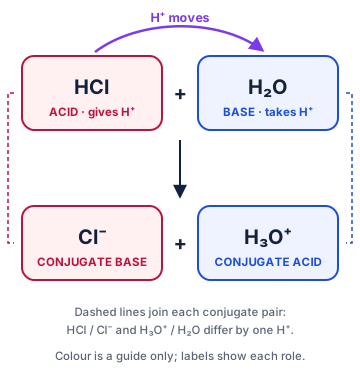
When hydrogen chloride dissolves in water, it gives a proton to a water molecule:
is the acid (proton donor) and water is the base (proton acceptor). The ion is called the hydronium ion.
2. Bases accept protons
Some bases contain hydroxide ions, such as sodium hydroxide: . The ion accepts protons.
Other bases contain no at all. Ammonia accepts a proton from water and produces :
3. Conjugate acid–base pairs
When an acid gives away a proton, what is left can take a proton back, so it is a base: its conjugate base. When a base accepts a proton it becomes its conjugate acid. The two members of a conjugate pair differ by exactly one :
- /
- /
- /
4. Strong and weak acids and bases
- A strong acid ionizes completely in water: essentially every molecule gives up its proton. Examples: , , (its first proton).
- A weak acid ionizes only partly: most molecules stay intact. Example: acetic acid, .
- Strong bases include the hydroxides of Group 1 metals, such as and . Weak bases include ammonia, .
A double arrow () shows a reaction that goes only partly; a single arrow () shows one that goes essentially to completion.
5. Neutralization
An acid and a base react to form a salt and water:
The essential change is that and combine to make water: .
Think of it like this
Think of the proton as a ball. The acid throws the ball and the base catches it. After the throw, the thrower is empty-handed but could catch a ball back (the conjugate base), and the catcher now holds a ball it could throw again (the conjugate acid).
More precisely
A bare ion doesn’t float freely in water: it is always attached to water molecules. Writing is a convenient shorthand for . There is also a broader definition, the Lewis definition, in which an acid accepts a pair of electrons and a base donates one. It covers reactions with no proton transfer at all.
Visualise it
Worked example
Worked example: Identifying acid, base and conjugate pairs
Question: In the reaction , identify the acid, the base and the two conjugate pairs.
- Water loses a proton (it becomes ), so water is the acid.
- Ammonia gains a proton (it becomes ), so ammonia is the base.
- Conjugate pairs differ by one : / and / .
Note: in the HCl reaction, water acted as a base; here it acts as an acid. Substances that can do both are called amphoteric.
Worked example: Writing a neutralization equation
Question: Write the equation for the neutralization of nitric acid, , by potassium hydroxide, .
- Acid + base → salt + water.
- The salt combines the metal ion from the base () with the anion from the acid (): .
Answer:
Common mistake
Common mistake: Confusing 'strong' with 'concentrated'
Strong describes how completely an acid ionizes. Concentrated describes how much acid is dissolved in a given volume. A dilute solution of a strong acid (HCl) and a concentrated solution of a weak acid (acetic acid) are both possible.
Common mistake: Thinking every base contains OH⁻
Ammonia, , has no hydroxide ion, but it is a base because it accepts a proton. The Brønsted–Lowry definition covers it; the Arrhenius definition, strictly applied, does not.
Common mistake: Mixing up conjugate pairs
A conjugate pair differs by exactly one . and are not a conjugate pair: they differ by two protons.
Notation note
- and are both used for the hydrated proton; many textbooks switch between them.
- “Ionize” and “dissociate” are often used interchangeably for acids in water.
- Some courses spell the term neutralisation (British spelling).
Remember this
Remember this
- Acid = proton (H⁺) donor; base = proton (H⁺) acceptor.
- Conjugate pairs differ by exactly one H⁺.
- Strong = ionizes completely; weak = ionizes partly. Strong ≠ concentrated.
- Acid + base → salt + water.
Test yourself
Check your understanding before moving on.
Flashcards
Acids and Bases: Flashcards
- QuestionWhat is a Brønsted–Lowry acid?Answer
A proton () donor.
- QuestionWhat is a Brønsted–Lowry base?Answer
A proton () acceptor.
- QuestionWhat is an Arrhenius acid?Answer
A substance that produces (more precisely ) ions when dissolved in water.
- QuestionWhat is the hydronium ion?Answer
: a proton attached to a water molecule.
- QuestionWhat is the conjugate base of ?Answer
(HCl minus one H⁺)
- QuestionWhat is the conjugate acid of ?Answer
(NH₃ plus one H⁺)
- QuestionWhat is the difference between a strong acid and a weak acid?Answer
A strong acid ionizes completely in water; a weak acid ionizes only partly.
- QuestionIs "strong" the same as "concentrated"?Answer
No. Strong = how completely it ionizes. Concentrated = how much is dissolved per volume.
- QuestionWhy is ammonia a base even though it has no ?Answer
It accepts a proton:
- QuestionWhat are the products of a neutralization reaction?Answer
A salt and water, e.g.
- QuestionWhat does "amphoteric" mean?Answer
Able to act as an acid or as a base. Water is amphoteric.
Tip: press Space to flip and ← → to move between cards.
Quiz
Acids and Bases: Quiz
7 questions
A Brønsted–Lowry acid donates a proton () and a base accepts one. Accepting an electron pair is the Lewis definition of an acid; producing describes an Arrhenius base.
Show answer
Answer: donates a proton
A Brønsted–Lowry acid donates a proton () and a base accepts one. Accepting an electron pair is the Lewis definition of an acid; producing describes an Arrhenius base.
Water accepts the proton from and becomes , so water is the base here.
Show answer
Answer:
Water accepts the proton from and becomes , so water is the base here.
A conjugate acid has one more than its base: + → . is the conjugate base of .
Show answer
Answer:
A conjugate acid has one more than its base: + → . is the conjugate base of .
A conjugate pair differs by exactly one . and do. / and / differ by two protons.
Show answer
Answer: and
A conjugate pair differs by exactly one . and do. / and / differ by two protons.
Weak refers to how much the acid ionizes, not how much is dissolved. Weak acids still react with bases; a concentrated solution of a weak acid is possible.
Show answer
Answer: It ionizes only partly in water
Weak refers to how much the acid ionizes, not how much is dissolved. Weak acids still react with bases; a concentrated solution of a weak acid is possible.
Acid + base → salt + water. The salt combines from the base with from the acid: .
Show answer
Answer:
Acid + base → salt + water. The salt combines from the base with from the acid: .
Water donates a proton to ammonia and becomes , so it acts as an acid. With HCl, water acts as a base, which is why water is called amphoteric.
Show answer
Answer: Acid
Water donates a proton to ammonia and becomes , so it acts as an acid. With HCl, water acts as a base, which is why water is called amphoteric.
Notes and downloads
Worksheet
Acids and Bases Worksheet
8 questions on Brønsted–Lowry acids and bases, conjugate pairs, strong vs weak and neutralization equations. Answer key included.
References
- Brown, T. L.; LeMay, H. E., Jr.; Bursten, B. E.; Murphy, C. J.; Woodward, P. M.; Stoltzfus, M. W. Chemistry: The Central Science, 15th ed.; Pearson, 2022.
Practise this topic with flashcards and a quiz at chemistryclarity.com/chemistry/acids-and-bases/
Spotted a mistake? Let us know and we'll fix it.