What is it?
The periodic table arranges all the known elements (118 of them) in order of increasing atomic number (number of protons), in rows and columns chosen so that elements with similar properties line up in the same column.
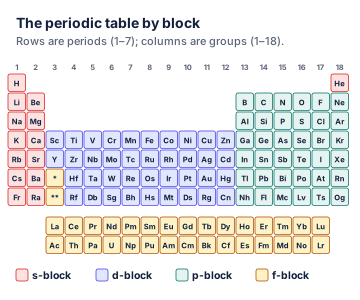
- A period is a horizontal row. There are 7 periods. The period number equals the number of the outermost occupied electron shell.
- A group is a vertical column, numbered 1 to 18. Elements in a group have the same number of outer (valence) electrons, so they react in similar ways.
Some groups have family names:
| Group | Family | Typical behaviour |
|---|---|---|
| 1 | Alkali metals (Li, Na, K, …) | Soft, very reactive metals; form 1+ ions; react with water to give hydrogen and an alkaline solution |
| 2 | Alkaline earth metals (Be, Mg, Ca, …) | Reactive metals; form 2+ ions |
| 3–12 | Transition metals (Fe, Cu, Zn, …) | Hard, dense metals; often coloured compounds; several possible ion charges |
| 17 | Halogens (F, Cl, Br, I) | Reactive non-metals; form 1− ions; exist as diatomic molecules () |
| 18 | Noble gases (He, Ne, Ar, …) | Very unreactive gases, with full outer shells |
The two rows usually printed below the table are the lanthanides and actinides.
Key idea
The table is periodic because properties repeat at regular intervals of atomic number. Elements in the same group behave similarly because they have the same outer electron arrangement. Position in the table predicts properties.
Why does it matter?
- One chart, a huge amount of information. From an element’s position you can predict whether it is a metal, how many valence electrons it has, which ion it forms and roughly how reactive it is.
- Writing formulas. Group number gives the usual ion charge, which you need to name and write compounds.
- It predicted new elements. Gaps in Mendeleev’s table were filled by elements discovered later, with the properties he forecast.
How does it work?
1. Metals, non-metals and metalloids
A staircase line from boron to astatine separates them:
- Metals (left and centre, about three-quarters of all elements): shiny, conduct heat and electricity, malleable, tend to lose electrons to form positive ions.
- Non-metals (top right, plus hydrogen): dull, poor conductors, brittle when solid, tend to gain or share electrons.
- Metalloids (along the staircase: B, Si, Ge, As, Sb, Te): in-between properties. Silicon and germanium are semiconductors, the basis of computer chips.
2. Valence electrons and ions
For the main groups:
- Groups 1 and 2: 1 and 2 valence electrons; they lose them to form 1+ and 2+ ions.
- Groups 13–18: the valence electrons are the group number minus 10 (3 to 8). Group 13 metals form 3+ ions; groups 15, 16 and 17 gain electrons to form 3−, 2− and 1− ions.
Each ion then has the same electron arrangement as the nearest noble gas.
3. Blocks
The table is divided into blocks according to the subshell being filled by the outermost electrons: the s-block (groups 1–2, and helium), p-block (groups 13–18), d-block (groups 3–12) and f-block (lanthanides and actinides). The block widths, 2, 6, 10 and 14 elements, are the numbers of electrons each subshell can hold.
4. Mendeleev’s table
In 1869 the Russian chemist Dmitri Mendeleev arranged the 63 elements then known by atomic mass and by their properties. He left gaps for undiscovered elements and predicted their properties. His “eka-silicon”, below silicon, was discovered in 1886 and named germanium. Later, the order was found to depend on atomic number, not mass, which fixed a few pairs that looked out of order (such as tellurium and iodine).
Think of it like this
The periodic table works like a calendar. Days are in order, but they are arranged in weeks so that all the Mondays line up in one column. Elements are in order of atomic number, but arranged in periods so that elements with similar “personalities” line up in one group.
More precisely
Hydrogen is placed in group 1 because it has one electron, but it is a non-metal and in some ways resembles the halogens too. Helium has 2 valence electrons and belongs to the s-block, but it is placed with the noble gases because its shell is full. Which elements to call metalloids varies slightly between sources (polonium and astatine are sometimes included). The heaviest elements (above about 100) are made artificially, a few atoms at a time.
Visualise it
Worked example
Worked example: Locating an element
Question: Identify the element in period 3, group 17, and describe it.
- Period 3, group 17 is chlorine (Cl).
- Group 17: a halogen, a reactive non-metal, with 7 valence electrons.
- It gains one electron to form the chloride ion, , which has the same arrangement as argon.
Worked example: Predicting ions and a formula
Question: Predict the ions formed by magnesium and nitrogen, and the formula of magnesium nitride.
- Magnesium is in group 2: it loses 2 electrons, forming .
- Nitrogen is in group 15: it has 5 valence electrons and gains 3, forming .
- Charges must balance: , so the formula is .
Worked example: Testing Mendeleev's prediction
Question: Mendeleev predicted that eka-silicon would have an atomic mass of 72 and a density of 5.5 g/cm³. Germanium has an atomic mass of 72.63 and a density of 5.32 g/cm³. Calculate the percent error of each prediction.
-
Atomic mass:
-
Density:
-
Both predictions were within a few percent, made 15 years before the element was found.
Worked example: Classifying an unknown element
Question: Element X is a shiny grey solid, but it is brittle and conducts electricity only weakly. It is in group 14, period 3. What is it, and how is it classified?
Period 3, group 14 is silicon. Its mixed properties (shiny like a metal, brittle like a non-metal, a semiconductor) make it a metalloid.
Common mistake
Common mistake: Confusing periods and groups
Periods are rows (across); groups are columns (down). Elements in a group have similar properties; elements in a period change gradually from metals to non-metals.
Common mistake: Thinking the table is ordered by atomic mass
The modern table is ordered by atomic number. Argon (39.95) comes before potassium (39.10) even though it is heavier, because argon has 18 protons and potassium 19.
Common mistake: Counting group 13–18 valence electrons as the group number
With the 1–18 numbering, aluminium (group 13) has 3 valence electrons, not 13. Subtract 10 for groups 13–18.
Notation note
- Older tables number the main groups I–VIII (or 1A–8A). Group VII = group 17; group 0 or VIII = group 18.
- Hydrogen is usually shown at the top of group 1, but it is not an alkali metal.
Remember this
Remember this
- Ordered by atomic number. Periods = rows (1–7); groups = columns (1–18).
- Same group = same number of valence electrons = similar properties.
- Group 1 alkali metals, group 2 alkaline earth metals, 3–12 transition metals, 17 halogens, 18 noble gases.
- Metals left, non-metals top right, metalloids along the staircase.
- Ions: groups 1, 2, 13 → 1+, 2+, 3+; groups 15, 16, 17 → 3−, 2−, 1−.
- Blocks: s (2 wide), p (6), d (10), f (14).
Test yourself
Check your understanding before moving on.
Flashcards
The Periodic Table: Flashcards
- QuestionIn what order are elements arranged in the modern periodic table?Answer
Increasing atomic number (number of protons).
- QuestionWhat is a period, and what is a group?Answer
Period: a horizontal row (1–7). Group: a vertical column (1–18).
- QuestionWhy do elements in the same group have similar properties?Answer
They have the same number of valence (outer) electrons.
- QuestionName the families in groups 1, 2, 17 and 18.Answer
Alkali metals, alkaline earth metals, halogens, noble gases.
- QuestionWhere are the metalloids, and name three.Answer
Along the staircase line from boron to astatine: e.g. B, Si, Ge (also As, Sb, Te).
- QuestionWhich ions do groups 1, 2 and 13 form? And groups 15, 16 and 17?Answer
1+, 2+, 3+; and 3−, 2−, 1−.
- QuestionHow many valence electrons does an element in group 16 have?Answer
6 (group number minus 10).
- QuestionName the four blocks and their widths.Answer
s (2), p (6), d (10), f (14): the electron capacities of the subshells.
- QuestionWhich element did Mendeleev call eka-silicon?Answer
Germanium, discovered in 1886 with the properties he had predicted.
- QuestionWhy does argon come before potassium, although it is heavier?Answer
The table is ordered by atomic number: Ar has 18 protons, K has 19.
Tip: press Space to flip and ← → to move between cards.
Quiz
The Periodic Table: Quiz
7 questions
Period 3 is the third row; group 2 is the second column: magnesium (Mg), an alkaline earth metal.
Show answer
Answer: Magnesium
Period 3 is the third row; group 2 is the second column: magnesium (Mg), an alkaline earth metal.
The halogens (F, Cl, Br, I, At) are in group 17. Group 18 is the noble gases.
Show answer
Answer: Group 17
The halogens (F, Cl, Br, I, At) are in group 17. Group 18 is the noble gases.
Silicon lies on the staircase line and has properties between those of metals and non-metals; it is a semiconductor.
Show answer
Answer: Silicon
Silicon lies on the staircase line and has properties between those of metals and non-metals; it is a semiconductor.
Sulfur has 6 valence electrons and gains 2 to reach the arrangement of argon, forming the sulfide ion S²⁻.
Show answer
Answer: S²⁻
Sulfur has 6 valence electrons and gains 2 to reach the arrangement of argon, forming the sulfide ion S²⁻.
Group 1 elements all have one outer electron, which they lose easily to form 1+ ions. Their masses are quite different and they are in different periods.
Show answer
Answer: They each have one valence electron
Group 1 elements all have one outer electron, which they lose easily to form 1+ ions. Their masses are quite different and they are in different periods.
Groups 3–12 form the d-block (transition metals); iron's outer electrons are filling the 3d subshell.
Show answer
Answer: d-block
Groups 3–12 form the d-block (transition metals); iron's outer electrons are filling the 3d subshell.
Aluminium (group 13) forms Al³⁺; oxygen (group 16) forms O²⁻. 2 × (+3) + 3 × (−2) = 0, so Al₂O₃.
Show answer
Answer: Al₂O₃
Aluminium (group 13) forms Al³⁺; oxygen (group 16) forms O²⁻. 2 × (+3) + 3 × (−2) = 0, so Al₂O₃.
Notes and downloads
Worksheet
The Periodic Table Worksheet
8 questions on periods and groups, families, metals and non-metals, valence electrons, ions, blocks and Mendeleev's predictions. Answer key included.
References
- Brown, T. L.; LeMay, H. E., Jr.; Bursten, B. E.; Murphy, C. J.; Woodward, P. M.; Stoltzfus, M. W. Chemistry: The Central Science, 15th ed.; Pearson, 2022.
Practise this topic with flashcards and a quiz at chemistryclarity.com/chemistry/the-periodic-table/
Spotted a mistake? Let us know and we'll fix it.