What is it?
Every compound has a formula and a name. The formula shows which elements are present and in what ratio; the name says the same thing in words. is sodium chloride; is carbon dioxide. Chemists around the world follow the same naming rules, set by IUPAC (the International Union of Pure and Applied Chemistry), so a name means exactly one substance.
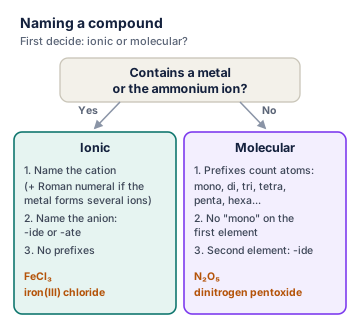
There are two main families, named in different ways:
- Ionic compounds, made of a metal (or the ammonium ion) combined with a non-metal: name the ions. Example: , magnesium chloride.
- Molecular (covalent) compounds, made of non-metals only: use Greek prefixes to count the atoms. Example: , dinitrogen tetroxide.
Key idea
An ionic compound has no overall charge: the positive charges of the cations exactly cancel the negative charges of the anions. That single rule lets you write the formula of any ionic compound from its name.
Why does it matter?
- It’s the language of chemistry. Equations, labels, recipes and safety data sheets all use formulas and names.
- Safety. Sodium chloride is table salt; sodium chlorate is a weedkiller and strong oxidizer. One syllable separates them.
- Calculations depend on it. You can’t find a molar mass or balance an equation without the correct formula.
How does it work?
1. Common ions
You will meet these ions again and again:
| Positive ions (cations) | Negative ions (anions) |
|---|---|
| hydrogen, sodium, potassium, silver | fluoride, chloride, bromide, iodide |
| ammonium | hydroxide, nitrate, hydrogencarbonate |
| magnesium, calcium, barium, zinc | oxide, sulfide |
| aluminium | sulfate, carbonate |
| iron(II), iron(III) | phosphate, nitride |
| copper(I), copper(II) | ethanoate (acetate) |
Groups of atoms that carry a charge together, such as , are polyatomic ions.
2. Naming ionic compounds
- Name the cation first, then the anion: is potassium bromide.
- A simple anion from one element ends in -ide: chloride, oxide, sulfide.
- Most polyatomic anions containing oxygen end in -ate: sulfate, nitrate, carbonate.
- A metal that can form more than one ion (many transition metals) gets a Roman numeral for its charge: is iron(II) chloride; is iron(III) chloride.
- No prefixes are used: is calcium chloride, not calcium dichloride.
3. Writing ionic formulas
- Write the two ions with their charges.
- Choose the smallest numbers of each ion that make the total charge zero.
- Write the numbers as subscripts (leave out 1). Put a polyatomic ion in brackets if you need more than one of it: , .
4. Naming molecular compounds
Use a Greek prefix for the number of each kind of atom, and end the second element with -ide:
| Number | Prefix | Number | Prefix |
|---|---|---|---|
| 1 | mono | 6 | hexa |
| 2 | di | 7 | hepta |
| 3 | tri | 8 | octa |
| 4 | tetra | 9 | nona |
| 5 | penta | 10 | deca |
- “Mono” is not used for the first element: is carbon monoxide, not monocarbon monoxide.
- The final “a” or “o” of the prefix is dropped before “oxide”: monoxide, tetroxide, pentoxide.
Examples: carbon dioxide, sulfur trioxide, dinitrogen pentoxide, sulfur hexafluoride. Some molecules keep common names: is water, is ammonia and is methane.
5. Common acids
Acids are named by tradition: hydrochloric acid, nitric acid, sulfuric acid, phosphoric acid, carbonic acid and ethanoic (acetic) acid.
Think of it like this
Think of charges as weights on a see-saw that must balance exactly. To balance (3 units on one side) against (2 units on the other), the smallest balanced load is two aluminium ions (6 units) against three oxide ions (6 units). So aluminium oxide is .
More precisely
The Roman numeral is the oxidation state of the metal (see Redox Reactions). Older names used endings instead, such as ferrous () and ferric (); you may still see them on old bottles. Hydrates include water in the crystal: is copper(II) sulfate pentahydrate. IUPAC prefers “hydrogencarbonate” to the older “bicarbonate”.
Visualise it
Worked example
Worked example: Formula from a name: aluminium oxide
Question: Write the formula of aluminium oxide.
-
Ions: and .
-
The smallest whole-number total that both 3 and 2 divide into is 6, so use 2 aluminium ions and 3 oxide ions:
-
Formula: .
Worked example: A polyatomic ion: calcium nitrate
Question: Write the formula of calcium nitrate.
- Ions: and . Two nitrate ions balance one calcium ion: .
- Two nitrate ions need brackets: . The subscript 2 applies to the whole group, so the formula contains 1 Ca, 2 N and 6 O.
Worked example: Name from a formula: FeCl₃
Question: Name .
- Iron forms more than one ion, so find its charge. Three chloride ions give .
- The compound is neutral, so iron is : iron(III) chloride.
Worked example: Naming a molecular compound
Question: Name and write the formula of nitrogen trifluoride.
- Two non-metals, so use prefixes: 4 = tetra, 10 = deca. is tetraphosphorus decoxide.
- Nitrogen trifluoride: no prefix on nitrogen means 1, tri means 3: .
Common mistake
Common mistake: Using prefixes for ionic compounds
is magnesium chloride, not magnesium dichloride. The charges already fix the ratio, so ionic names never use prefixes. Prefixes are only for compounds of non-metals.
Common mistake: Mixing up -ide and -ate
Sodium sulfide is ; sodium sulfate is . “-ide” usually means a single element; “-ate” means a polyatomic ion with oxygen.
Common mistake: Forgetting brackets, or writing charges in the formula
Calcium hydroxide is , not , which would mean one O and two H. And the charges are used to work out the formula but are not written in it: , not .
Notation note
- The Roman numeral follows the metal name directly, with no space: iron(III) chloride.
- A charge is written as a superscript with the number first, then the sign: and .
Remember this
Remember this
- Metal (or ) + non-metal: ionic. Name the cation, then the anion; no prefixes.
- Roman numerals give the charge of metals that form more than one ion: iron(II), iron(III), copper(II).
- -ide: one element (chloride, oxide). -ate: polyatomic ion with oxygen (sulfate, nitrate).
- Write ionic formulas so the charges add to zero; bracket a polyatomic ion used more than once.
- Non-metals only: molecular. Use mono, di, tri, tetra…; no “mono” on the first element.
Test yourself
Check your understanding before moving on.
Flashcards
Chemical Names and Formulas: Flashcards
- QuestionHow do you tell an ionic compound from a molecular one by its formula?Answer
Ionic: contains a metal (or ). Molecular: non-metals only.
- QuestionGive the formula and charge of the sulfate, nitrate, carbonate and hydroxide ions.Answer
, , ,
- QuestionGive the formula and charge of the ammonium and phosphate ions.Answer
and
- QuestionWrite the formula of aluminium oxide.Answer
: 2 × (+3) + 3 × (−2) = 0
- QuestionWrite the formula of calcium hydroxide.Answer
: brackets because there are two hydroxide ions.
- QuestionName .Answer
Iron(III) chloride: three give −3, so iron is +3.
- QuestionWhat does -ide mean, and what does -ate mean?Answer
-ide: an anion of one element (chloride, oxide). -ate: a polyatomic anion containing oxygen (sulfate, nitrate).
- QuestionList the Greek prefixes from 1 to 6.Answer
mono, di, tri, tetra, penta, hexa
- QuestionName and .Answer
Dinitrogen pentoxide; carbon monoxide (no "mono" on the first element).
- QuestionGive the formulas of hydrochloric, nitric and sulfuric acid.Answer
, ,
Tip: press Space to flip and ← → to move between cards.
Quiz
Chemical Names and Formulas: Quiz
7 questions
MgCl₂ is ionic (magnesium is a metal), so no prefixes are used. Magnesium forms only Mg²⁺, so no Roman numeral is needed either.
Show answer
Answer: magnesium chloride
MgCl₂ is ionic (magnesium is a metal), so no prefixes are used. Magnesium forms only Mg²⁺, so no Roman numeral is needed either.
Na⁺ and SO₄²⁻: two sodium ions balance one sulfate ion, 2 × (+1) + (−2) = 0. Na₂S is sodium sulfide.
Show answer
Answer: Na₂SO₄
Na⁺ and SO₄²⁻: two sodium ions balance one sulfate ion, 2 × (+1) + (−2) = 0. Na₂S is sodium sulfide.
Al³⁺ and O²⁻: 2 × (+3) + 3 × (−2) = 0, so Al₂O₃.
Show answer
Answer: Al₂O₃
Al³⁺ and O²⁻: 2 × (+3) + 3 × (−2) = 0, so Al₂O₃.
Oxide is O²⁻, so copper must be +2 for the compound to be neutral. The Roman numeral goes straight after the metal: copper(II) oxide.
Show answer
Answer: copper(II) oxide
Oxide is O²⁻, so copper must be +2 for the compound to be neutral. The Roman numeral goes straight after the metal: copper(II) oxide.
NH₄⁺ and PO₄³⁻: three ammonium ions balance one phosphate ion, 3 × (+1) + (−3) = 0. The ammonium ion is bracketed because there are three of it.
Show answer
Answer: (NH₄)₃PO₄
NH₄⁺ and PO₄³⁻: three ammonium ions balance one phosphate ion, 3 × (+1) + (−3) = 0. The ammonium ion is bracketed because there are three of it.
Nitrogen and oxygen are both non-metals, so use prefixes: di (2) nitrogen, tetra (4) oxygen, with the "a" dropped before "oxide".
Show answer
Answer: dinitrogen tetroxide
Nitrogen and oxygen are both non-metals, so use prefixes: di (2) nitrogen, tetra (4) oxygen, with the "a" dropped before "oxide".
Ca²⁺ needs two OH⁻ ions. The brackets show that the subscript 2 applies to the whole OH group; CaOH₂ would mean one O and two H.
Show answer
Answer: Ca(OH)₂
Ca²⁺ needs two OH⁻ ions. The brackets show that the subscript 2 applies to the whole OH group; CaOH₂ would mean one O and two H.
Notes and downloads
Worksheet
Chemical Names and Formulas Worksheet
8 questions on naming ionic and molecular compounds, writing formulas with polyatomic ions and Roman numerals, and common acids. Answer key included.
References
- Brown, T. L.; LeMay, H. E., Jr.; Bursten, B. E.; Murphy, C. J.; Woodward, P. M.; Stoltzfus, M. W. Chemistry: The Central Science, 15th ed.; Pearson, 2022.
Practise this topic with flashcards and a quiz at chemistryclarity.com/chemistry/chemical-names-and-formulas/
Spotted a mistake? Let us know and we'll fix it.