What is it?
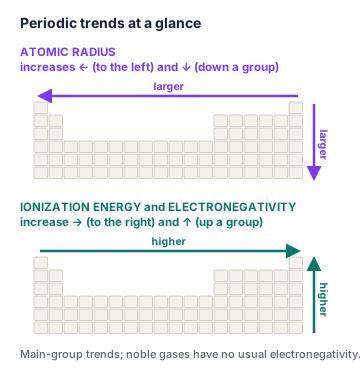
Periodic trends are the regular, predictable changes in the properties of elements as you move across a period (left to right) or down a group (top to bottom) of the periodic table. The four most important are:
- Atomic radius: the size of an atom.
- First ionization energy: the energy needed to remove one electron from each atom in a mole of gaseous atoms.
- Electronegativity: how strongly an atom attracts the shared electrons in a chemical bond.
- Ionic radius: the size of an ion.
Key idea
Two factors explain almost every trend: the number of shells (more shells means outer electrons are farther from the nucleus) and the effective nuclear charge (the net positive charge an outer electron actually feels).
Why does it matter?
- It predicts reactivity. Group 1 metals get more reactive down the group because their outer electron is easier to remove.
- It predicts bonding. The difference in electronegativity between two atoms tells you whether a bond is nonpolar, polar or ionic.
- It organises facts. Instead of memorising the properties of 118 elements, you learn a few patterns and the reasons behind them.
How does it work?
1. Effective nuclear charge
Inner electrons shield outer electrons from the full nuclear charge. A simple estimate:
where is the number of protons and is the number of inner (core) electrons. For sodium, ; for chlorine, in the same period, .
- Across a period: protons are added but the core stays the same, so increases.
- Down a group: a new shell is added each period, so outer electrons are farther away.
2. Atomic radius
- Decreases across a period: a higher pulls the same shell closer.
- Increases down a group: each period adds a shell.
3. First ionization energy
- Increases across a period: outer electrons are held more tightly.
- Decreases down a group: the outer electron is farther away and more shielded. Group 1: Li 520.2, Na 495.8, K 418.8, Rb 403.0, Cs 375.7 kJ/mol.
4. Electronegativity
- Increases across a period and decreases down a group, for the same reasons.
- Fluorine is the most electronegative element (3.98 on the Pauling scale); caesium and francium are the least.
5. Ionic radius
- Cations are smaller than their atoms: often a whole shell is lost, and the remaining electrons feel more nuclear pull.
- Anions are larger than their atoms: the extra electrons repel each other, and the same nuclear charge holds more electrons.
- In an isoelectronic series (same number of electrons), more protons means a smaller ion: (all have 10 electrons).
Think of it like this
Think of the nucleus as a magnet and the outer electrons as paper clips. Across a period the magnet gets stronger while the clips stay at the same distance, so they are held more tightly. Down a group the clips sit farther away, behind more layers of other clips, so they are held more loosely.
More precisely
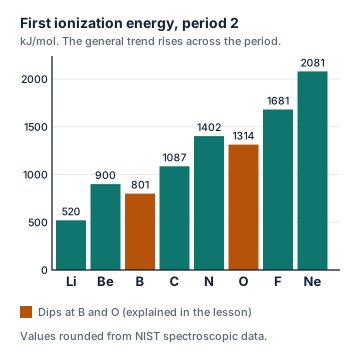
Ionization energy does not rise perfectly smoothly across a period. In period 2 there are two dips. Boron (800.6 kJ/mol) is lower than beryllium (899.5) because its outer electron is in a 2p orbital, slightly higher in energy than 2s. Oxygen (1313.9) is lower than nitrogen (1402.3) because oxygen’s fourth 2p electron is paired, and repulsion between the paired electrons makes one of them easier to remove.
Visualise it
Worked example
Worked example: Ranking atomic radius
Question: Arrange Na, Mg, K and Cl in order of increasing atomic radius.
- Na, Mg and Cl are in period 3, where radius decreases from left to right: Cl < Mg < Na.
- K is directly below Na in group 1, with one more shell: K > Na.
- Order: Cl < Mg < Na < K
Worked example: Explaining an ionization-energy trend
Question: Why is the first ionization energy of sodium (495.8 kJ/mol) lower than that of lithium (520.2 kJ/mol)?
- Na is [Ne] 3s¹ and Li is [He] 2s¹. Both have one outer s electron with .
- Sodium’s outer electron is in the third shell, farther from the nucleus and shielded by more inner electrons.
- It is held less strongly, so less energy is needed to remove it.
Common mistake
Common mistake: Thinking more protons make a bigger atom across a period
Across a period atoms get smaller, even though they have more protons and electrons. The added electrons go into the same shell, while the extra protons pull that shell in more tightly.
Common mistake: Confusing ionization energy with electronegativity
Ionization energy is about removing an electron from an isolated gaseous atom. Electronegativity is about attracting shared electrons in a bond. They follow similar trends but measure different things.
Common mistake: Assuming an ion is the same size as its atom
is much smaller than Na (it has lost its whole third shell), and is larger than Cl.
Notation note
- Ionization energies are usually given in kJ/mol (sometimes in eV per atom).
- Electronegativity has no units; the Pauling scale is the most common.
- is a simple estimate. More detailed methods (such as Slater’s rules) give values that are not whole numbers.
Remember this
Remember this
- Across a period: increases, radius decreases, ionization energy and electronegativity increase.
- Down a group: more shells, radius increases, ionization energy and electronegativity decrease.
- Cations are smaller than their atoms; anions are larger.
- Period 2 ionization-energy dips: B (2p electron) and O (paired 2p electron).
Test yourself
Check your understanding before moving on.
Flashcards
Periodic Trends: Flashcards
- QuestionHow does atomic radius change across a period and down a group?Answer
Decreases across a period (left to right); increases down a group.
- QuestionWhat is effective nuclear charge?Answer
The net positive charge felt by an outer electron, roughly (protons minus inner electrons).
- QuestionWhat is first ionization energy?Answer
The energy needed to remove one electron from each atom in a mole of gaseous atoms.
- QuestionHow does first ionization energy change across a period and down a group?Answer
Increases across a period; decreases down a group.
- QuestionWhich element is the most electronegative?Answer
Fluorine (3.98 on the Pauling scale).
- QuestionIs a cation larger or smaller than its atom?Answer
Smaller. It often loses a whole shell, and the remaining electrons are pulled in more strongly.
- QuestionIs an anion larger or smaller than its atom?Answer
Larger. The added electrons repel each other, and the same nuclear charge holds more electrons.
- QuestionOrder by size: , , ,Answer
(all have 10 electrons; more protons means a smaller ion)
- QuestionWhy is the first ionization energy of B lower than that of Be?Answer
Boron's outer electron is in a 2p orbital, which is higher in energy than 2s, so it is easier to remove.
- QuestionWhy is the first ionization energy of O lower than that of N?Answer
Oxygen's fourth 2p electron is paired; repulsion between the paired electrons makes one of them easier to remove.
Tip: press Space to flip and ← → to move between cards.
Quiz
Periodic Trends: Quiz
7 questions
Radius increases down a group. K is below Li and Na in group 1, and Cl is far to the right in period 3.
Show answer
Answer: K
Radius increases down a group. K is below Li and Na in group 1, and Cl is far to the right in period 3.
Ionization energy increases across a period and decreases down a group. F is furthest right in period 2.
Show answer
Answer: F
Ionization energy increases across a period and decreases down a group. F is furthest right in period 2.
Protons are added but the number of inner electrons stays the same, so the outer shell is pulled in more tightly.
Show answer
Answer: Effective nuclear charge increases while the outer shell stays the same
Protons are added but the number of inner electrons stays the same, so the outer shell is pulled in more tightly.
All four have 10 electrons. Mg²⁺ has the most protons (12), so it pulls its electrons in most tightly.
Show answer
Answer:
All four have 10 electrons. Mg²⁺ has the most protons (12), so it pulls its electrons in most tightly.
Electronegativity decreases down group 1 (K 0.82 < Na 0.93 < Li 0.98), and fluorine is the highest of all (3.98).
Show answer
Answer: K < Na < Li < F
Electronegativity decreases down group 1 (K 0.82 < Na 0.93 < Li 0.98), and fluorine is the highest of all (3.98).
N (2p³) has three unpaired electrons; in O (2p⁴) one orbital holds a pair, and the extra repulsion lowers the ionization energy.
Show answer
Answer: Oxygen has a paired 2p electron, and the repulsion makes it easier to remove
N (2p³) has three unpaired electrons; in O (2p⁴) one orbital holds a pair, and the extra repulsion lowers the ionization energy.
Chlorine has 10 inner electrons (a [Ne] core), so .
Show answer
Answer: 7
Chlorine has 10 inner electrons (a [Ne] core), so .
Notes and downloads
Worksheet
Periodic Trends Worksheet
9 questions on atomic radius, ionization energy, electronegativity and ionic radius. Answer key included.
References
- Brown, T. L.; LeMay, H. E., Jr.; Bursten, B. E.; Murphy, C. J.; Woodward, P. M.; Stoltzfus, M. W. Chemistry: The Central Science, 15th ed.; Pearson, 2022.
Practise this topic with flashcards and a quiz at chemistryclarity.com/chemistry/periodic-trends/
Spotted a mistake? Let us know and we'll fix it.