What is it?
An electron configuration shows how an atom’s electrons are arranged in shells and subshells. For example, oxygen (8 electrons) is:
Read it as: 2 electrons in the 1s subshell, 2 in 2s, and 4 in 2p.
- The number is the shell (energy level), = 1, 2, 3…
- The letter is the subshell type: s, p, d or f.
- The superscript is the number of electrons in that subshell.
Key idea
Electrons fill the lowest-energy subshells first. Each subshell holds a fixed maximum: s = 2, p = 6, d = 10, f = 14 electrons.
Why does it matter?
- It explains the periodic table. Elements in the same group have similar outer (valence) configurations, which is why they behave alike.
- It predicts chemistry. The number of valence electrons determines how an atom bonds and what ions it forms.
- It explains colour, magnetism and more. Unpaired electrons and partly filled d subshells give many transition-metal compounds their colours and magnetic properties.
How does it work?
1. Shells, subshells and orbitals
| Subshell | Orbitals | Maximum electrons |
|---|---|---|
| s | 1 | 2 |
| p | 3 | 6 |
| d | 5 | 10 |
| f | 7 | 14 |
Each orbital holds at most 2 electrons with opposite spins (the Pauli exclusion principle).
2. The filling order (Aufbau principle)
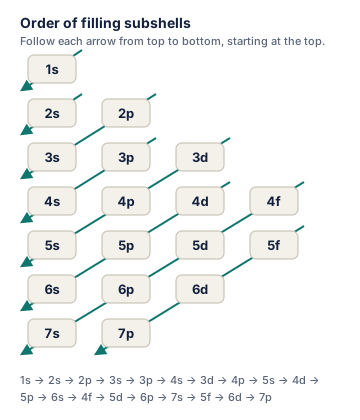
Subshells fill in order of increasing energy:
1s → 2s → 2p → 3s → 3p → 4s → 3d → 4p → 5s → 4d → 5p → 6s → 4f → 5d → 6p → 7s → 5f → 6d → 7p
Notice that 4s fills before 3d. The diagonal diagram below is an easy way to remember the order.
3. Hund’s rule
Within a subshell, electrons occupy separate orbitals with parallel spins before any orbital gets a second electron. For nitrogen’s three 2p electrons: [↑] [↑] [↑], not [↑↓] [↑] [ ].
4. Noble-gas shorthand
Replace the inner (core) electrons with the previous noble gas in square brackets:
- Sodium: = [Ne] 3s¹
- Iron: [Ar] 3d⁶ 4s² (also written [Ar] 4s² 3d⁶)
5. Ions
- Anions: add electrons. : [Ne] 3s² 3p⁶ = [Ar].
- Main-group cations: remove electrons from the outermost subshell. : [Ne].
- Transition-metal cations: remove 4s electrons first, then 3d. : [Ar] 3d⁶; : [Ar] 3d⁵.
Think of it like this
Think of a hotel filling rooms from the ground floor up. Guests (electrons) take the cheapest rooms (lowest energy) first. Hund’s rule is like passengers on a bus: people take empty double seats on their own before anyone sits next to a stranger.
More precisely
A few elements break the simple filling order because half-filled and completely filled d subshells are especially stable: chromium is [Ar] 3d⁵ 4s¹ (not 3d⁴ 4s²) and copper is [Ar] 3d¹⁰ 4s¹ (not 3d⁹ 4s²). Also, once the 3d subshell contains electrons, its energy drops below 4s. That’s why transition metals lose their 4s electrons first when they form ions.
Visualise it
Worked example
Worked example: Writing a configuration
Question: Write the full and noble-gas configurations of sulfur (Z = 16).
- 16 electrons, filled in order: 1s² (2), 2s² (4), 2p⁶ (10), 3s² (12), 3p⁴ (16)
- Full:
- Noble-gas form: [Ne] 3s² 3p⁴: 6 valence electrons, two of them unpaired (Hund’s rule).
Worked example: A transition-metal ion
Question: Write the configuration of (Fe: Z = 26).
- Fe atom: [Ar] 3d⁶ 4s²
- Remove 3 electrons, 4s first: remove both 4s electrons, then one 3d electron.
- : [Ar] 3d⁵ (five unpaired electrons, one in each 3d orbital)
Common mistake
Common mistake: Filling 3d before 4s
Potassium is [Ar] 4s¹, not [Ar] 3d¹. The 4s subshell fills before 3d.
Common mistake: Removing 3d electrons first from transition metals
When transition metals form ions, the 4s electrons are removed first. is [Ar] 3d⁶, not [Ar] 3d⁴ 4s².
Common mistake: Pairing electrons too early
Hund’s rule: put one electron in each orbital of a subshell before pairing. Oxygen’s 2p⁴ is [↑↓] [↑] [↑], with two unpaired electrons.
Notation note
- Superscripts are sometimes written on the line, e.g. 1s2 2s2 2p4, when superscripts aren’t available.
- The order of writing 3d and 4s varies between textbooks ([Ar] 3d⁶ 4s² or [Ar] 4s² 3d⁶). Both are accepted.
- “Aufbau” is German for “building up”.
Remember this
Remember this
- Subshell capacities: s 2, p 6, d 10, f 14; each orbital holds 2 electrons.
- Fill in order (4s before 3d); Hund’s rule: spread out before pairing.
- Noble-gas shorthand: [previous noble gas] + outer electrons.
- Transition-metal ions lose 4s electrons first. Exceptions: Cr and Cu.
Test yourself
Check your understanding before moving on.
Flashcards
Electron Configuration: Flashcards
- QuestionHow many electrons can s, p, d and f subshells hold?Answer
s 2, p 6, d 10, f 14
- QuestionHow many electrons can one orbital hold?Answer
Two, with opposite spins (Pauli exclusion principle).
- QuestionWhich fills first: 4s or 3d?Answer
4s fills before 3d.
- QuestionWhat is Hund's rule?Answer
Electrons occupy separate orbitals in a subshell, with parallel spins, before pairing up.
- QuestionWrite the electron configuration of oxygen (Z = 8).Answer
- QuestionWrite the noble-gas configuration of sodium (Z = 11).Answer
[Ne] 3s¹
- QuestionWrite the configuration of (Fe: Z = 26).Answer
[Ar] 3d⁶ (the two 4s electrons are removed first)
- QuestionWhat are the electron configurations of chromium and copper?Answer
Cr: [Ar] 3d⁵ 4s¹; Cu: [Ar] 3d¹⁰ 4s¹ (exceptions to the simple filling order).
- QuestionHow many unpaired electrons does nitrogen have?Answer
Three: its 2p³ electrons occupy three separate orbitals.
- QuestionWhat does the noble-gas core [Ar] represent?Answer
The 18 electrons of argon:
Tip: press Space to flip and ← → to move between cards.
Quiz
Electron Configuration: Quiz
7 questions
9 electrons: 1s holds 2, 2s holds 2, and the remaining 5 go into 2p.
Show answer
Answer:
9 electrons: 1s holds 2, 2s holds 2, and the remaining 5 go into 2p.
After argon (18 electrons), the next subshell to fill is 4s, not 3d.
Show answer
Answer: [Ar] 4s¹
After argon (18 electrons), the next subshell to fill is 4s, not 3d.
Oxygen 2p⁴: by Hund's rule, [↑↓] [↑] [↑], so two unpaired electrons.
Show answer
Answer: 2
Oxygen 2p⁴: by Hund's rule, [↑↓] [↑] [↑], so two unpaired electrons.
Fe is [Ar] 3d⁶ 4s². Transition metals lose 4s electrons first, so Fe²⁺ is [Ar] 3d⁶.
Show answer
Answer: [Ar] 3d⁶
Fe is [Ar] 3d⁶ 4s². Transition metals lose 4s electrons first, so Fe²⁺ is [Ar] 3d⁶.
10 (Ne) + 2 + 3 = 15 electrons, so Z = 15: phosphorus.
Show answer
Answer: Phosphorus
10 (Ne) + 2 + 3 = 15 electrons, so Z = 15: phosphorus.
Copper is an exception: a completely filled 3d subshell is especially stable, so one 4s electron moves to 3d.
Show answer
Answer: [Ar] 3d¹⁰ 4s¹
Copper is an exception: a completely filled 3d subshell is especially stable, so one 4s electron moves to 3d.
That is Pauli. Filling lowest energy first is the Aufbau principle; spreading out before pairing is Hund's rule.
Show answer
Answer: An orbital holds at most two electrons, with opposite spins
That is Pauli. Filling lowest energy first is the Aufbau principle; spreading out before pairing is Hund's rule.
Notes and downloads
Worksheet
Electron Configuration Worksheet
9 questions on configurations of atoms and ions, orbital diagrams and unpaired electrons. Answer key included.
References
- Brown, T. L.; LeMay, H. E., Jr.; Bursten, B. E.; Murphy, C. J.; Woodward, P. M.; Stoltzfus, M. W. Chemistry: The Central Science, 15th ed.; Pearson, 2022.
Practise this topic with flashcards and a quiz at chemistryclarity.com/chemistry/electron-configuration/
Spotted a mistake? Let us know and we'll fix it.