What is it?
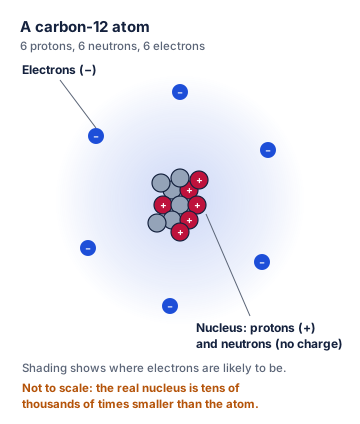
Every atom is built from three kinds of particle:
| Particle | Charge | Mass (approx.) | Where it is |
|---|---|---|---|
| Proton () | +1 | 1 u | In the nucleus |
| Neutron () | 0 | 1 u | In the nucleus |
| Electron () | −1 | about 1/1836 of a proton | Around the nucleus |
The nucleus is a tiny, dense centre containing the protons and neutrons. The electrons occupy the much larger space around it.
Key idea
The number of protons decides which element an atom is. Every carbon atom has 6 protons; any atom with 6 protons is carbon.
Why does it matter?
The arrangement of these particles explains almost everything in chemistry:
- Protons give each element its identity and its place in the periodic table.
- Electrons take part in chemical reactions and bonding, so they decide how an element behaves.
- Neutrons help hold the nucleus together and explain why atoms of the same element can have different masses (isotopes), which matters in fields such as radiocarbon dating and medical imaging.
How does it work?
1. Atomic number and mass number
- Atomic number () = number of protons.
- Mass number () = number of protons + number of neutrons.
- So the number of neutrons = .
These are written as a nuclide symbol, with the mass number at the top left and the atomic number at the bottom left:
Sodium-23 has 11 protons and 23 − 11 = 12 neutrons.
2. Neutral atoms and ions
In a neutral atom, the number of electrons equals the number of protons, so the charges cancel.
An ion forms when an atom gains or loses electrons (never protons):
- Losing electrons gives a positive ion (cation): has 11 protons and 10 electrons.
- Gaining electrons gives a negative ion (anion): has 17 protons and 18 electrons.
3. Isotopes
Isotopes are atoms of the same element (same number of protons) with different numbers of neutrons, and therefore different mass numbers:
| Isotope | Protons | Neutrons |
|---|---|---|
| Carbon-12 | 6 | 6 |
| Carbon-13 | 6 | 7 |
| Carbon-14 | 6 | 8 |
Isotopes of an element have essentially the same chemical properties, because they have the same number of electrons.
Think of it like this
If an atom were the size of a large sports stadium, its nucleus would be about the size of a small marble at the centre, yet it would hold almost all of the stadium’s mass. The rest of the “stadium” is the space where the electrons are found.
More precisely
A proton (1.007 u) and a neutron (1.009 u) are not exactly 1 u, and the electron’s mass is about 0.000549 u. Electrons don’t travel in neat circular orbits like planets. Quantum mechanics describes them by orbitals, regions where an electron is likely to be found. Protons and neutrons are themselves made of smaller particles called quarks, which is beyond what chemistry needs here.
Visualise it
Worked example
Worked example: Counting particles in an ion
Question: How many protons, neutrons and electrons are in the ion ?
- Protons = atomic number = 26
- Neutrons = = 56 − 26 = 30
- A charge of 3+ means 3 electrons have been lost: 26 − 3 = 23 electrons
Worked example: Writing the symbol from particle counts
Question: A particle has 17 protons, 20 neutrons and 18 electrons. Write its symbol.
- 17 protons means the element is chlorine (Z = 17).
- Mass number = 17 + 20 = 37.
- 18 electrons is one more than 17 protons, so the charge is 1−.
Answer: , a chloride ion of chlorine-37.
Common mistake
Common mistake: Changing protons to make an ion
Ions form by gaining or losing electrons. If the number of protons changed, it would be a different element.
Common mistake: Finding neutrons from electrons
Neutrons = mass number − protons (atomic number), not mass number − electrons. For ions the two give different answers.
Common mistake: Confusing mass number with atomic mass
The mass number is a whole-number count of protons and neutrons in one particular isotope (chlorine-35 has A = 35). The atomic mass on the periodic table (Cl = 35.45) is an average over the element’s naturally occurring isotopes, so it is usually not a whole number.
Notation note
- An isotope can be written in several ways: , , carbon-14, or C-14. The atomic number is often left out because the symbol already tells you the element.
- The particles inside the nucleus (protons and neutrons) are together called nucleons.
- “u” (unified atomic mass unit) is also written amu or Da (dalton).
Remember this
Remember this
- Protons (+) and neutrons (0) are in the nucleus; electrons (−) are around it.
- Atomic number Z = protons; mass number A = protons + neutrons.
- Ions: change the number of electrons, never protons.
- Isotopes: same element, different numbers of neutrons.
Test yourself
Check your understanding before moving on.
Flashcards
Inside the Atom: Flashcards
- QuestionWhat are the charges of the proton, neutron and electron?Answer
Proton +1, neutron 0, electron −1.
- QuestionWhere are protons, neutrons and electrons found?Answer
Protons and neutrons in the nucleus; electrons around the nucleus.
- QuestionWhat is the atomic number, Z?Answer
The number of protons in the nucleus. It identifies the element.
- QuestionWhat is the mass number, A?Answer
The number of protons + neutrons in the nucleus.
- QuestionHow do you find the number of neutrons?Answer
Neutrons = mass number − atomic number ().
- QuestionHow many neutrons are in sodium-23 (Z = 11)?Answer
23 − 11 = 12 neutrons
- QuestionHow does an atom become a positive ion?Answer
By losing electrons. The number of protons does not change.
- QuestionHow many electrons are in (Z = 20)?Answer
20 − 2 = 18 electrons
- QuestionWhat are isotopes?Answer
Atoms of the same element (same number of protons) with different numbers of neutrons.
- QuestionWhere is almost all of an atom's mass?Answer
In the nucleus. Electrons have very little mass (about 1/1836 of a proton).
- QuestionWhy is the atomic mass of chlorine (35.45) not a whole number?Answer
It is an average over chlorine's naturally occurring isotopes (chlorine-35 and chlorine-37).
Tip: press Space to flip and ← → to move between cards.
Quiz
Inside the Atom: Quiz
7 questions
Neutrons are neutral (charge 0). Protons are +1 and electrons are −1. The nucleus has an overall positive charge because it contains protons.
Show answer
Answer: Neutron
Neutrons are neutral (charge 0). Protons are +1 and electrons are −1. The nucleus has an overall positive charge because it contains protons.
The atomic number (Z) counts protons and identifies the element. Protons plus neutrons is the mass number.
Show answer
Answer: protons in the nucleus
The atomic number (Z) counts protons and identifies the element. Protons plus neutrons is the mass number.
Neutrons = A − Z = 23 − 11 = 12. The answer 34 adds instead of subtracting.
Show answer
Answer: 12
Neutrons = A − Z = 23 − 11 = 12. The answer 34 adds instead of subtracting.
A 2+ charge means two electrons have been lost: 20 − 2 = 18. The answer 22 adds the electrons instead.
Show answer
Answer: 18
A 2+ charge means two electrons have been lost: 20 − 2 = 18. The answer 22 adds the electrons instead.
Both have 6 protons (so both are carbon) and, as neutral atoms, 6 electrons. Carbon-12 has 6 neutrons and carbon-14 has 8.
Show answer
Answer: Number of neutrons
Both have 6 protons (so both are carbon) and, as neutral atoms, 6 electrons. Carbon-12 has 6 neutrons and carbon-14 has 8.
17 protons makes it chlorine; mass number = 17 + 20 = 37; 18 electrons is one more than the protons, so the charge is 1−.
Show answer
Answer:
17 protons makes it chlorine; mass number = 17 + 20 = 37; 18 electrons is one more than the protons, so the charge is 1−.
Neutrons = 238 − 92 = 146. Uranium-235 has 235 − 92 = 143 neutrons.
Show answer
Answer: 146
Neutrons = 238 − 92 = 146. Uranium-235 has 235 − 92 = 143 neutrons.
Notes and downloads
Worksheet
Inside the Atom Worksheet
7 questions on subatomic particles, atomic and mass numbers, ions and isotopes. Answer key included.
References
- Brown, T. L.; LeMay, H. E., Jr.; Bursten, B. E.; Murphy, C. J.; Woodward, P. M.; Stoltzfus, M. W. Chemistry: The Central Science, 15th ed.; Pearson, 2022.
Practise this topic with flashcards and a quiz at chemistryclarity.com/chemistry/atomic-structure/
Spotted a mistake? Let us know and we'll fix it.