What is it?
In quantum mechanics, an electron in an atom is described by an orbital: a region of space where the electron is likely to be found. Each orbital, and each electron in it, is labelled by quantum numbers, like an address:
| Quantum number | Symbol | Allowed values | What it describes |
|---|---|---|---|
| Principal | 1, 2, 3, … | The shell: size and main energy level | |
| Angular momentum (azimuthal) | 0 to | The subshell: shape of the orbital | |
| Magnetic | to , in steps of 1 | The orientation of the orbital in space | |
| Spin | or | The spin of the electron |
The value of is usually given as a letter: is s, is p, is d and is f. So is the 3p subshell.
Key idea
The first three quantum numbers (, , ) identify an orbital; the fourth () identifies one of the two electrons in it. Pauli exclusion principle: no two electrons in an atom can have the same set of all four quantum numbers. That’s why each orbital holds at most two electrons, with opposite spins.
Why does it matter?
- It explains the electron configuration rules. The number of values gives the number of orbitals per subshell (1, 3, 5, 7), and so the capacities 2, 6, 10 and 14 electrons that build the periodic table.
- It explains the shape of the periodic table. The s, p, d and f blocks are 2, 6, 10 and 14 elements wide.
- Orbital shapes explain bonding. The directions of p and d orbitals determine bond angles and molecular shapes.
How does it work?
1. Counting orbitals and electrons
For a given , takes values, so there are orbitals in the subshell:
| Subshell | values | Orbitals | Max electrons | |
|---|---|---|---|---|
| s | 0 | 0 | 1 | 2 |
| p | 1 | −1, 0, +1 | 3 | 6 |
| d | 2 | −2, −1, 0, +1, +2 | 5 | 10 |
| f | 3 | −3 to +3 | 7 | 14 |
Shell contains subshells, orbitals and at most electrons. For example, the shell has 2s and 2p: 4 orbitals, 8 electrons.
2. Orbital shapes
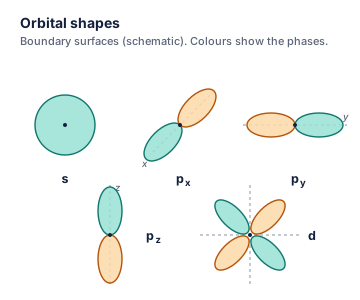
- s orbitals are spherical. Larger gives a larger sphere.
- p orbitals have two lobes (a dumbbell) on opposite sides of the nucleus, with a nodal plane between them. The three p orbitals point along the x, y and z axes: , , .
- d orbitals mostly have four lobes (a cloverleaf); one () has two lobes and a ring.
3. Nodes
A node is a surface where the chance of finding the electron is zero. An orbital has nodes in total: of them are angular (planes or cones), and are radial (spheres).
Think of it like this
The quantum numbers are like an address in a city. is the district (how far from the centre), is the type of street (its shape), is which way the street points, and is which of the two apartments in the building the electron lives in. No two electrons share the same full address.
More precisely
An orbital is a solution of the Schrödinger equation, a wavefunction, . The probability of finding the electron is proportional to . The usual drawings are boundary surfaces enclosing about 90 % of that probability. In hydrogen all subshells with the same have the same energy; in many-electron atoms, shielding makes s lower than p, and p lower than d, which leads to the Aufbau filling order. The two lobes of a p orbital have opposite phases (signs of ), which matters when orbitals overlap to form bonds.
Visualise it
Worked example
Worked example: Allowed values in a shell
Question: List the allowed values of and for . How many orbitals and electrons can the shell hold?
- = 0, 1, 2 (3s, 3p, 3d).
- : for : 0; for : −1, 0, +1; for : −2, −1, 0, +1, +2.
- Orbitals: 1 + 3 + 5 = 9 . Electrons: 18 .
Worked example: Which sets are allowed?
Question: Which of these sets are allowed? (a) (b) (c) (d)
- (a) Allowed: is below , lies between and : a 2p electron.
- (b) Not allowed: must be at most .
- (c) Not allowed: for , can only be −1, 0 or +1.
- (d) Not allowed: must be or .
Worked example: Naming a subshell
Question: Name the subshell with , , and state how many electrons it can hold.
is d, so this is 4d. It has orbitals, holding 10 electrons.
Worked example: Quantum numbers of a valence electron
Question: Give a possible set of quantum numbers for the outermost electron of sodium (1s² 2s² 2p⁶ 3s¹).
The electron is in 3s: , , , (or ).
Worked example: Counting nodes
Question: How many nodes of each kind does a 3p orbital have?
Total . Angular (a nodal plane). Radial (a nodal sphere).
Common mistake
Common mistake: Letting l equal n
runs from 0 to . There is no 1p or 2d subshell: the first p subshell is 2p and the first d subshell is 3d.
Common mistake: Confusing orbitals with electrons
A p subshell has 3 orbitals but holds up to 6 electrons. Always check whether a question asks for orbitals or electrons.
Common mistake: Thinking an orbital is a path
An orbital is not an orbit the electron travels around. It is a region of probability; the electron has no definite path.
Notation note
- is a lower-case L; some books write it .
- A subshell is written number + letter (3p), and its electron count as a superscript (3p⁴).
Remember this
Remember this
- = 1, 2, 3…; = 0 to (s, p, d, f); = to ; = .
- Orbitals per subshell: (1, 3, 5, 7). Per shell: orbitals, electrons.
- Pauli: no two electrons have the same four quantum numbers, so 2 electrons per orbital.
- s spherical, p two lobes (x, y, z), d mostly four lobes.
- Nodes: total; angular; radial.
Test yourself
Check your understanding before moving on.
Flashcards
Quantum Numbers and Orbitals: Flashcards
- QuestionName the four quantum numbers and their symbols.Answer
Principal , angular momentum , magnetic , spin .
- QuestionWhat values can take for a given ?Answer
0, 1, 2, ...,
- QuestionWhat letters stand for = 0, 1, 2 and 3?Answer
s, p, d, f
- QuestionWhat values can take?Answer
Whole numbers from to : values.
- QuestionHow many orbitals are in an s, p, d and f subshell?Answer
1, 3, 5 and 7
- QuestionHow many orbitals and electrons fit in shell ?Answer
orbitals and electrons (e.g. n = 3: 9 orbitals, 18 electrons).
- QuestionState the Pauli exclusion principle.Answer
No two electrons in an atom can have the same four quantum numbers, so an orbital holds at most two electrons, with opposite spins.
- QuestionDescribe the shapes of s and p orbitals.Answer
s: spherical. p: two lobes (dumbbell) along the x, y or z axis.
- QuestionIs the set allowed?Answer
No: cannot equal (maximum for is 1).
- QuestionHow many radial and angular nodes does a 3p orbital have?Answer
Angular: . Radial: . Total: .
Tip: press Space to flip and ← → to move between cards.
Quiz
Quantum Numbers and Orbitals: Quiz
7 questions
The angular momentum quantum number l sets the shape: s (l = 0) spherical, p (l = 1) two lobes, d (l = 2) mostly four lobes.
Show answer
Answer: l
The angular momentum quantum number l sets the shape: s (l = 0) spherical, p (l = 1) two lobes, d (l = 2) mostly four lobes.
For d, l = 2, so mₗ = −2, −1, 0, +1, +2: five orbitals. 10 is the maximum number of electrons.
Show answer
Answer: 5
For d, l = 2, so mₗ = −2, −1, 0, +1, +2: five orbitals. 10 is the maximum number of electrons.
For n = 2, l can only be 0 or 1 (s or p). The first d subshell is 3d.
Show answer
Answer: 2d
For n = 2, l can only be 0 or 1 (s or p). The first d subshell is 3d.
Shell n holds 2n² electrons: 2 × 4² = 32 (4s 2 + 4p 6 + 4d 10 + 4f 14). 16 is the number of orbitals.
Show answer
Answer: 32
Shell n holds 2n² electrons: 2 × 4² = 32 (4s 2 + 4p 6 + 4d 10 + 4f 14). 16 is the number of orbitals.
For n = 3, l can be 2, and mₗ = −1 lies between −2 and +2. (3, 1, −2) has |mₗ| > l; (3, 3) has l = n; n cannot be 0.
Show answer
Answer: (3, 2, −1, +½)
For n = 3, l can be 2, and mₗ = −1 lies between −2 and +2. (3, 1, −2) has |mₗ| > l; (3, 3) has l = n; n cannot be 0.
l = 1 is a p subshell, and n = 4 is the shell: 4p, with 3 orbitals and up to 6 electrons.
Show answer
Answer: 4p
l = 1 is a p subshell, and n = 4 is the shell: 4p, with 3 orbitals and up to 6 electrons.
Radial nodes = n − l − 1 = 4 − 0 − 1 = 3. An s orbital has no angular nodes (l = 0), so all n − 1 = 3 nodes are radial.
Show answer
Answer: 3
Radial nodes = n − l − 1 = 4 − 0 − 1 = 3. An s orbital has no angular nodes (l = 0), so all n − 1 = 3 nodes are radial.
Notes and downloads
Worksheet
Quantum Numbers and Orbitals Worksheet
8 questions on the four quantum numbers, allowed sets, counting orbitals and electrons, orbital shapes and nodes. Answer key included.
References
- Brown, T. L.; LeMay, H. E., Jr.; Bursten, B. E.; Murphy, C. J.; Woodward, P. M.; Stoltzfus, M. W. Chemistry: The Central Science, 15th ed.; Pearson, 2022.
Practise this topic with flashcards and a quiz at chemistryclarity.com/chemistry/quantum-numbers-and-orbitals/
Spotted a mistake? Let us know and we'll fix it.