Worksheet
The Periodic Table Worksheet
8 questions on periods and groups, families, metals and non-metals, valence electrons, ions, blocks and Mendeleev's predictions. Answer key included.
- Type
- Worksheet
- Level
- Beginner
- Format
- PDF, ready to print
Preview the questions
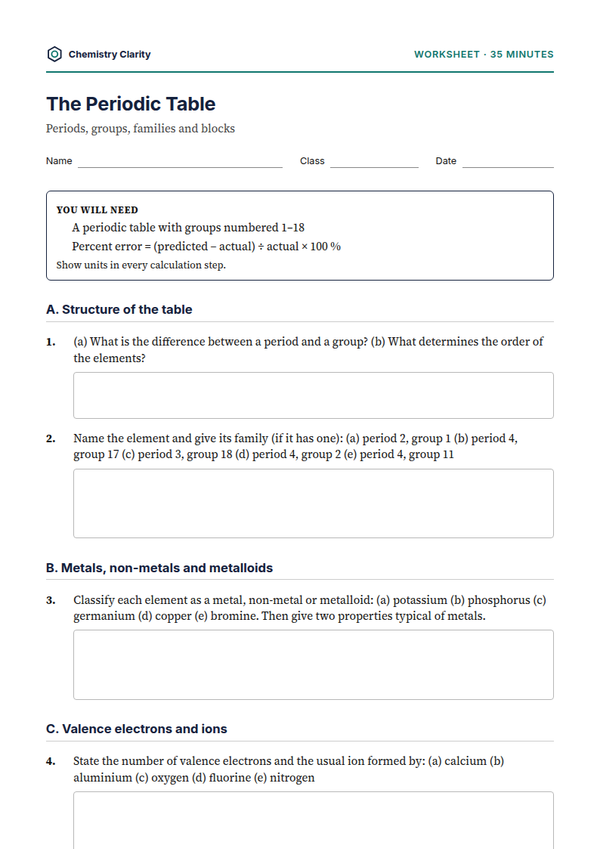
All the questions on this worksheet (about 35 minutes). Download the PDF to print it with space for working; the free answer key has full worked solutions.
A. Structure of the table
1.
(a) What is the difference between a period and a group? (b) What determines the order of the elements?
2.
Name the element and give its family (if it has one): (a) period 2, group 1 (b) period 4, group 17 (c) period 3, group 18 (d) period 4, group 2 (e) period 4, group 11
B. Metals, non-metals and metalloids
3.
Classify each element as a metal, non-metal or metalloid: (a) potassium (b) phosphorus (c) germanium (d) copper (e) bromine. Then give two properties typical of metals.
C. Valence electrons and ions
4.
State the number of valence electrons and the usual ion formed by: (a) calcium (b) aluminium (c) oxygen (d) fluorine (e) nitrogen
5.
Use the groups to predict the formulas of: (a) sodium oxide (b) calcium chloride (c) aluminium sulfide (d) magnesium nitride
D. Blocks
6.
Which block is each element in? (a) Na (b) Fe (c) Br (d) U. Explain how the block is linked to the electrons.
E. History and patterns
7.
Mendeleev predicted that eka-silicon would have an atomic mass of 72 and a density of 5.5 g/cm³. Germanium has an atomic mass of 72.63 and a density of 5.32 g/cm³. (a) Calculate the percent error of each prediction. (b) Why was leaving gaps in the table such a bold step?
F. Challenge
8.
Potassium reacts with water more vigorously than sodium, which reacts more vigorously than lithium. Fluorine is more reactive than chlorine. Suggest why reactivity increases down group 1 but decreases down group 17.