What is it?
Most elements exist naturally as a mixture of isotopes: atoms with the same number of protons but different numbers of neutrons, and therefore different masses.
The atomic mass printed on the periodic table is the weighted average mass of an element’s atoms, taking into account how common each isotope is (its natural abundance).
Key idea
The periodic-table atomic mass is an average weighted by abundance. That’s why chlorine is 35.45 u and not a whole number: no single chlorine atom has a mass of 35.45 u.
Why does it matter?
- Every calculation with molar mass uses it. When you calculate moles from grams, you rely on average atomic masses, because real samples contain the natural mix of isotopes.
- Isotopes are useful in their own right. Carbon-14 is used to date ancient materials, and other isotopes are used in medical imaging and as tracers to follow chemical reactions.
- It explains the periodic table. Seeing that atomic masses are averages removes the mystery of the decimals.
How does it work?
1. Measuring isotopes
A mass spectrometer separates atoms (as ions) by mass. It measures the mass of each isotope and its relative abundance: what fraction of all the atoms it makes up.
2. Calculating the weighted average
Multiply each isotope’s mass by its abundance written as a decimal fraction (75.76% → 0.7576), then add the results:
where the sum () runs over every isotope of the element.
The abundances of all the isotopes must add up to 100% (a total fraction of 1).
3. The average leans toward the most common isotope
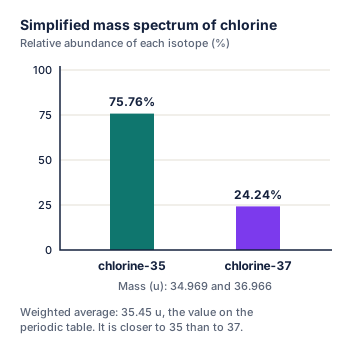
Because chlorine-35 is about three times as common as chlorine-37, the average (35.45 u) is much closer to 35 than to 37.
Think of it like this
Your final course grade might be an exam worth 75% and coursework worth 25%. If you score 35 on the exam and 37 on the coursework, your overall mark isn’t the simple average (36). It’s pulled toward the exam score because the exam counts more. Isotope abundances work the same way: they’re the “weights”.
More precisely
Chlorine exists naturally as molecules, so a real mass spectrum of chlorine gas also shows molecular peaks (around 70, 72 and 74 u). The diagram below is simplified to show single atoms. Isotope abundances also vary very slightly between natural sources, which is why IUPAC gives some standard atomic weights as a small range. Values such as Cl = 35.45 are conventional rounded values for everyday use.
Visualise it
Worked example
Worked example: Average atomic mass of chlorine
Question: Chlorine-35 (34.969 u) makes up 75.76% of chlorine atoms, and chlorine-37 (36.966 u) makes up 24.24%. Calculate the average atomic mass.
- Convert to fractions: 0.7576 and 0.2424 (they add up to 1).
- Multiply and add:
- u
Answer: 35.45 u, the value on the periodic table.
Worked example: An element with three isotopes
Question: Magnesium consists of magnesium-24 (23.985 u, 78.99%), magnesium-25 (24.986 u, 10.00%) and magnesium-26 (25.983 u, 11.01%). Calculate its average atomic mass.
u
Worked example: Finding an abundance from the average
Question: Gallium has two isotopes, gallium-69 (68.926 u) and gallium-71 (70.925 u). Its average atomic mass is 69.723 u. What percentage of gallium atoms are gallium-69?
- Let = fraction of gallium-69, so gallium-71 is .
- , so
Answer: about 60.1% of gallium atoms are gallium-69 (and 39.9% are gallium-71).
Common mistake
Common mistake: Taking a simple average
Averaging 34.969 and 36.966 gives 35.97 u, which is wrong. The isotopes are not equally common, so each mass must be weighted by its abundance.
Common mistake: Using percentages instead of fractions
Multiplying by 75.76 instead of 0.7576 gives an answer 100 times too big. Convert percentages to decimals first (or divide your final sum by 100).
Common mistake: Confusing mass number with isotope mass
The mass number (35) is a whole-number count of protons and neutrons. The isotope mass (34.969 u) is the measured mass, which is slightly different. Use the isotope masses for accurate averages.
Notation note
- Periodic-table values are also called relative atomic mass (, no units) or atomic weight, especially in UK courses and in IUPAC terminology.
- Abundance may be given as a percentage or as a fraction; check which before calculating.
Remember this
Remember this
- Atomic mass on the periodic table = weighted average of the isotope masses.
- Average = Σ (fraction × isotope mass), with fractions adding up to 1.
- The average is closest to the most abundant isotope.
- Never use a simple average unless the isotopes are equally common.
Test yourself
Check your understanding before moving on.
Flashcards
Isotopes and Atomic Mass: Flashcards
- QuestionWhat does the atomic mass on the periodic table represent?Answer
The weighted average mass of an element's atoms, based on the natural abundance of each isotope.
- QuestionWhat is natural abundance?Answer
The percentage (or fraction) of an element's atoms that are a particular isotope.
- QuestionHow do you calculate an average atomic mass?Answer
Multiply each isotope's mass by its abundance as a decimal fraction, then add the results.
- QuestionWhy is chlorine's atomic mass (35.45 u) closer to 35 than to 37?Answer
Chlorine-35 is about three times as common as chlorine-37, so it carries more weight in the average.
- QuestionWhat instrument measures isotope masses and abundances?Answer
A mass spectrometer.
- QuestionWhat should the abundances of all an element's isotopes add up to?Answer
100% (a total fraction of 1).
- QuestionBoron is 19.9% boron-10 (10.013 u) and 80.1% boron-11 (11.009 u). What is its average atomic mass?Answer
u
- QuestionWhat is the difference between mass number and isotope mass?Answer
Mass number is a whole-number count of protons + neutrons (e.g. 35); isotope mass is the measured mass (e.g. 34.969 u).
- QuestionWhy is a simple average of isotope masses usually wrong?Answer
Isotopes are not equally common; each mass must be weighted by its abundance.
Tip: press Space to flip and ← → to move between cards.
Quiz
Isotopes and Atomic Mass: Quiz
7 questions
Most elements are mixtures of isotopes. The atomic mass is the average of their masses, weighted by how common each isotope is.
Show answer
Answer: They are weighted averages of the masses of an element's isotopes
Most elements are mixtures of isotopes. The atomic mass is the average of their masses, weighted by how common each isotope is.
(0.6915 × 62.930) + (0.3085 × 64.928) = 43.516 + 20.030 = 63.55 u. The answer 63.93 u is the simple (unweighted) average.
Show answer
Answer: 63.55 u
(0.6915 × 62.930) + (0.3085 × 64.928) = 43.516 + 20.030 = 63.55 u. The answer 63.93 u is the simple (unweighted) average.
The average (10.8 u) is closer to 11.0 than to 10.0, so the heavier isotope must be more common.
Show answer
Answer: The 11.0 u isotope
The average (10.8 u) is closer to 11.0 than to 10.0, so the heavier isotope must be more common.
(0.5069 × 78.918) + (0.4931 × 80.916) = 79.90 u. Using percentages without dividing by 100 gives 7990, 100 times too big.
Show answer
Answer: 79.90 u
(0.5069 × 78.918) + (0.4931 × 80.916) = 79.90 u. Using percentages without dividing by 100 gives 7990, 100 times too big.
(0.0759 × 6.015) + (0.9241 × 7.016) = 6.94 u, close to 7 because lithium-7 is far more common.
Show answer
Answer: 6.94 u
(0.0759 × 6.015) + (0.9241 × 7.016) = 6.94 u, close to 7 because lithium-7 is far more common.
Let x = fraction of gallium-69: 68.926x + 70.925(1 − x) = 69.723, so x = 1.202 ÷ 1.999 = 0.601, or 60.1%. 39.9% is the abundance of gallium-71.
Show answer
Answer: 60.1%
Let x = fraction of gallium-69: 68.926x + 70.925(1 − x) = 69.723, so x = 1.202 ÷ 1.999 = 0.601, or 60.1%. 39.9% is the abundance of gallium-71.
Both have 17 protons and, as neutral atoms, 17 electrons, so they behave the same chemically. Chlorine-35 has 18 neutrons and chlorine-37 has 20.
Show answer
Answer: They have different numbers of neutrons
Both have 17 protons and, as neutral atoms, 17 electrons, so they behave the same chemically. Chlorine-35 has 18 neutrons and chlorine-37 has 20.
Notes and downloads
Worksheet
Isotopes and Atomic Mass Worksheet
7 questions on isotopes, abundance and weighted average atomic mass. Answer key included.
References
- Brown, T. L.; LeMay, H. E., Jr.; Bursten, B. E.; Murphy, C. J.; Woodward, P. M.; Stoltzfus, M. W. Chemistry: The Central Science, 15th ed.; Pearson, 2022.
Practise this topic with flashcards and a quiz at chemistryclarity.com/chemistry/isotopes-and-atomic-mass/
Spotted a mistake? Let us know and we'll fix it.