What is it?
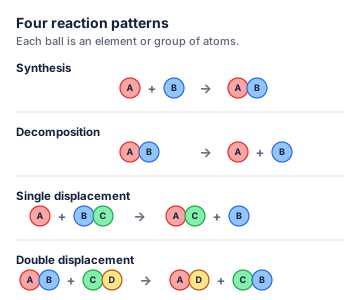
Thousands of reactions fall into a few common patterns. Recognizing the pattern lets you predict the products and write the equation:
| Type | Pattern | Example |
|---|---|---|
| Synthesis (combination) | A + B → AB | |
| Decomposition | AB → A + B | |
| Single displacement | A + BC → AC + B | |
| Double displacement | AB + CD → AD + CB | |
| Combustion | fuel + O₂ → oxides |
Key idea
Look at the reactants: two substances joining, one substance breaking apart, an element plus a compound, two compounds swapping partners, or something burning in oxygen. The pattern tells you what the products will be; then balance the equation.
Why does it matter?
- Predicting products. You can write the equation for a reaction you have never seen.
- Everyday chemistry. Burning fuels (combustion), making lime from limestone (decomposition), extracting metals (displacement) and treating indigestion (neutralization, a double displacement).
- It leads to deeper ideas. Displacement and combustion are redox reactions; many double displacements are precipitation or acid–base reactions.
How does it work?
1. Synthesis
Two or more substances combine into one product. Often an element + element: ; or a metal oxide + water: .
2. Decomposition
One compound breaks into simpler substances, usually when heated or by electricity:
- metal carbonates → metal oxide + carbon dioxide:
- electrolysis of water:
3. Single displacement and the activity series
A more reactive element displaces a less reactive one from its compound. For metals, use the activity series (most reactive first):
K > Na > Ca > Mg > Al > Zn > Fe > Pb > (H) > Cu > Ag > Au
- A metal displaces any metal below it from a solution of its salt. Zinc displaces copper: . Copper does not displace zinc: no reaction.
- Metals above hydrogen displace hydrogen from acids: .
- Halogens: a more reactive halogen displaces a less reactive one (F > Cl > Br > I): .
4. Double displacement
Two ionic compounds swap partners. A reaction happens if a precipitate (insoluble solid), water or a gas forms:
- precipitation:
- neutralization:
- gas formation:
5. Combustion
A substance reacts rapidly with oxygen, releasing heat and light. Hydrocarbons burning completely give carbon dioxide and water: . With too little oxygen, combustion is incomplete, producing poisonous carbon monoxide (CO) or soot (C).
Think of it like this
The patterns are like dance moves. In synthesis, two dancers pair up. In decomposition, a couple splits. In single displacement, a newcomer cuts in and takes someone’s partner (but only if they are “more attractive”: higher in the activity series). In double displacement, two couples swap partners.
More precisely
These categories overlap and are not the only ones. Single displacement and combustion are always redox reactions; many synthesis and decomposition reactions are too. Double displacement reactions are not redox: no oxidation states change. A more fundamental classification uses the driving force: electron transfer (redox), proton transfer (acid–base) or the formation of an insoluble solid (precipitation).
Visualise it
Worked example
Worked example: Classifying reactions
Question: Classify: (a) (b) (c) (d)
- (a) One reactant → two products: decomposition.
- (b) Element + compound, element swapped: single displacement.
- (c) Two compounds swap partners: double displacement (PbI₂ precipitates).
- (d) Two elements → one compound: synthesis (also a combustion of aluminium).
Worked example: Will it react?
Question: Predict whether each reaction happens: (a) (b) (c)
- (a) Zinc is above copper: yes, .
- (b) Copper is below zinc: no reaction.
- (c) Silver is below hydrogen: no reaction.
Worked example: Mass from a decomposition
Question: 10.0 g of calcium carbonate is heated until it fully decomposes: . What mass of carbon dioxide is released?
Worked example: Writing a combustion equation
Question: Write the balanced equation for the complete combustion of propane, .
- Products of complete combustion: and .
- Balance C (3 CO₂), then H (4 H₂O), then O: 3 × 2 + 4 × 1 = 10 O atoms, so 5 O₂.
Common mistake
Common mistake: Predicting a displacement that can't happen
A metal only displaces a metal below it in the activity series. gives no reaction, however long you wait.
Common mistake: Assuming every double displacement happens
Mixing and gives no reaction: all four possible products are soluble, so no precipitate, water or gas forms. The ions just stay in solution.
Common mistake: Writing diatomic elements as single atoms
Oxygen, hydrogen, nitrogen and the halogens are diatomic: , , , . “Mg + O → MgO” is not a correct equation.
Notation note
- State symbols: (s) solid, (l) liquid, (g) gas, (aq) dissolved in water.
- “Δ” or “heat” written over the arrow shows that a reaction needs heating.
Remember this
Remember this
- Synthesis A + B → AB; decomposition AB → A + B.
- Single displacement A + BC → AC + B: only if A is more reactive (activity series).
- Double displacement AB + CD → AD + CB: only if a precipitate, water or gas forms.
- Complete combustion of a hydrocarbon gives CO₂ + H₂O.
- Classify, predict the products, then balance.
Test yourself
Check your understanding before moving on.
Flashcards
Types of Chemical Reactions: Flashcards
- QuestionGive the general pattern of a synthesis and a decomposition reaction.Answer
Synthesis: A + B → AB. Decomposition: AB → A + B.
- QuestionGive the general pattern of single and double displacement.Answer
Single: A + BC → AC + B. Double: AB + CD → AD + CB.
- QuestionWhat are the products of complete combustion of a hydrocarbon?Answer
Carbon dioxide and water.
- QuestionWhat does incomplete combustion produce?Answer
Carbon monoxide (CO) and/or soot (C), as well as water.
- QuestionWhen does a single displacement reaction happen?Answer
When the free element is more reactive (higher in the activity series) than the element it replaces.
- QuestionDoes Cu react with ZnSO₄ solution?Answer
No: copper is below zinc in the activity series.
- QuestionWhen does a double displacement reaction happen?Answer
When a precipitate, water or a gas forms.
- QuestionWhat do metal carbonates give when heated?Answer
The metal oxide and carbon dioxide, e.g. CaCO₃ → CaO + CO₂.
- QuestionWhich metals displace hydrogen from acids?Answer
Metals above hydrogen in the activity series (e.g. Mg, Zn, Fe), not Cu, Ag or Au.
- QuestionBalance the complete combustion of propane, C₃H₈.Answer
C₃H₈ + 5O₂ → 3CO₂ + 4H₂O
Tip: press Space to flip and ← → to move between cards.
Quiz
Types of Chemical Reactions: Quiz
7 questions
One compound breaks into two simpler substances: decomposition.
Show answer
Answer: Decomposition
One compound breaks into two simpler substances: decomposition.
An element (Mg) replaces hydrogen in a compound: single displacement. Magnesium is above hydrogen in the activity series.
Show answer
Answer: Single displacement
An element (Mg) replaces hydrogen in a compound: single displacement. Magnesium is above hydrogen in the activity series.
Complete combustion of a compound of C, H and O gives carbon dioxide and water: C₂H₅OH + 3O₂ → 2CO₂ + 3H₂O.
Show answer
Answer: CO₂ and H₂O
Complete combustion of a compound of C, H and O gives carbon dioxide and water: C₂H₅OH + 3O₂ → 2CO₂ + 3H₂O.
Iron is above copper in the activity series: Fe + CuSO₄ → FeSO₄ + Cu. Silver and gold are below copper.
Show answer
Answer: Iron
Iron is above copper in the activity series: Fe + CuSO₄ → FeSO₄ + Cu. Silver and gold are below copper.
A more reactive halogen displaces a less reactive one (F > Cl > Br > I). Only chlorine displacing iodine fits.
Show answer
Answer: Cl₂ + 2KI → 2KCl + I₂
A more reactive halogen displaces a less reactive one (F > Cl > Br > I). Only chlorine displacing iodine fits.
The possible products KCl and NaNO₃ are both soluble, so the ions stay in solution and there is no reaction.
Show answer
Answer: No precipitate, water or gas can form
The possible products KCl and NaNO₃ are both soluble, so the ions stay in solution and there is no reaction.
10.0 g ÷ 100.09 g/mol = 0.0999 mol CaCO₃ = 0.0999 mol CO₂; × 44.01 g/mol = 4.40 g. 5.60 g is the mass of CaO formed.
Show answer
Answer: 4.40 g
10.0 g ÷ 100.09 g/mol = 0.0999 mol CaCO₃ = 0.0999 mol CO₂; × 44.01 g/mol = 4.40 g. 5.60 g is the mass of CaO formed.
Notes and downloads
Worksheet
Types of Chemical Reactions Worksheet
8 questions on classifying reactions, predicting products with the activity series, writing balanced equations and a decomposition calculation. Answer key included.
References
- Brown, T. L.; LeMay, H. E., Jr.; Bursten, B. E.; Murphy, C. J.; Woodward, P. M.; Stoltzfus, M. W. Chemistry: The Central Science, 15th ed.; Pearson, 2022.
Practise this topic with flashcards and a quiz at chemistryclarity.com/chemistry/types-of-chemical-reactions/
Spotted a mistake? Let us know and we'll fix it.