What is it?
A mole is a counting unit for particles. One mole of anything contains 6.022 × 10²³ of those things. The particles can be atoms, molecules, ions or formula units.
The number 6.022 × 10²³ is called Avogadro’s number. The symbol for “one mole” is mol.
Key idea
A mole is a number of particles: 1 mol = 6.022 × 10²³ particles. Chemists use it because atoms are far too small and numerous to count one by one.
Why does it matter?
Atoms and molecules are extremely small. A single drop of water (about 0.05 g) contains roughly 1.7 × 10²¹ water molecules. Nobody can count particles like that, but we can weigh substances on a balance.
The mole is the bridge between the two worlds:
- The particle world, where reactions happen one atom or molecule at a time.
- The laboratory world, where we measure grams.
Balanced chemical equations are written in particles, and therefore in moles. For example,
means 2 molecules of hydrogen react with 1 molecule of oxygen. It equally means 2 mol of react with 1 mol of to form 2 mol of . The mole lets you turn that ratio into masses you can actually weigh out. This is the basis of all stoichiometry.
How does it work?
1. The mole is a counting number
Just as “a dozen” always means 12, “a mole” always means 6.022 × 10²³. A mole of carbon atoms, a mole of water molecules and a mole of sodium ions all contain the same number of particles.
Think of it like this
A dozen eggs and a dozen watermelons contain the same number of items, but they have very different masses. In the same way, one mole of carbon atoms (12.01 g) and one mole of gold atoms (196.97 g) contain exactly the same number of atoms. Gold atoms are simply heavier.
2. Molar mass links moles to grams
The molar mass (symbol ) is the mass of one mole of a substance, in grams per mole (g/mol).
Conveniently, the molar mass in g/mol has the same number as the atomic mass or formula mass in atomic mass units (u):
| Substance | Mass of one particle | Molar mass |
|---|---|---|
| Carbon atom, | 12.01 u | 12.01 g/mol |
| Water molecule, | 2(1.008) + 16.00 = 18.02 u | 18.02 g/mol |
| Sodium chloride, | 22.99 + 35.45 = 58.44 u | 58.44 g/mol |
To find a molar mass, add up the atomic masses of all the atoms in the formula, taking account of the subscripts.
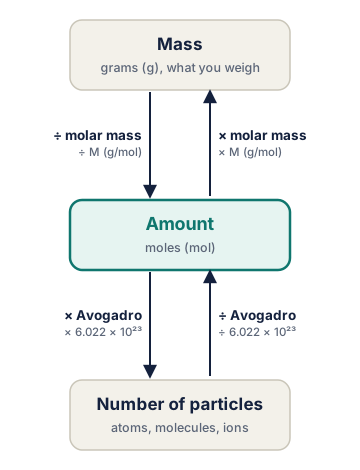
3. Two conversions do almost everything
Between mass and moles:
where is the amount in moles, is the mass in grams, and is the molar mass in g/mol.
Between moles and number of particles:
where is the number of particles and is the Avogadro constant.
More precisely
Since 20 May 2019, the mole has been defined by fixing the Avogadro constant at exactly 6.022 140 76 × 10²³ mol⁻¹. Before that, one mole was defined as the number of atoms in exactly 12 g of carbon-12. Under today’s definition, one mole of carbon-12 has a mass extremely close to 12 g, but not exactly 12 g. For school and introductory university calculations, 6.022 × 10²³ is precise enough.
Visualise it
Worked example
Worked example: From grams to moles to molecules
Question: How many moles of water, and how many water molecules, are in 36.0 g of water? (H = 1.008, O = 16.00)
- Find the molar mass of : g/mol.
- Convert mass to moles:
- Convert moles to molecules: molecules.
Answer: 36.0 g of water is 2.00 mol, which is 1.20 × 10²⁴ molecules.
Check the units: g ÷ (g/mol) leaves mol, and mol × mol⁻¹ leaves a pure number of molecules.
Worked example: From moles to grams
Question: What is the mass of 0.250 mol of sodium chloride, ? (Na = 22.99, Cl = 35.45)
- Find the molar mass: g/mol.
- Rearrange to give .
- Substitute:
Answer: 0.250 mol of sodium chloride has a mass of 14.6 g.
Common mistake
Common mistake: Mixing up atoms and molecules
One mole of oxygen gas, , contains 6.022 × 10²³ molecules but twice as many atoms (1.204 × 10²⁴), because each molecule has two oxygen atoms. Its molar mass is 2 × 16.00 = 32.00 g/mol, not 16.00 g/mol.
Always ask: a mole of what? Atoms, molecules or ions? Write the formula and count the atoms in it.
Common mistake: Multiplying when you should divide
Students often multiply mass by molar mass to get moles. Let the units guide you: to cancel grams, you must divide by g/mol. If your answer’s units don’t come out as mol, the setup is upside down.
Notation note
Textbooks use slightly different names and symbols for the same ideas:
- Amount of substance () is the quantity measured in moles. “Number of moles” means the same thing.
- Atomic mass unit: many textbooks write amu. The symbol accepted in the SI is u (also called the dalton, Da).
- Formula weight and molecular weight are older textbook names for the mass of one formula unit or molecule in u. Many textbooks now say formula mass and molecular mass instead.
- The Avogadro constant, = 6.022 × 10²³ mol⁻¹, has units. Avogadro’s number is the same value written as a plain number.
Remember this
Remember this
- 1 mol = 6.022 × 10²³ particles.
- Molar mass (g/mol) has the same number as the atomic or formula mass (u).
- moles = mass ÷ molar mass, and particles = moles × 6.022 × 10²³.
- Always ask: a mole of what?
Watch the video
Key points
- [Key point 1]
- [Key point 2]
- [Key point 3]
Test yourself
Check your understanding before moving on.
Flashcards
The Mole Concept: Flashcards
- QuestionWhat is a mole?Answer
A counting unit for particles. One mole contains particles (atoms, molecules, ions or formula units).
- QuestionWhat is the value of the Avogadro constant, to four significant figures?Answer
mol⁻¹
- QuestionWhat is molar mass?Answer
The mass of one mole of a substance, in g/mol. It has the same number as the atomic or formula mass in u.
- QuestionWhich formula converts a mass in grams into moles?Answer
(moles = mass ÷ molar mass)
- QuestionWhich formula converts moles into a number of particles?Answer
(particles = moles × )
- QuestionWhat is the molar mass of water, ? (H = 1.008, O = 16.00)Answer
g/mol
- QuestionWhat is the mass of one mole of oxygen gas, ? (O = 16.00)Answer
32.00 g. Each molecule contains two oxygen atoms, so g/mol.
- QuestionHow many oxygen atoms are in 1 mol of ?Answer
2 mol of O atoms, which is atoms.
- QuestionDo 1 mol of carbon and 1 mol of gold contain the same number of atoms?Answer
Yes, both contain atoms. Their masses differ (12.01 g and 196.97 g) because gold atoms are heavier.
- QuestionWhat is the name of the quantity measured in moles, and its symbol?Answer
Amount of substance, symbol . Its unit is the mole (mol).
- QuestionHow has the mole been defined since 2019?Answer
By fixing the Avogadro constant at exactly mol⁻¹.
Tip: press Space to flip and ← → to move between cards.
Quiz
The Mole Concept: Quiz
7 questions
A mole is a fixed counting number, like a dozen. One mole of any substance contains particles. The mass of a mole depends on the substance, but the number of particles does not.
Show answer
Answer:
A mole is a fixed counting number, like a dozen. One mole of any substance contains particles. The mass of a mole depends on the substance, but the number of particles does not.
One carbon atom plus two oxygen atoms: g/mol. The answer 28.01 g/mol forgets the subscript 2 (it is the molar mass of CO).
Show answer
Answer: 44.01 g/mol
One carbon atom plus two oxygen atoms: g/mol. The answer 28.01 g/mol forgets the subscript 2 (it is the molar mass of CO).
mol. The answer 162 mol comes from multiplying instead of dividing. Check the units: g ÷ (g/mol) gives mol.
Show answer
Answer: 0.499 mol
mol. The answer 162 mol comes from multiplying instead of dividing. Check the units: g ÷ (g/mol) gives mol.
g. The answer 117 g comes from dividing 58.44 by 0.500 instead of multiplying.
Show answer
Answer: 29.2 g
g. The answer 117 g comes from dividing 58.44 by 0.500 instead of multiplying.
1.00 mol of contains molecules. Each molecule has 2 oxygen atoms, so there are atoms.
Show answer
Answer:
1.00 mol of contains molecules. Each molecule has 2 oxygen atoms, so there are atoms.
Both samples contain the same number of particles, . Helium particles are single atoms, but each molecule contains two atoms. So 1 mol of contains twice as many atoms.
Show answer
Answer: 1 mol of
Both samples contain the same number of particles, . Helium particles are single atoms, but each molecule contains two atoms. So 1 mol of contains twice as many atoms.
In the 2019 revision of the SI, the Avogadro constant was fixed at exactly mol⁻¹. The carbon-12 definition was used before 2019, and many textbooks still mention it.
Show answer
Answer: By fixing the numerical value of the Avogadro constant exactly
In the 2019 revision of the SI, the Avogadro constant was fixed at exactly mol⁻¹. The carbon-12 definition was used before 2019, and many textbooks still mention it.
Notes and downloads
Lecture notes
Lecture Notes: The Mole Concept
Read online, print, or download as a PDF.
Worksheet
Mole Concept Worksheet
15 questions on moles, molar mass, Avogadro's number and counting atoms in compounds, from basic understanding to a challenge question. Answer key included.
Practice test
Stoichiometry Exam Pack (Example)
Example of a premium resource listing. Not a real product.
References
- Brown, T. L.; LeMay, H. E., Jr.; Bursten, B. E.; Murphy, C. J.; Woodward, P. M.; Stoltzfus, M. W. Chemistry: The Central Science, 15th ed.; Pearson, 2022.
- Bureau International des Poids et Mesures (BIPM). The International System of Units (SI), 9th ed.; BIPM, 2019. Link
Spotted a mistake? Let us know and we'll fix it.