Worksheet
Precipitation and Net Ionic Equations Worksheet
8 questions on solubility rules, predicting precipitates, writing complete and net ionic equations, and gravimetric calculations. Answer key included.
- Type
- Worksheet
- Level
- Intermediate
- Format
- PDF, ready to print
Preview the questions
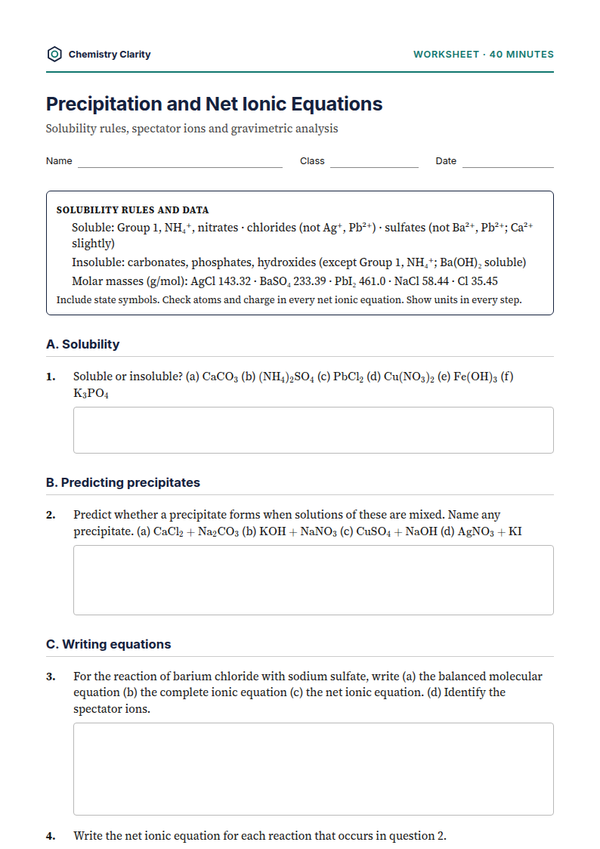
All the questions on this worksheet (about 40 minutes). Download the PDF to print it with space for working; the free answer key has full worked solutions.
A. Solubility
1.
Soluble or insoluble? (a) (b) (c) (d) (e) (f)
B. Predicting precipitates
2.
Predict whether a precipitate forms when solutions of these are mixed. Name any precipitate. (a) (b) (c) (d)
C. Writing equations
3.
For the reaction of barium chloride with sodium sulfate, write (a) the balanced molecular equation (b) the complete ionic equation (c) the net ionic equation. (d) Identify the spectator ions.
4.
Write the net ionic equation for each reaction that occurs in question 2.
5.
Write the net ionic equation for the neutralization of nitric acid by potassium hydroxide, and explain why it is the same as for hydrochloric acid and sodium hydroxide.
D. Calculations
6.
Excess barium chloride is added to 50.0 mL of a sodium sulfate solution. The dried precipitate of has a mass of 0.466 g. Calculate the concentration of sulfate in mol/L.
7.
Excess lead(II) nitrate is added to 20.0 mL of 0.120 mol/L potassium iodide. Calculate the mass of lead(II) iodide that forms.
E. Challenge
8.
A 0.300 g sample of impure sodium chloride is dissolved and treated with excess silver nitrate, giving 0.717 g of . Calculate (a) the mass of chlorine in the sample (b) the percent chlorine by mass (c) the percent purity of the NaCl, assuming the impurity contains no chlorine.