What is it?
Stoichiometry (stoy-kee-OM-uh-tree) is the part of chemistry that uses a balanced chemical equation to calculate how much of each substance reacts or is produced.
The key is that the coefficients in a balanced equation give the mole ratio between the substances. In
2 mol of hydrogen react with 1 mol of oxygen to make 2 mol of water.
Key idea
The numbers in front of the formulas compare moles, not grams. To use them, always convert to moles first.
Why does it matter?
- In the lab: how much of each starting material should you weigh out, and how much product should you expect?
- In industry: manufacturers of fertilisers, medicines and fuels must know exactly how much raw material they need, because waste costs money.
- In everyday life: the amount of oxygen a fuel needs to burn completely, or the amount of carbon dioxide it produces, is a stoichiometry calculation.
How does it work?
The three-step method
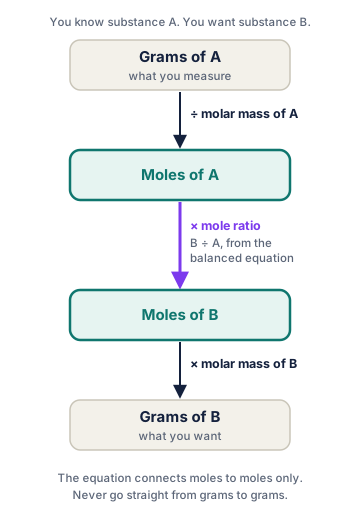
- Convert what you know into moles. For a mass, divide by the molar mass.
- Use the mole ratio from the balanced equation to find moles of the substance you want: where and are the coefficients of A (what you have) and B (what you want).
- Convert moles of B into what is asked for. For a mass, multiply by the molar mass of B.
Before you start, check that the equation is balanced. An unbalanced equation gives the wrong mole ratio, and therefore the wrong answer.
Think of it like this
A sandwich recipe says: 2 slices of bread + 1 slice of cheese → 1 sandwich. With 10 slices of bread you need 5 slices of cheese and can make 5 sandwiches. You compared numbers of slices, not their weights. A balanced equation is a recipe that counts particles, and moles are how chemists count particles.
More precisely
These calculations give the theoretical amount of product: the most that could form if the reaction went to completion and nothing was lost. Real reactions often give less. Comparing the two (percent yield), and working out which reactant runs out first (the limiting reactant), are covered in the next lesson.
Visualise it
Worked example
Worked example: Mass of product from mass of reactant
Question: What mass of water forms when 5.00 g of hydrogen gas reacts completely with oxygen? (H = 1.008, O = 16.00)
- Moles of : g/mol, so mol
- Mole ratio: , so moles of = 2.480 mol
- Mass of : g
Answer: 44.7 g of water.
Check: the reaction also uses 39.7 g of oxygen, and 5.00 g + 39.7 g = 44.7 g. Mass is conserved.
Worked example: Burning propane
Question: Propane burns in oxygen: . What mass of oxygen is needed to burn 22.0 g of propane, and what mass of carbon dioxide forms? (C = 12.01, H = 1.008, O = 16.00)
- Moles of propane: g/mol, so mol
- Oxygen: mol, and g
- Carbon dioxide: mol, and g
Answer: 79.8 g of oxygen is needed, and 65.9 g of carbon dioxide forms.
Common mistake
Common mistake: Using the coefficients as a mass ratio
In , the coefficients do not mean that 2 g of hydrogen reacts with 1 g of oxygen. They compare moles. Always convert grams to moles before using the ratio.
Common mistake: Turning the mole ratio upside down
Write the ratio as what you want ÷ what you have. To find oxygen from propane, multiply moles of propane by 5/1, not 1/5. Writing the units on every number makes the mistake easy to spot.
Common mistake: Starting from an unbalanced equation
The ratio is only correct if the equation is balanced. Check that every element has the same number of atoms on both sides before you calculate.
Notation note
- The numbers in front of formulas are called coefficients or stoichiometric coefficients.
- The fraction made from two coefficients is called the mole ratio, or stoichiometric factor.
- “Reacts completely” or “in excess” in a question tells you there is enough of the other reactant, so only the one you’re given limits the amount of product.
Remember this
Remember this
- Balanced equation first; its coefficients give mole ratios.
- Road map: grams → moles → (mole ratio) → moles → grams.
- Mole ratio = want ÷ have.
- Check your answer: total mass of reactants used = total mass of products.
Test yourself
Check your understanding before moving on.
Flashcards
Stoichiometry: Flashcards
- QuestionWhat is stoichiometry?Answer
Using a balanced chemical equation to calculate the amounts of substances that react or are produced.
- QuestionWhat do the coefficients in a balanced equation tell you?Answer
The mole ratio between the substances (not the mass ratio).
- QuestionWhat are the three steps of a stoichiometry calculation?Answer
1. Convert what you know to moles. 2. Multiply by the mole ratio from the balanced equation. 3. Convert moles to what is asked for.
- QuestionHow do you write the mole ratio so it isn't upside down?Answer
Want ÷ have: (coefficient of the substance you want) ÷ (coefficient of the substance you know).
- QuestionIn , how many moles of react with 4 mol of ?Answer
mol of
- QuestionIn , how many moles of form from 3.0 mol of ?Answer
mol of
- QuestionWhy must the equation be balanced before you calculate?Answer
Only a balanced equation gives the correct mole ratio. An unbalanced one gives the wrong answer.
- QuestionCan you convert grams of A directly into grams of B using the coefficients?Answer
No. The equation connects moles to moles. Go grams → moles → moles → grams.
- QuestionHow can you check a stoichiometry answer?Answer
Mass is conserved: the total mass of reactants used equals the total mass of products formed.
Tip: press Space to flip and ← → to move between cards.
Quiz
Stoichiometry: Quiz
7 questions
The coefficients are 1 for and 2 for , so 1 mol of oxygen gives 2 mol of water. The answer 16 : 18 mixes up masses with moles.
Show answer
Answer: 1 : 2
The coefficients are 1 for and 2 for , so 1 mol of oxygen gives 2 mol of water. The answer 16 : 18 mixes up masses with moles.
Mole ratio = want ÷ have = 2/3. So mol. The answer 4.5 mol uses the ratio upside down (3/2).
Show answer
Answer: 2.0 mol
Mole ratio = want ÷ have = 2/3. So mol. The answer 4.5 mol uses the ratio upside down (3/2).
mol of . The answer 0.400 mol divides by 5 instead of multiplying.
Show answer
Answer: 10.0 mol
mol of . The answer 0.400 mol divides by 5 instead of multiplying.
1.00 mol of propane gives 3.00 mol of (ratio 3/1). Mass = g.
Show answer
Answer: 132 g
1.00 mol of propane gives 3.00 mol of (ratio 3/1). Mass = g.
Moles of = 28.0 ÷ 28.02 = 0.9993 mol. Moles of = 0.9993 × 2 = 1.999 mol. Mass = 1.999 × 17.03 = 34.0 g. The answer 28.0 g wrongly assumes the masses are equal.
Show answer
Answer: 34.0 g
Moles of = 28.0 ÷ 28.02 = 0.9993 mol. Moles of = 0.9993 × 2 = 1.999 mol. Mass = 1.999 × 17.03 = 34.0 g. The answer 28.0 g wrongly assumes the masses are equal.
Mole ratio = want ÷ have = 2/4. So mol of .
Show answer
Answer: 3.00 mol
Mole ratio = want ÷ have = 2/4. So mol of .
Coefficients compare numbers of particles (moles). 2 mol of (4.03 g) reacts with 1 mol of (32.00 g), so the mass ratio is very different from 2 : 1.
Show answer
Answer: The coefficients give a mole ratio, not a mass ratio
Coefficients compare numbers of particles (moles). 2 mol of (4.03 g) reacts with 1 mol of (32.00 g), so the mass ratio is very different from 2 : 1.
Notes and downloads
Worksheet
Stoichiometry Worksheet
8 questions on mole ratios and mass calculations from balanced equations. Answer key included.
References
- Brown, T. L.; LeMay, H. E., Jr.; Bursten, B. E.; Murphy, C. J.; Woodward, P. M.; Stoltzfus, M. W. Chemistry: The Central Science, 15th ed.; Pearson, 2022.
Practise this topic with flashcards and a quiz at chemistryclarity.com/chemistry/stoichiometry/
Spotted a mistake? Let us know and we'll fix it.