What is it?
Light is electromagnetic radiation: a wave of electric and magnetic fields that travels through space at the speed of light, m/s. A wave is described by its:
- wavelength, (lambda): the distance from one crest to the next, in m or nm;
- frequency, (nu): the number of waves passing a point each second, in s⁻¹ or hertz (Hz).
They are linked by
Light also behaves as a stream of particles called photons. Each photon carries a fixed amount (a quantum) of energy:
where J s is Planck’s constant. Short wavelength means high frequency and high energy.
Key idea
When atoms are heated or excited by electricity, they emit light of only certain exact wavelengths: a line spectrum, different for every element. This shows that electrons in atoms can have only certain energies (energy levels). Each line is a photon released when an electron drops from a higher level to a lower one.
Why does it matter?
- Identifying elements. Every element has its own line spectrum, like a fingerprint. Flame tests, street lamps and the analysis of starlight all rely on it; helium was discovered in the Sun’s spectrum before it was found on Earth.
- Energy levels lead to electron configurations. The idea of quantized energy levels is the starting point for shells, subshells and orbitals.
- Light and chemistry. Photons with enough energy break bonds (UV light causes sunburn), and the colours of solutions are the basis of spectrophotometry.
How does it work?
1. The electromagnetic spectrum
From low to high energy: radio waves, microwaves, infrared, visible light (about 400 nm violet to 700 nm red), ultraviolet, X-rays and gamma rays. Only a narrow band is visible to us.
2. Line spectra
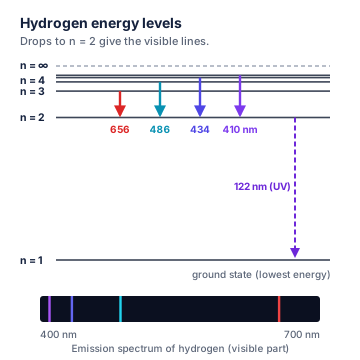
A hot solid gives a continuous spectrum (all colours, like a rainbow). A gas of one element, excited by heat or electricity, gives an emission line spectrum: bright lines at fixed wavelengths on a dark background. Hydrogen’s visible lines are at 656 nm (red), 486 nm (blue-green), 434 nm and 410 nm (violet). Cool gas in front of a bright source absorbs the same wavelengths, giving dark lines (an absorption spectrum).
3. The Bohr model of hydrogen
In 1913 Niels Bohr proposed that the electron in a hydrogen atom can only occupy orbits with certain energies:
where
- is the ground state, the lowest energy. Higher are excited states.
- Energies are negative because the electron is bound: zero energy means the electron has been removed ().
- When the electron drops from a higher level to a lower one, it emits one photon whose energy equals the gap:
(written as a positive energy for the photon emitted, with the lower level). Drops to give the visible lines of hydrogen; drops to give ultraviolet lines.
Think of it like this
Energy levels are like the rungs of a ladder, not a ramp. You can stand on a rung, but not between rungs. Jumping down from one rung to another always releases the same exact amount of energy, which is why each jump gives light of one exact colour.
More precisely
Bohr’s model works perfectly only for hydrogen and other one-electron ions. It was replaced by quantum mechanics, in which electrons are described by orbitals (regions where the electron is likely to be found) rather than fixed orbits. The energy levels of hydrogen predicted by quantum mechanics are the same as Bohr’s, which is why his formula is still used. The wave–particle nature of light was confirmed by the photoelectric effect, explained by Einstein in 1905.
Visualise it
Worked example
Worked example: Frequency from wavelength
Question: Hydrogen’s red line has a wavelength of 656 nm. What is its frequency?
-
Convert to metres:
-
Rearrange :
Worked example: Energy of a photon and of a mole of photons
Question: What is the energy of one photon of the 656 nm light, and of one mole of these photons?
-
One photon:
-
One mole:
Worked example: Predicting a line with the Bohr model
Question: Calculate the wavelength of the photon emitted when a hydrogen electron drops from to .
-
Energy gap:
-
Wavelength, from :
-
This is exactly hydrogen’s red line: the Bohr model explains the observed spectrum.
Worked example: Ionization energy of hydrogen
Question: How much energy is needed to remove the electron from a hydrogen atom in its ground state? Give the answer per mole.
-
From ( J) to (): J per atom.
-
Per mole:
-
This matches the measured first ionization energy of hydrogen, 1312 kJ/mol.
Common mistake
Common mistake: Forgetting to convert nm to m
In and , the wavelength must be in metres to match in m/s. 656 nm is m, not 656 m.
Common mistake: Thinking longer wavelength means more energy
Energy is inversely proportional to wavelength. Red light (700 nm) has less energy per photon than violet light (400 nm), and UV has more than both.
Common mistake: Mixing per-photon and per-mole energies
gives the energy of one photon (about J). To compare with bond energies in kJ/mol, multiply by Avogadro’s number and divide by 1000.
Notation note
- is the Greek letter nu (frequency), not the letter v (velocity).
- 1 Hz = 1 s⁻¹; 1 nm = 10⁻⁹ m.
Remember this
Remember this
- and ; m/s, J s.
- Short wavelength = high frequency = high energy. Visible light: about 400–700 nm.
- Atoms emit and absorb only certain wavelengths (line spectra) because electron energy levels are quantized.
- Bohr: ; a photon carries the energy difference between two levels.
- Per mole: multiply the photon energy by .
Test yourself
Check your understanding before moving on.
Flashcards
Light and Atomic Spectra: Flashcards
- QuestionGive the equation linking the speed of light, wavelength and frequency.Answer
, with m/s
- QuestionGive the equation for the energy of a photon.Answer
, with J s
- QuestionWhich has more energy per photon: red light or violet light?Answer
Violet: shorter wavelength, higher frequency, more energy.
- QuestionWhat is the approximate wavelength range of visible light?Answer
About 400 nm (violet) to 700 nm (red).
- QuestionWhat is a line spectrum, and what does it show?Answer
Light of only certain exact wavelengths, emitted by an excited element. It shows that electron energy levels are quantized.
- QuestionGive the Bohr energy of level n in hydrogen.Answer
- QuestionWhy are the Bohr energies negative?Answer
The electron is bound to the nucleus; zero energy means it has been removed (n = ∞).
- QuestionWhich drops give hydrogen's visible lines?Answer
Drops from higher levels down to n = 2 (656, 486, 434 and 410 nm).
- QuestionWhat is the frequency of 656 nm light?Answer
(2.998 × 10⁸ m/s) ÷ (656 × 10⁻⁹ m) = 4.57 × 10¹⁴ s⁻¹
- QuestionHow do you convert the energy of one photon into kJ/mol?Answer
Multiply by Avogadro's number (6.022 × 10²³ mol⁻¹) and divide by 1000.
Tip: press Space to flip and ← → to move between cards.
Quiz
Light and Atomic Spectra: Quiz
7 questions
c = λν, so a shorter wavelength means a higher frequency; E = hν, so the energy rises too.
Show answer
Answer: Both increase
c = λν, so a shorter wavelength means a higher frequency; E = hν, so the energy rises too.
Of these, ultraviolet has the shortest wavelength and therefore the highest photon energy, which is why it can damage skin.
Show answer
Answer: Ultraviolet
Of these, ultraviolet has the shortest wavelength and therefore the highest photon energy, which is why it can damage skin.
λ = c/ν = (2.998 × 10⁸ m/s) ÷ (98.1 × 10⁶ s⁻¹) = 3.06 m. Remember that 1 MHz = 10⁶ Hz.
Show answer
Answer: 3.06 m
λ = c/ν = (2.998 × 10⁸ m/s) ÷ (98.1 × 10⁶ s⁻¹) = 3.06 m. Remember that 1 MHz = 10⁶ Hz.
E = hc/λ = (6.626 × 10⁻³⁴ J s × 2.998 × 10⁸ m/s) ÷ (450 × 10⁻⁹ m) = 4.41 × 10⁻¹⁹ J. 4.41 × 10⁻²⁸ J results from leaving λ in nm.
Show answer
Answer: 4.41 × 10⁻¹⁹ J
E = hc/λ = (6.626 × 10⁻³⁴ J s × 2.998 × 10⁸ m/s) ÷ (450 × 10⁻⁹ m) = 4.41 × 10⁻¹⁹ J. 4.41 × 10⁻²⁸ J results from leaving λ in nm.
Each line is a photon emitted when an electron drops between two allowed energy levels. The levels are different in every element, so the pattern of lines is unique.
Show answer
Answer: Its electrons can only have certain energies, which differ from element to element
Each line is a photon emitted when an electron drops between two allowed energy levels. The levels are different in every element, so the pattern of lines is unique.
ΔE = 2.179 × 10⁻¹⁸ J × (1/2² − 1/4²) = 4.086 × 10⁻¹⁹ J, and λ = hc/ΔE = 486 nm. The drop from 3 to 2 gives 656 nm.
Show answer
Answer: n = 4 to n = 2
ΔE = 2.179 × 10⁻¹⁸ J × (1/2² − 1/4²) = 4.086 × 10⁻¹⁹ J, and λ = hc/ΔE = 486 nm. The drop from 3 to 2 gives 656 nm.
2.179 × 10⁻¹⁸ J per atom × 6.022 × 10²³ mol⁻¹ = 1.312 × 10⁶ J/mol = 1312 kJ/mol. 328 kJ/mol would be from n = 2.
Show answer
Answer: 1312 kJ/mol
2.179 × 10⁻¹⁸ J per atom × 6.022 × 10²³ mol⁻¹ = 1.312 × 10⁶ J/mol = 1312 kJ/mol. 328 kJ/mol would be from n = 2.
Notes and downloads
Worksheet
Light and Atomic Spectra Worksheet
8 questions on wavelength, frequency and photon energy, line spectra and Bohr-model calculations for hydrogen. Answer key included.
References
- Bureau International des Poids et Mesures (BIPM). The International System of Units (SI), 9th ed.; BIPM, 2019. Link
- Brown, T. L.; LeMay, H. E., Jr.; Bursten, B. E.; Murphy, C. J.; Woodward, P. M.; Stoltzfus, M. W. Chemistry: The Central Science, 15th ed.; Pearson, 2022.
Practise this topic with flashcards and a quiz at chemistryclarity.com/chemistry/light-and-atomic-spectra/
Spotted a mistake? Let us know and we'll fix it.