Worksheet
Light and Atomic Spectra Worksheet
8 questions on wavelength, frequency and photon energy, line spectra and Bohr-model calculations for hydrogen. Answer key included.
- Type
- Worksheet
- Level
- Intermediate
- Format
- PDF, ready to print
Preview the questions
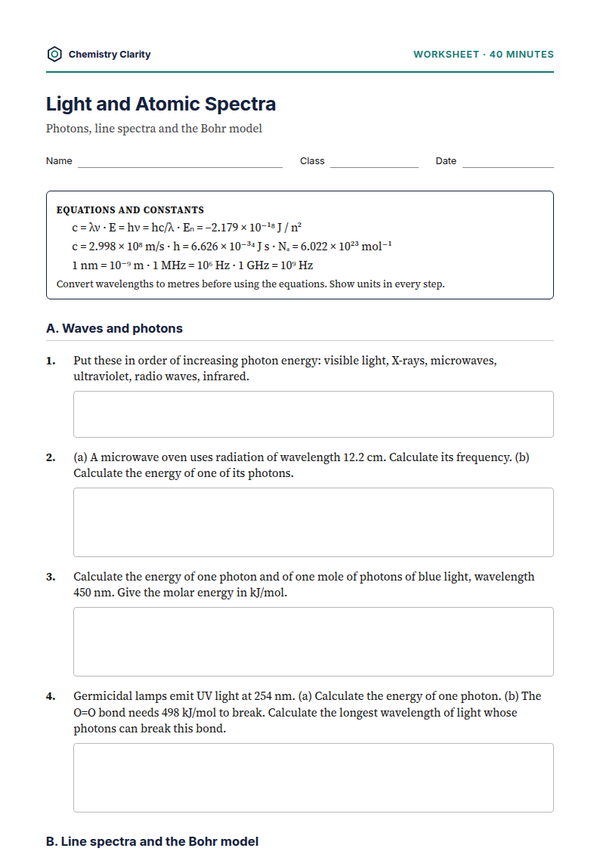
All the questions on this worksheet (about 40 minutes). Download the PDF to print it with space for working; the free answer key has full worked solutions.
A. Waves and photons
1.
Put these in order of increasing photon energy: visible light, X-rays, microwaves, ultraviolet, radio waves, infrared.
2.
(a) A microwave oven uses radiation of wavelength 12.2 cm. Calculate its frequency. (b) Calculate the energy of one of its photons.
3.
Calculate the energy of one photon and of one mole of photons of blue light, wavelength 450 nm. Give the molar energy in kJ/mol.
4.
Germicidal lamps emit UV light at 254 nm. (a) Calculate the energy of one photon. (b) The O=O bond needs 498 kJ/mol to break. Calculate the longest wavelength of light whose photons can break this bond.
B. Line spectra and the Bohr model
5.
Explain the difference between a continuous spectrum and a line spectrum, and why line spectra show that energy levels are quantized.
6.
Use the Bohr model to calculate the wavelength of light emitted when a hydrogen electron drops (a) from n = 4 to n = 2 (b) from n = 2 to n = 1. In which region of the spectrum is each line?
7.
Calculate the energy needed to remove an electron from a hydrogen atom in the n = 2 level, per atom and per mole.
C. Challenge
8.
A student claims: “A single photon of red light carries 182 kJ of energy.” Explain the error, and calculate the correct energy of one photon of 656 nm light.