What is it?
Energy is the capacity to do work or to transfer heat. It comes in two broad kinds:
- Kinetic energy, the energy of motion: . The random motion of particles is thermal energy.
- Potential energy, energy stored because of position or arrangement: a raised object (), charges near each other, or the chemical energy stored in the arrangement of atoms and electrons in bonds.
Energy is measured in joules (J). One joule is the energy of a force of one newton acting over one metre: . Other units you will meet:
| Unit | In joules |
|---|---|
| kilojoule, kJ | J |
| calorie, cal | 4.184 J (exactly) |
| food Calorie, Cal (= 1 kcal) | 4184 J |
| kilowatt-hour, kWh | J |
| litre-atmosphere, L·atm | 101.325 J |
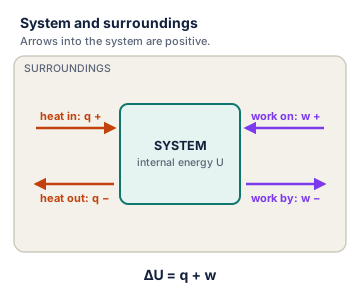
Energy moves between things in only two ways: as heat (), a transfer caused by a temperature difference, or as work (), a transfer caused by a force acting through a distance, such as a gas pushing back a piston.
Key idea
Energy is never created or destroyed, only transferred or changed from one form to another. This is the first law of thermodynamics. For a chemical system:
The change in the system’s internal energy, , equals the heat added to it plus the work done on it.
Why does it matter?
- Every reaction involves energy. Burning fuel, charging a battery and digesting food all convert chemical energy into heat, work or electrical energy.
- It is the foundation of thermochemistry. Enthalpy, Hess’s law and Gibbs free energy are all built on the first law.
- Everyday units. Food labels give energy in kJ and kcal; electricity bills in kWh. Converting between them is the same dimensional analysis you already know.
How does it work?
1. System and surroundings
The system is the part we study (for example, the chemicals in a flask); the surroundings are everything else. Systems can be:
- open: matter and energy can cross the boundary (an open pan of boiling water);
- closed: energy can cross but matter cannot (a sealed flask);
- isolated: neither can cross (an ideal sealed, insulated flask).
2. Heat is not temperature
Temperature measures how hot something is: it reflects the average kinetic energy of its particles. Heat is energy in transit from a hotter object to a colder one. A bath of warm water has a lower temperature than a cup of boiling water, but it holds far more thermal energy, because it contains far more particles. Heat always flows from higher to lower temperature, until both are at the same temperature (thermal equilibrium).
3. Work done by a gas
When a gas expands against a constant external pressure, it pushes the surroundings back and does work on them:
The minus sign means that when the gas expands ( positive) the system loses energy ( negative). When the gas is compressed, is positive. If the volume does not change, no expansion work is done ().
4. Sign convention
Chemistry looks at everything from the system’s point of view:
| Positive (+) | Negative (−) | |
|---|---|---|
| Heat flows into the system | Heat flows out | |
| Work is done on the system | Work is done by the system | |
| Internal energy increases | Internal energy decreases |
Think of it like this
Think of the system’s internal energy as a bank account. Heat and work are the only two kinds of transaction: deposits are positive, withdrawals are negative. The balance () only changes by the sum of the transactions, and money is never printed or destroyed.
More precisely
Internal energy is a state function: depends only on the start and end states, not on the route. Heat and work are not state functions: the same can be reached with different splits of and . Many physics books write the first law as , where is work done by the system; it is the same law with a different sign convention. At constant pressure, the heat transferred equals the enthalpy change, , which is why chemists usually measure (see Enthalpy and Calorimetry).
Visualise it
Worked example
Worked example: Kinetic energy
Question: A 0.145 kg baseball travels at 40.0 m/s. What is its kinetic energy?
Worked example: Converting energy units
Question: A snack bar provides 250 kcal. Express this in kilojoules.
Worked example: Work done by an expanding gas
Question: A gas expands from 2.00 L to 5.00 L against a constant external pressure of 1.50 atm. Calculate the work in joules.
-
Change in volume:
-
Work:
-
The sign is negative: the gas does work on the surroundings and loses 456 J.
Worked example: The first law
Question: While expanding as in the last example, the gas absorbs 1.20 kJ of heat. What is ?
-
Heat flows in, so . From the last example, .
-
First law:
-
The internal energy of the gas increases by 744 J: it gained more energy as heat than it lost as work.
Common mistake
Common mistake: Treating heat and temperature as the same thing
Temperature is a property of an object (in °C or K); heat is energy transferred (in J). A spark at 1000 °C carries very little heat; a warm bath at 40 °C can deliver a lot.
Common mistake: Getting the sign of work wrong
An expanding gas does work on the surroundings, so is negative. Check: the system is spending energy, so its share must go down.
Common mistake: Leaving work in L·atm
in atm × L gives L·atm, not joules. Multiply by 101.325 J/(L·atm) before adding to a heat in joules.
Notation note
- is internal energy (some books use ); is heat; is work.
- The symbol Δ (“change in”) always means final minus initial: .
- A food “Calorie” with a capital C is a kilocalorie: 1 Cal = 1 kcal = 4.184 kJ.
Remember this
Remember this
- Energy: kinetic () or potential (, chemical); unit J; 1 cal = 4.184 J; 1 L·atm = 101.325 J.
- Energy crosses a boundary only as heat (, driven by a temperature difference) or work (, a force through a distance).
- Temperature is not heat: temperature measures average particle energy; heat is energy in transit.
- Gas expansion work: ; no volume change means no expansion work.
- First law: ; positive means energy into the system.
Test yourself
Check your understanding before moving on.
Flashcards
Energy, Heat and Work: Flashcards
- QuestionWhat is energy?Answer
The capacity to do work or to transfer heat. SI unit: the joule, J (1 J = 1 kg m² s⁻²).
- QuestionGive the formulas for kinetic energy and gravitational potential energy.Answer
and
- QuestionHow many joules are in 1 cal, 1 kcal and 1 kWh?Answer
1 cal = 4.184 J; 1 kcal = 4184 J; 1 kWh = 3.6 × 10⁶ J
- QuestionWhat is the difference between heat and temperature?Answer
Temperature reflects the average kinetic energy of the particles; heat is energy transferred because of a temperature difference.
- QuestionOpen, closed or isolated: which systems exchange energy but not matter?Answer
Closed systems.
- QuestionState the first law of thermodynamics as an equation.Answer
: energy is conserved.
- QuestionWhat is the sign of w when a gas expands? And of q when heat leaves the system?Answer
Both negative: the system loses energy.
- QuestionGive the formula for the work done when a gas expands against a constant external pressure.Answer
- QuestionHow many joules are in 1 L·atm?Answer
101.325 J
- QuestionA gas absorbs 1200 J of heat and does 456 J of work. What is ΔU?Answer
ΔU = (+1200 J) + (−456 J) = +744 J
Tip: press Space to flip and ← → to move between cards.
Quiz
Energy, Heat and Work: Quiz
7 questions
Temperature reflects the average particle energy; heat is energy in transit, always from hotter to colder. A large warm bath holds more thermal energy than a small cup of boiling water.
Show answer
Answer: Heat is energy transferred because of a temperature difference
Temperature reflects the average particle energy; heat is energy in transit, always from hotter to colder. A large warm bath holds more thermal energy than a small cup of boiling water.
E = ½mv² = ½ × 1000 kg × (20.0 m/s)² = 2.00 × 10⁵ J = 200. kJ. 400. kJ forgets the ½; 20.0 kJ forgets to square the speed.
Show answer
Answer: 200. kJ
E = ½mv² = ½ × 1000 kg × (20.0 m/s)² = 2.00 × 10⁵ J = 200. kJ. 400. kJ forgets the ½; 20.0 kJ forgets to square the speed.
250 kcal × 4.184 kJ/kcal = 1046 kJ = 1.05 × 10³ kJ. 59.8 kJ comes from dividing instead of multiplying.
Show answer
Answer: 1.05 × 10³ kJ
250 kcal × 4.184 kJ/kcal = 1046 kJ = 1.05 × 10³ kJ. 59.8 kJ comes from dividing instead of multiplying.
A rigid container cannot change volume, so no expansion work is done (ΔV = 0, w = 0). All the heat added raises the internal energy: ΔU = q.
Show answer
Answer: w = 0, so ΔU = q
A rigid container cannot change volume, so no expansion work is done (ΔV = 0, w = 0). All the heat added raises the internal energy: ΔU = q.
w = −PΔV = −3.00 atm × 2.00 L = −6.00 L·atm × 101.325 J/(L·atm) = −608 J. It is negative because the expanding gas does work on the surroundings.
Show answer
Answer: −608 J
w = −PΔV = −3.00 atm × 2.00 L = −6.00 L·atm × 101.325 J/(L·atm) = −608 J. It is negative because the expanding gas does work on the surroundings.
q = −300. J (heat out), w = +150. J (work on the system). ΔU = q + w = −300. J + 150. J = −150. J.
Show answer
Answer: −150. J
q = −300. J (heat out), w = +150. J (work on the system). ΔU = q + w = −300. J + 150. J = −150. J.
A closed system (e.g. a sealed flask) lets energy cross its boundary as heat or work, but not matter. An open system exchanges both; an isolated system exchanges neither.
Show answer
Answer: Closed
A closed system (e.g. a sealed flask) lets energy cross its boundary as heat or work, but not matter. An open system exchanges both; an isolated system exchanges neither.
Notes and downloads
Worksheet
Energy, Heat and Work Worksheet
8 questions on forms and units of energy, heat versus temperature, gas expansion work and the first law of thermodynamics. Answer key included.
References
- Bureau International des Poids et Mesures (BIPM). The International System of Units (SI), 9th ed.; BIPM, 2019. Link
- Brown, T. L.; LeMay, H. E., Jr.; Bursten, B. E.; Murphy, C. J.; Woodward, P. M.; Stoltzfus, M. W. Chemistry: The Central Science, 15th ed.; Pearson, 2022.
Practise this topic with flashcards and a quiz at chemistryclarity.com/chemistry/energy-heat-and-work/
Spotted a mistake? Let us know and we'll fix it.