What is it?
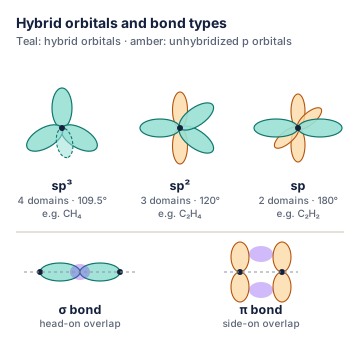
Carbon’s outer electrons are in one 2s and three 2p orbitals, which point in different directions at 90° to each other. Yet the four bonds in methane are identical and point to the corners of a tetrahedron at 109.5°. Hybridization explains this: an atom’s valence orbitals mix to form an equal number of new, identical hybrid orbitals that point where the bonds are.
| Hybridization | Orbitals mixed | Hybrid orbitals | Electron domains | Geometry | Angle |
|---|---|---|---|---|---|
| sp³ | one s + three p | 4 | 4 | Tetrahedral | 109.5° |
| sp² | one s + two p | 3 (+ 1 unhybridized p) | 3 | Trigonal planar | 120° |
| sp | one s + one p | 2 (+ 2 unhybridized p) | 2 | Linear | 180° |
Bonds come in two kinds:
- A sigma (σ) bond forms when orbitals overlap head-on, along the line between the two nuclei. Every single bond is a σ bond.
- A pi (π) bond forms when two parallel p orbitals overlap side-on, above and below the line between the nuclei.
A double bond is one σ + one π; a triple bond is one σ + two π.
Key idea
Count the electron domains (bonded atoms + lone pairs) around an atom, exactly as in VSEPR. 4 domains → sp³, 3 → sp², 2 → sp. The p orbitals that are left over are the ones that form π bonds.
Why does it matter?
- It connects shape to orbitals. VSEPR predicts the shape; hybridization explains which orbitals make it.
- Double bonds don’t rotate. Twisting a π bond would break the side-on overlap, so groups on a C=C are locked in place. This is why cis and trans isomers exist.
- Reactivity. π electrons sit above and below the bond, exposed to attack, which is why alkenes react by addition (see Electrophilic Addition to Alkenes).
How does it work?
1. Finding the hybridization
- Draw the Lewis structure.
- Count electron domains around the atom: each bonded atom counts as one (whether the bond is single, double or triple), and each lone pair counts as one.
- Match: 4 → sp³, 3 → sp², 2 → sp.
2. Three carbon compounds
- Ethane, : each C has 4 domains, so sp³, 109.5°; 7 σ bonds, free rotation about C–C.
- Ethene, : each C has 3 domains, so sp², 120°, planar. The C=C is one σ (sp²–sp²) plus one π (from the leftover p orbitals).
- Ethyne, : each C has 2 domains, so sp, 180°, linear. The C≡C is one σ plus two π bonds at right angles.
3. Atoms with lone pairs
Lone pairs occupy hybrid orbitals too. In , N has 3 bonds + 1 lone pair = 4 domains: sp³ (bond angle squeezed to about 107°). In , O has 2 bonds + 2 lone pairs: sp³ (about 104.5°).
4. Counting σ and π bonds
Single = 1σ. Double = 1σ + 1π. Triple = 1σ + 2π. Count every bond in the full structure, including C–H bonds.
Think of it like this
Mixing orbitals is like mixing paint. One tin of white (s) and three tins of blue (p) make four identical tins of light blue (sp³). The colour is “25 % s, 75 % p”, and all four tins are the same. Mix one white with two blue and you get three tins of sp², with one blue tin left unmixed: that leftover p orbital is ready to make a π bond.
More precisely
Hybridization is a model within valence bond theory; it is a way of describing the bonding, not a step that atoms “do”. Molecular orbital theory is a more complete description that explains, for example, why is magnetic. A π bond is weaker than a σ bond, because side-on overlap is smaller than head-on overlap: the C=C bond (614 kJ/mol) is less than twice as strong as C–C (348 kJ/mol). Atoms with more than four electron domains, such as S in , are better described without d-orbital hybrids, so they are left out here.
Visualise it
Worked example
Worked example: Hybridization of carbon
Question: Give the hybridization of carbon in (a) (b) (methanal) (c) .
- (a) 4 bonded atoms, no lone pairs: 4 domains, sp³.
- (b) 3 bonded atoms (2 H, 1 O): 3 domains, sp², trigonal planar.
- (c) 2 bonded atoms (O=C=O): 2 domains, sp, linear.
Worked example: Counting σ and π bonds
Question: How many σ and π bonds are in ethanoic acid, ?
- Bonds: 3 × C–H, 1 × C–C, 1 × C=O, 1 × C–O, 1 × O–H.
- σ bonds: every bond has one, so 3 + 1 + 1 + 1 + 1 = 7 σ.
- π bonds: only the C=O has one: 1 π.
Worked example: A triple bond
Question: Describe the bonding in hydrogen cyanide, .
- Carbon has 2 domains (H and N): sp, linear, 180°.
- C–H is a σ bond (sp–s). C≡N is 1 σ + 2 π.
- Total: 2 σ and 2 π. Nitrogen also has 2 domains (C and its lone pair), so it is sp too.
Worked example: An atom with lone pairs
Question: What is the hybridization of the oxygen atom in water, and why is the bond angle less than 109.5°?
O has 2 bonds + 2 lone pairs = 4 domains: sp³. The lone pairs repel more strongly than bonding pairs, squeezing the H–O–H angle to about 104.5°.
Common mistake
Common mistake: Counting a double bond as two domains
A double or triple bond counts as one electron domain, because it points in one direction. has two domains on carbon (sp), not four.
Common mistake: Forgetting that every bond has a σ
A double bond is σ + π, not two π bonds. The first bond between two atoms is always σ.
Common mistake: Forgetting lone pairs
Lone pairs count as domains: N in is sp³, not sp², even though it has only three bonds.
Notation note
- sp³ is read “s-p-three”; the superscript counts the p orbitals mixed, not electrons.
- σ is the Greek letter sigma; π is pi.
Remember this
Remember this
- Electron domains = bonded atoms + lone pairs. 4 → sp³ (109.5°), 3 → sp² (120°), 2 → sp (180°).
- σ: head-on overlap, along the bond axis. π: side-on overlap of parallel p orbitals.
- Single = σ; double = σ + π; triple = σ + 2π.
- Leftover (unhybridized) p orbitals make the π bonds.
- π bonds prevent rotation about double bonds.
Test yourself
Check your understanding before moving on.
Flashcards
Hybridization and Sigma and Pi Bonds: Flashcards
- QuestionWhat is hybridization?Answer
The mixing of an atom's valence orbitals to form an equal number of identical hybrid orbitals pointing towards the bonds.
- QuestionWhich hybridization goes with 4, 3 and 2 electron domains?Answer
4 → sp³ (109.5°), 3 → sp² (120°), 2 → sp (180°)
- QuestionHow many hybrid and unhybridized p orbitals does an sp² atom have?Answer
3 sp² hybrids and 1 unhybridized p orbital.
- QuestionWhat is a sigma (σ) bond?Answer
A bond formed by head-on overlap of orbitals along the line between the nuclei. Every single bond is σ.
- QuestionWhat is a pi (π) bond?Answer
A bond formed by side-on overlap of parallel p orbitals, above and below the bond axis.
- QuestionWhat bonds make up a double bond and a triple bond?Answer
Double: 1σ + 1π. Triple: 1σ + 2π.
- QuestionWhat is the hybridization of carbon in ethene and in ethyne?Answer
Ethene: sp². Ethyne: sp.
- QuestionWhat is the hybridization of N in NH₃?Answer
sp³: 3 bonds + 1 lone pair = 4 domains.
- QuestionWhy can't groups rotate freely about a C=C double bond?Answer
Rotation would break the side-on overlap of the π bond.
- QuestionHow many σ and π bonds are in CH₃COOH?Answer
7 σ and 1 π.
Tip: press Space to flip and ← → to move between cards.
Quiz
Hybridization and Sigma and Pi Bonds: Quiz
7 questions
Carbon has 4 bonded atoms and no lone pairs: 4 electron domains, so sp³, tetrahedral, 109.5°.
Show answer
Answer: sp³
Carbon has 4 bonded atoms and no lone pairs: 4 electron domains, so sp³, tetrahedral, 109.5°.
The first bond between two atoms is always σ (head-on); the second is a π bond (side-on overlap of p orbitals).
Show answer
Answer: one σ and one π bond
The first bond between two atoms is always σ (head-on); the second is a π bond (side-on overlap of p orbitals).
Carbon is bonded to two O atoms with no lone pairs: 2 domains (each double bond counts once), so sp and linear.
Show answer
Answer: sp
Carbon is bonded to two O atoms with no lone pairs: 2 domains (each double bond counts once), so sp and linear.
Three sp² hybrids lie in a plane, as far apart as possible: 120° (trigonal planar).
Show answer
Answer: 120°
Three sp² hybrids lie in a plane, as far apart as possible: 120° (trigonal planar).
Two C–H bonds (2 σ) plus the C≡C (1 σ + 2 π): 3 σ and 2 π in total.
Show answer
Answer: 3 σ, 2 π
Two C–H bonds (2 σ) plus the C≡C (1 σ + 2 π): 3 σ and 2 π in total.
O has 2 bonds and 2 lone pairs: 4 domains, so sp³. Lone pairs count as domains.
Show answer
Answer: sp³
O has 2 bonds and 2 lone pairs: 4 domains, so sp³. Lone pairs count as domains.
Both bonds hold two electrons, but side-on overlap is less effective, so the π bond is weaker: C=C (614 kJ/mol) is less than twice C–C (348 kJ/mol).
Show answer
Answer: Side-on overlap of p orbitals is smaller than head-on overlap
Both bonds hold two electrons, but side-on overlap is less effective, so the π bond is weaker: C=C (614 kJ/mol) is less than twice C–C (348 kJ/mol).
Notes and downloads
Worksheet
Hybridization and Sigma and Pi Bonds Worksheet
8 questions on finding hybridization from electron domains, bond angles, and counting sigma and pi bonds. Answer key included.
References
- Brown, T. L.; LeMay, H. E., Jr.; Bursten, B. E.; Murphy, C. J.; Woodward, P. M.; Stoltzfus, M. W. Chemistry: The Central Science, 15th ed.; Pearson, 2022.
Practise this topic with flashcards and a quiz at chemistryclarity.com/chemistry/hybridization-and-sigma-pi-bonds/
Spotted a mistake? Let us know and we'll fix it.