Why alkenes attract electrophiles
A C=C double bond contains a π bond: a cloud of electron density above and below the plane of the molecule. Those electrons are held less tightly than in a single bond, so the double bond behaves as a nucleophile and is attacked by electrophiles: electron-poor species such as .
Key idea
Electrophilic addition has two steps: (1) the π electrons attack the electrophile, forming a carbocation; (2) a nucleophile (such as ) bonds to the carbocation. The more stable carbocation forms faster, and that decides the product.
Step by step: HBr + propene
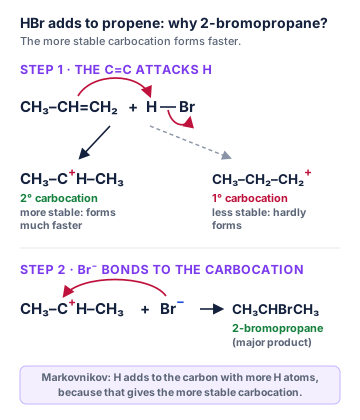
- The π bond attacks the H of H–Br, and the H–Br bond breaks, leaving . The H can add to either end of the double bond, so two carbocations are possible.
- Adding H to the end carbon () puts the positive charge on the middle carbon: a secondary (2°) carbocation. Adding H to the middle carbon gives a primary (1°) carbocation.
- bonds to whichever carbocation formed. Since the 2° carbocation forms much faster, the major product is 2-bromopropane.
Why carbocation stability matters
Carbocation stability: 3° > 2° > 1° > methyl. Alkyl groups stabilize the positive carbon by pushing electron density towards it (an inductive effect) and by hyperconjugation (neighbouring C–H bonds share some electron density with the empty p orbital). A more stable carbocation has a lower-energy transition state leading to it, so it forms faster.
That is the modern explanation of Markovnikov’s rule (1870): in the addition of HX to an unsymmetrical alkene, the hydrogen adds to the carbon that already has more hydrogen atoms.
Worked example: Predicting the major product
Question: Predict the major product of (a) 2-methylpropene + HCl (b) propene + water with an acid catalyst.
- (a) H adds to the end, giving the 3° carbocation ; adds to it: 2-chloro-2-methylpropane, .
- (b) adds to the end carbon, giving the 2° carbocation; water attacks it and loses : propan-2-ol, (the major product).
Bromine: the bromonium ion
has no H, but as it approaches the electron-rich double bond, the Br–Br bond becomes polarized. The near Br is attacked by the π bond, and instead of an open carbocation a three-membered bromonium ion forms. then attacks from the opposite face, so the two bromine atoms end up on opposite sides (anti addition). This reaction is the basis of the bromine-water test: the orange colour disappears as adds across the C=C.
Common mistakes
Common mistake: Putting Br on the carbon with more H
Markovnikov’s rule is about where the H goes. The H goes to the carbon with more H; the Br (or OH, Cl) goes to the other carbon, the more substituted one.
Common mistake: Drawing the arrow from H+ to the double bond
The electrons come from the π bond, so the curved arrow starts at the double bond and points to the H.
More precisely
When a carbocation can become more stable by moving a neighbouring H or group with its electron pair (a rearrangement), it often does, giving unexpected products. In the presence of peroxides, HBr (but not HCl) adds by a radical mechanism and gives the anti-Markovnikov product, 1-bromopropane; this was explained by Kharasch and Mayo in 1933.
Timeline
- 1870Vladimir Markovnikov publishes his rule for the addition of hydrogen halides to unsymmetrical alkenes.
- 1933Morris Kharasch and Frank Mayo explain the "peroxide effect": with peroxides, HBr adds the opposite way (anti-Markovnikov) by a radical mechanism.
- 1937Irving Roberts and George Kimball propose the bridged bromonium ion to explain anti addition of bromine.
Sources and further reading
Explore next
SN1 vs SN2: Choosing the Right Substitution Mechanism
One step or two? How to predict which mechanism a haloalkane follows, and why it matters.
Nucleophilic substitution step by step: curved arrows, rate laws, stereochemistry, and the four factors (substrate, nucleophile, solvent, leaving group) that decide between SN1 and SN2.
Spotted a mistake? Let us know and we'll fix it.