What is it?
Organic chemistry is the chemistry of carbon compounds. Carbon is special because each carbon atom forms four covalent bonds and can bond to other carbon atoms, building chains, branches and rings of almost any size.
The simplest organic compounds are hydrocarbons, which contain only carbon and hydrogen. They form three families:
- Alkanes: only C–C single bonds. General formula . Example: ethane, .
- Alkenes: at least one C=C double bond. General formula . Example: ethene, .
- Alkynes: at least one C≡C triple bond. General formula . Example: ethyne, .
Alkanes are called saturated: each carbon holds as many hydrogen atoms as possible. Alkenes and alkynes are unsaturated.
Key idea
Each family is a homologous series: a set of compounds with the same general formula and similar chemistry, in which each member differs from the next by one unit. The name tells you the number of carbons (the stem) and the family (the ending: -ane, -ene, -yne).
Why does it matter?
- Fuels. Natural gas (methane), bottled gas (propane and butane), petrol (mostly to ) and diesel are hydrocarbons.
- Materials. Ethene and propene are the starting materials for the plastics polyethylene and polypropylene.
- Language. The alkane names are the foundation of every other organic name: ethanol, ethanoic acid and ethyl ethanoate all start from “eth-” (2 carbons).
How does it work?
1. The first ten stems
| Carbons | Stem | Alkane |
|---|---|---|
| 1 | meth- | methane, |
| 2 | eth- | ethane, |
| 3 | prop- | propane, |
| 4 | but- | butane, |
| 5 | pent- | pentane, |
| 6 | hex- | hexane, |
| 7 | hept- | heptane, |
| 8 | oct- | octane, |
| 9 | non- | nonane, |
| 10 | dec- | decane, |
2. Four ways to draw a molecule
Butane can be written as:
- Molecular formula: (atoms only, no structure).
- Structural formula: every atom and every bond drawn out.
- Condensed formula: (each carbon with its hydrogens, in order).
- Skeletal formula: a zigzag line. Each corner and line end is a carbon atom; hydrogen atoms on carbon are not drawn.
Around each carbon in an alkane the four bonds point to the corners of a tetrahedron (109.5°), which is why chains are zigzag, not straight.
3. Naming branched alkanes (IUPAC rules)
- Find the longest continuous carbon chain. It gives the parent name (for example, 5 carbons: pentane). The chain may bend; it does not have to be the one written in a straight line.
- Number the chain from the end that gives the branches the lowest numbers (locants).
- Name each branch (substituent) from its number of carbons with the ending -yl: methyl, ; ethyl, .
- If a substituent appears more than once, use di-, tri-, tetra-, and give a locant for each one.
- List different substituents in alphabetical order (ignore di-, tri-). Use commas between numbers and hyphens between numbers and words: 2,3-dimethylpentane, 3-ethyl-2-methylhexane.
4. Structural isomers
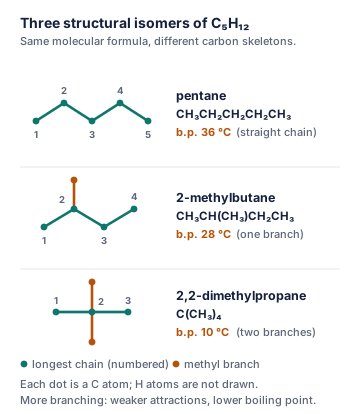
Structural isomers have the same molecular formula but different arrangements of atoms. has two (butane and 2-methylpropane); has three (see the figure); has five. Isomers are different compounds with different properties: more branching makes molecules more compact, so their attractions are weaker and their boiling points lower.
5. Alkenes and alkynes
Name them like alkanes, but the longest chain must contain the multiple bond, and you number it from the end that gives the double or triple bond the lowest locant. Write the locant of the first carbon of the double bond before the ending:
- is but-1-ene; is but-2-ene.
6. Combustion
In plenty of oxygen, hydrocarbons burn completely to carbon dioxide and water, releasing a lot of energy:
With too little oxygen, incomplete combustion also forms carbon monoxide (CO, a toxic gas) and soot (C).
Think of it like this
An IUPAC name is like a postal address. The parent chain is the street (“pentane”), the locants are the house numbers (“2-”), and the substituents are what is at each house (“methyl”). Anyone who reads the address can find exactly one molecule, and every molecule has exactly one correct address.
More precisely
Hydrocarbon chains can also close into rings. Cycloalkanes such as cyclohexane, , have the general formula , the same as alkenes, so a formula alone does not tell you the family. The boiling-point trend comes from London dispersion forces, which grow with the size and surface contact of the molecules: longer chains have higher boiling points, and branched isomers lower ones.
Visualise it
Worked example
Worked example: Naming a branched alkane
Question: Name .
- Longest chain: the five carbons written in a row, so the parent is pentane.
- Number the chain: the methyl groups are on carbons 2 and 4 from either end, so the locants are 2 and 4.
- Two methyl groups: dimethyl.
- Name: 2,4-dimethylpentane (molecular formula , which fits ).
Worked example: Finding the hidden longest chain
Question: A student names as “2-ethylbutane”. Find the correct name.
- Follow the chain through the ethyl group: and of the ethyl branch plus three more carbons give a chain of 5, not 4.
- The parent is therefore pentane, with one branch on carbon 3 (counting from either end).
- Correct name: 3-methylpentane. An ethyl group on carbon 2 is always a sign that the longest chain was missed.
Worked example: Mass of carbon dioxide from burning propane
Question: What mass of forms when 11.0 g of propane burns completely? ( = 44.09 g/mol; = 44.01 g/mol)
- Equation:
- 32.9 g
Common mistake
Common mistake: Not finding the longest chain
The longest chain is often bent on paper. Names such as “2-ethylbutane” or “1-methylbutane” are always wrong: a 2-ethyl or 1-methyl group means the chain could have been longer (3-methylpentane and pentane).
Common mistake: Numbering from the wrong end
is 2-methylpentane, not 4-methylpentane. Number from the end nearer the branch.
Common mistake: Ordering substituents by number instead of alphabet
Substituents are listed alphabetically, and di-, tri- do not count: 3-ethyl-2,3-dimethylpentane, not 2,3-dimethyl-3-ethylpentane (“e” comes before “m”).
Notation note
- Current IUPAC names put the locant just before the ending (but-1-ene); older books write 1-butene. Both mean the same compound.
- In condensed formulas, a group in brackets is a branch on the carbon before it: is 2-methylpropane.
- R stands for “the rest of the molecule”, a carbon chain of any length.
Remember this
Remember this
- Alkanes (single bonds), alkenes (C=C), alkynes (C≡C).
- Stems: meth 1, eth 2, prop 3, but 4, pent 5, hex 6, hept 7, oct 8, non 9, dec 10.
- Naming: longest chain → lowest locants → substituents (-yl) with di-/tri- → alphabetical order.
- Isomers: same molecular formula, different structure; more branching → lower boiling point.
- Complete combustion: hydrocarbon + → + .
Test yourself
Check your understanding before moving on.
Flashcards
Hydrocarbons and Naming Alkanes: Flashcards
- QuestionWhat is a hydrocarbon?Answer
A compound containing only carbon and hydrogen.
- QuestionGeneral formula of the alkanes?Answer
CₙH₂ₙ₊₂ (only C–C single bonds), e.g. propane C₃H₈.
- QuestionGeneral formulas of the alkenes and the alkynes?Answer
Alkenes CₙH₂ₙ (one C=C); alkynes CₙH₂ₙ₋₂ (one C≡C).
- QuestionSaturated or unsaturated: what is the difference?Answer
Saturated (alkanes): only single C–C bonds, maximum H. Unsaturated (alkenes, alkynes): at least one C=C or C≡C.
- QuestionWhat is a homologous series?Answer
A family with the same general formula and similar chemistry, each member differing from the next by CH₂.
- QuestionStems for 1 to 10 carbons?Answer
meth, eth, prop, but, pent, hex, hept, oct, non, dec.
- QuestionThe steps for naming a branched alkane?Answer
Longest chain → number for lowest locants → name branches (methyl, ethyl) with di-/tri- → list alphabetically.
- QuestionWhat are structural isomers?Answer
Compounds with the same molecular formula but different arrangements of atoms, e.g. butane and 2-methylpropane (C₄H₁₀).
- QuestionHow does branching affect the boiling point of isomers?Answer
More branching → more compact molecules → weaker dispersion forces → lower boiling point (pentane 36 °C, 2,2-dimethylpropane 10 °C).
- QuestionProducts of complete and of incomplete combustion of a hydrocarbon?Answer
Complete: CO₂ + H₂O. Incomplete (too little O₂): also CO and soot (C).
Tip: press Space to flip and ← → to move between cards.
Quiz
Hydrocarbons and Naming Alkanes: Quiz
7 questions
Alkanes have only single bonds, so each carbon carries the maximum number of hydrogens: CₙH₂ₙ₊₂ (e.g. C₃H₈). CₙH₂ₙ is the alkenes and CₙH₂ₙ₋₂ the alkynes.
Show answer
Answer: CₙH₂ₙ₊₂
Alkanes have only single bonds, so each carbon carries the maximum number of hydrogens: CₙH₂ₙ₊₂ (e.g. C₃H₈). CₙH₂ₙ is the alkenes and CₙH₂ₙ₋₂ the alkynes.
Hept- means 7 carbons; for an alkane, H = 2(7) + 2 = 16.
Show answer
Answer: C₇H₁₆
Hept- means 7 carbons; for an alkane, H = 2(7) + 2 = 16.
The longest chain has 5 carbons. Numbering from the end nearer the branch puts the methyl on carbon 2, not 4. (Hexane is an isomer, but it is the unbranched chain.)
Show answer
Answer: 2-methylpentane
The longest chain has 5 carbons. Numbering from the end nearer the branch puts the methyl on carbon 2, not 4. (Hexane is an isomer, but it is the unbranched chain.)
Pentane, 2-methylbutane and 2,2-dimethylpropane.
Show answer
Answer: 3
Pentane, 2-methylbutane and 2,2-dimethylpropane.
2-Ethylbutane and 1-methylbutane miss the longest chain (they are 3-methylpentane and pentane). "2-dimethyl" needs two locants: 2,2-dimethylpropane.
Show answer
Answer: 3-methylpentane
2-Ethylbutane and 1-methylbutane miss the longest chain (they are 3-methylpentane and pentane). "2-dimethyl" needs two locants: 2,2-dimethylpropane.
Pentane is the largest unbranched molecule here: it has the most surface contact and the strongest dispersion forces (36 °C). Branching lowers the boiling point, and butane is smaller.
Show answer
Answer: pentane
Pentane is the largest unbranched molecule here: it has the most surface contact and the strongest dispersion forces (36 °C). Branching lowers the boiling point, and butane is smaller.
1 mol C₄H₁₀ × (13 mol O₂ / 2 mol C₄H₁₀) = 6.5 mol O₂.
Show answer
Answer: 6.5 mol
1 mol C₄H₁₀ × (13 mol O₂ / 2 mol C₄H₁₀) = 6.5 mol O₂.
Notes and downloads
Worksheet
Hydrocarbons and Naming Alkanes Worksheet
9 questions on hydrocarbon formulas, IUPAC naming of alkanes and alkenes, structural isomers and combustion calculations. Answer key included.
References
- Brown, T. L.; LeMay, H. E., Jr.; Bursten, B. E.; Murphy, C. J.; Woodward, P. M.; Stoltzfus, M. W. Chemistry: The Central Science, 15th ed.; Pearson, 2022.
Practise this topic with flashcards and a quiz at chemistryclarity.com/chemistry/hydrocarbons-and-alkanes/
Spotted a mistake? Let us know and we'll fix it.