Worksheet
Hybridization and Sigma and Pi Bonds Worksheet
8 questions on finding hybridization from electron domains, bond angles, and counting sigma and pi bonds. Answer key included.
- Type
- Worksheet
- Level
- Intermediate
- Format
- PDF, ready to print
Preview the questions
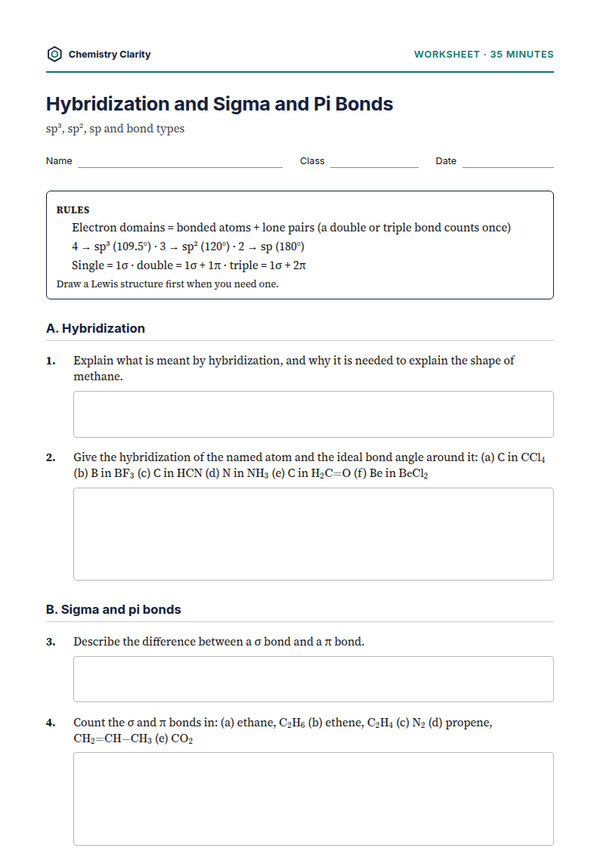
All the questions on this worksheet (about 35 minutes). Download the PDF to print it with space for working; the free answer key has full worked solutions.
A. Hybridization
1.
Explain what is meant by hybridization, and why it is needed to explain the shape of methane.
2.
Give the hybridization of the named atom and the ideal bond angle around it: (a) C in (b) B in (c) C in (d) N in (e) C in (f) Be in
B. Sigma and pi bonds
3.
Describe the difference between a σ bond and a π bond.
4.
Count the σ and π bonds in: (a) ethane, (b) ethene, (c) (d) propene, (e)
C. Carbon in organic molecules
5.
For propyne, , give the hybridization of each carbon atom (from left to right) and the bond angles around it.
6.
Explain why there are two different forms (isomers) of 1,2-dichloroethene, , but only one form of 1,2-dichloroethane, .
D. Lone pairs
7.
Water and carbon dioxide both have a central atom bonded to two others. Explain why the oxygen in water is sp³ but the carbon in CO₂ is sp, and how this affects their shapes.
E. Challenge
8.
Proteins contain the amide group . In methanamide, : (a) give the hybridization of C and O (b) count the σ and π bonds (c) predict the O=C–N bond angle.