What is it?
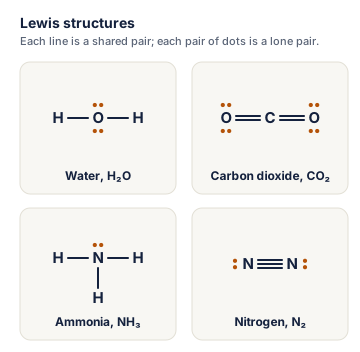
A Lewis structure (or electron-dot structure) shows how the valence electrons are arranged in a molecule or ion:
- a line (or a pair of dots) between two atoms is a shared pair, i.e. a covalent bond;
- pairs of dots on a single atom are lone pairs (non-bonding pairs).
Water, for example, is drawn as H–O–H with two lone pairs on oxygen.
Key idea
Most atoms in a stable Lewis structure have a full outer shell: 8 electrons (an octet) for second-period atoms such as C, N, O and F, but only 2 for hydrogen. Count every bond electron and lone-pair electron around the atom.
Why does it matter?
- It shows bonding at a glance: which atoms are joined, by single, double or triple bonds.
- It is the first step in predicting shape. VSEPR theory uses the bonds and lone pairs around the central atom to predict the 3D shape.
- It helps explain reactivity: lone pairs and partial charges show where a molecule is likely to react.
How does it work?
The step-by-step method
- Count the valence electrons of all atoms. Add one for each negative charge; subtract one for each positive charge.
- Draw the skeleton. The least electronegative atom (never H) usually goes in the centre. Join atoms with single bonds (2 electrons each).
- Complete the octets of the outer atoms with lone pairs (hydrogen needs only its one bond).
- Put any remaining electrons on the central atom as lone pairs.
- If the central atom has fewer than 8 electrons, turn lone pairs on outer atoms into shared pairs to make double or triple bonds.
| Group | 1 | 2 | 13 | 14 | 15 | 16 | 17 | 18 |
|---|---|---|---|---|---|---|---|---|
| Valence electrons | 1 | 2 | 3 | 4 | 5 | 6 | 7 | 8 |
Formal charge
When more than one structure seems possible, formal charge helps choose the best one:
where = valence electrons of the free atom, = electrons in its lone pairs, and = electrons in its bonds.
The best structure has formal charges as close to zero as possible, with any negative formal charge on the more electronegative atom. The formal charges always add up to the overall charge of the species.
Resonance
Sometimes two or more equally good structures differ only in where the double bond is placed. Ozone, , can be drawn as O=O–O or O–O=O. Neither picture is correct on its own: the real molecule is a resonance hybrid, an average of the two, and both O–O bonds are identical, between a single and a double bond in length.
Think of it like this
Building a Lewis structure is like sharing a fixed number of coins (electrons) among people (atoms) so that everyone ends up with eight. If there aren’t enough coins for everyone to have their own, neighbours share more pairs between them: that’s a double or triple bond.
More precisely
The octet rule has exceptions:
- Incomplete octets: boron and beryllium compounds such as (boron has only 6 electrons).
- Odd-electron molecules: has 11 valence electrons, so one atom must have an unpaired electron.
- Expanded octets: elements in period 3 and below can have more than 8 electrons around them, e.g. phosphorus in (10) and sulfur in (12).
Visualise it
Worked example
Worked example: Carbon dioxide, CO₂
- Valence electrons: C 4 + O 2 × 6 = 16
- Skeleton O–C–O uses 4 electrons; 12 remain.
- Give each O three lone pairs (12 electrons). None remain.
- Carbon has only 4 electrons around it. Move one lone pair from each O into a bond.
- Result: O=C=O, two lone pairs on each O. Every atom has an octet; all formal charges are 0.
Worked example: Hydrogen cyanide, HCN
- Valence electrons: H 1 + C 4 + N 5 = 10
- Skeleton H–C–N uses 4; 6 remain. Put 3 lone pairs on N.
- Carbon has only 4 electrons. Move two lone pairs from N into bonds: a triple bond.
- Result: H–C≡N: with one lone pair on N. Formal charges: H 0, C 4 − 0 − 4 = 0, N 5 − 2 − 3 = 0.
Common mistake
Common mistake: Forgetting the ion's charge
For the count is 5 + 4 × 1 − 1 = 8, not 9. For it is 4 + 3 × 6 + 2 = 24.
Common mistake: Putting hydrogen in the centre
Hydrogen forms only one bond, so it is always a terminal (outer) atom.
Common mistake: Drawing resonance as a back-and-forth flip
Resonance structures are not switching between forms. The real molecule is always the single averaged hybrid.
Notation note
- Brackets and a charge, e.g. [ … ]⁻, are drawn around Lewis structures of ions.
- Resonance structures are linked by a double-headed arrow, ↔.
- Lone pairs are sometimes left off simplified structures. In a full Lewis structure, always include them.
Remember this
Remember this
- Count valence electrons (adjust for charge), build a skeleton, complete outer octets, then the centre.
- Not enough electrons for octets? Make double or triple bonds.
- Formal charge = valence − lone-pair electrons − ½ bonding electrons; aim for zeros.
- Exceptions: B and Be (fewer than 8), odd-electron molecules, period 3+ elements (more than 8).
Test yourself
Check your understanding before moving on.
Flashcards
Lewis Structures: Flashcards
- QuestionIn a Lewis structure, what does a line between two atoms represent?Answer
A shared pair of electrons (a single covalent bond).
- QuestionWhat is a lone pair?Answer
A pair of valence electrons on one atom that is not shared in a bond.
- QuestionWhat is the octet rule?Answer
Atoms tend to bond until they have 8 electrons in their outer shell (hydrogen: 2).
- QuestionHow many valence electrons are in ?Answer
4 + 3 × 6 + 2 = 24
- QuestionHow many valence electrons are in ?Answer
5 + 4 × 1 − 1 = 8
- QuestionWhich atom usually goes in the centre of a Lewis structure?Answer
The least electronegative atom, never hydrogen.
- QuestionWhat is the formula for formal charge?Answer
Valence electrons − lone-pair electrons − ½ × bonding electrons
- QuestionWhat is resonance?Answer
When two or more valid Lewis structures differ only in electron placement; the real species is an average (hybrid) of them.
- QuestionDraw the Lewis structure of in words.Answer
N≡N, a triple bond, with one lone pair on each nitrogen (10 valence electrons).
- QuestionGive an example of a molecule with an incomplete octet.Answer
: boron has only 6 electrons around it.
Tip: press Space to flip and ← → to move between cards.
Quiz
Lewis Structures: Quiz
7 questions
2 × 1 (H) + 6 (O) = 8: two bonding pairs and two lone pairs.
Show answer
Answer: 8
2 × 1 (H) + 6 (O) = 8: two bonding pairs and two lone pairs.
8 valence electrons: three N–H bonds use 6, leaving one lone pair on N.
Show answer
Answer: 1
8 valence electrons: three N–H bonds use 6, leaving one lone pair on N.
With 16 electrons, O=C=O gives every atom an octet and all formal charges are zero.
Show answer
Answer: Two C=O double bonds
With 16 electrons, O=C=O gives every atom an octet and all formal charges are zero.
5 (N) + 3 × 6 (O) + 1 for the negative charge = 24.
Show answer
Answer: 24
5 (N) + 3 × 6 (O) + 1 for the negative charge = 24.
Carbon: 4 valence − 0 lone-pair electrons − ½ × 8 bonding electrons = 0.
Show answer
Answer: 0
Carbon: 4 valence − 0 lone-pair electrons − ½ × 8 bonding electrons = 0.
The real molecule is an average of O=O–O and O–O=O, so each bond is between a single and a double bond.
Show answer
Answer: The molecule is a resonance hybrid of two structures
The real molecule is an average of O=O–O and O–O=O, so each bond is between a single and a double bond.
Boron forms three single bonds and has no lone pairs: only 6 electrons around it.
Show answer
Answer:
Boron forms three single bonds and has no lone pairs: only 6 electrons around it.
Notes and downloads
Worksheet
Lewis Structures Worksheet
9 questions on counting valence electrons, drawing Lewis structures, formal charge and resonance. Answer key included.
References
- Brown, T. L.; LeMay, H. E., Jr.; Bursten, B. E.; Murphy, C. J.; Woodward, P. M.; Stoltzfus, M. W. Chemistry: The Central Science, 15th ed.; Pearson, 2022.
Practise this topic with flashcards and a quiz at chemistryclarity.com/chemistry/lewis-structures/
Spotted a mistake? Let us know and we'll fix it.