What is it?
VSEPR stands for valence-shell electron-pair repulsion. It predicts the 3D shape of a molecule from one simple idea: the regions of electrons around a central atom repel each other and spread out to be as far apart as possible.
Each region of electrons around the central atom is called an electron domain. A domain is:
- a lone pair, or
- a bond to another atom: single, double or triple (a multiple bond counts as one domain).
Key idea
Count the electron domains around the central atom to get the electron-domain geometry. Then look only at where the atoms are to name the molecular shape. Lone pairs affect the shape but are not part of its name.
Why does it matter?
- Shape controls properties. Whether a molecule is polar, and so how it dissolves and how high it boils, depends on its shape.
- Shape controls biology. Enzymes, drugs and smell receptors work because molecules have particular shapes that fit together.
- It’s quick. With a Lewis structure, you can predict shapes and bond angles in seconds.
How does it work?
1. Steps
- Draw the Lewis structure.
- Count the electron domains on the central atom (bonds + lone pairs; multiple bonds count once).
- Find the electron-domain geometry from the number of domains.
- Name the molecular shape from the positions of the atoms.
2. The shapes
| Domains | Lone pairs | Molecular shape | Bond angle | Example |
|---|---|---|---|---|
| 2 | 0 | linear | 180° | |
| 3 | 0 | trigonal planar | 120° | |
| 3 | 1 | bent | slightly less than 120° | |
| 4 | 0 | tetrahedral | 109.5° | |
| 4 | 1 | trigonal pyramidal | about 107° | |
| 4 | 2 | bent | about 104.5° | |
| 5 | 0 | trigonal bipyramidal | 90° and 120° | |
| 6 | 0 | octahedral | 90° |
3. Why lone pairs squeeze bond angles
A lone pair is held by only one nucleus, so it sits closer to the central atom, takes up more space and repels more strongly than a bonding pair. The order of repulsion is:
lone pair–lone pair > lone pair–bond pair > bond pair–bond pair
That’s why the angle drops from 109.5° in to about 107° in (one lone pair) and about 104.5° in (two lone pairs).
4. Shape and polarity
A molecule is polar if its bond polarities do not cancel out.
- has two polar C=O bonds, but they point in opposite directions (linear), so they cancel: nonpolar.
- has two polar O–H bonds in a bent shape, so they don’t cancel: polar.
- (tetrahedral, four identical bonds): nonpolar. (one bond different): polar.
Think of it like this
Tie four balloons together at their knots. They automatically point to the corners of a tetrahedron, because each balloon pushes the others away. Two balloons sit in a line; three spread out flat in a triangle.
More precisely
With 5 or 6 domains, lone pairs give further shapes. With 5 domains, lone pairs go in the flat “equator” positions, giving seesaw (, 1 lone pair), T-shaped (, 2) and linear (, 3). With 6 domains, you get square pyramidal (, 1) and square planar (, 2).
Visualise it
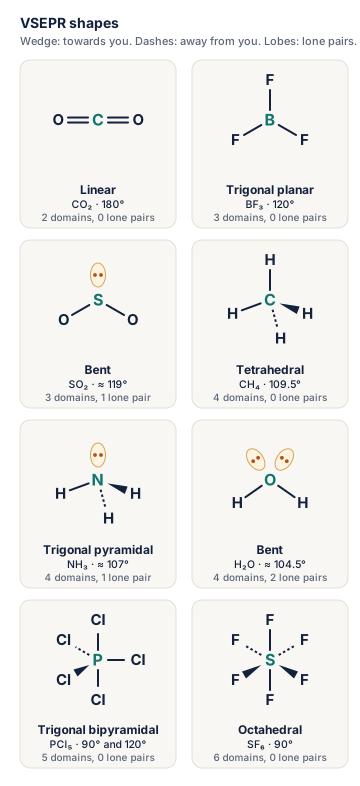
Worked example
Worked example: Ammonia, NH₃
- Lewis structure: N bonded to three H, with one lone pair on N.
- Domains on N: 3 bonds + 1 lone pair = 4, so the electron-domain geometry is tetrahedral.
- Atoms occupy only three corners, so the shape is trigonal pyramidal, with H–N–H about 107°.
- The N–H bond polarities don’t cancel in this shape, so is polar.
Worked example: Formaldehyde, CH₂O
- Lewis structure: C in the centre, single bonds to two H and a double bond to O; no lone pairs on C.
- Domains on C: 3 (the C=O double bond counts once).
- Shape: trigonal planar, angles about 120°.
Common mistake
Common mistake: Counting a double bond as two domains
A double or triple bond points in one direction, so it counts as one electron domain. has 2 domains on carbon, not 4.
Common mistake: Naming the shape from the electron domains
Water has 4 domains (tetrahedral electron geometry) but its molecular shape is bent, because only the atoms are counted when naming the shape.
Common mistake: Assuming polar bonds mean a polar molecule
and have polar bonds but are nonpolar molecules, because their symmetry makes the bond polarities cancel.
Notation note
- In 3D drawings, a solid wedge points towards you and a dashed bond points away; ordinary lines lie in the plane of the page.
- Some books write “AXₘEₙ” notation: A = central atom, X = bonded atoms, E = lone pairs. For example, water is AX₂E₂.
Remember this
Remember this
- Electron domains (bonds + lone pairs, multiple bonds count once) spread out as far as possible.
- 2 linear 180°; 3 trigonal planar 120°; 4 tetrahedral 109.5°; 5 trigonal bipyramidal; 6 octahedral.
- Lone pairs repel more and squeeze bond angles: CH₄ 109.5°, NH₃ about 107°, H₂O about 104.5°.
- Polar molecule = polar bonds that do not cancel by symmetry.
Test yourself
Check your understanding before moving on.
Flashcards
Molecular Shapes (VSEPR): Flashcards
- QuestionWhat does VSEPR stand for?Answer
Valence-shell electron-pair repulsion.
- QuestionWhat counts as one electron domain?Answer
A lone pair, or a bond to another atom. Single, double and triple bonds each count as one domain.
- QuestionShape and bond angle with 4 domains and 0 lone pairs?Answer
Tetrahedral, 109.5° (e.g. )
- QuestionShape of ?Answer
Trigonal pyramidal, about 107° (4 domains, 1 lone pair)
- QuestionShape of ?Answer
Bent, about 104.5° (4 domains, 2 lone pairs)
- QuestionShape and bond angle with 3 domains and 0 lone pairs?Answer
Trigonal planar, 120° (e.g. )
- QuestionWhy do lone pairs make bond angles smaller?Answer
Lone pairs repel more strongly than bonding pairs, pushing the bonds closer together.
- QuestionWhy is nonpolar even though C=O bonds are polar?Answer
It is linear, so the two bond polarities point in opposite directions and cancel.
- QuestionShape of ?Answer
Octahedral, 90° (6 domains, 0 lone pairs)
- QuestionShape of ?Answer
Trigonal bipyramidal, 90° and 120° (5 domains, 0 lone pairs)
Tip: press Space to flip and ← → to move between cards.
Quiz
Molecular Shapes (VSEPR): Quiz
7 questions
4 bonding domains and no lone pairs on carbon spread out to the corners of a tetrahedron, 109.5° apart.
Show answer
Answer: Tetrahedral
4 bonding domains and no lone pairs on carbon spread out to the corners of a tetrahedron, 109.5° apart.
Each C=O double bond counts as one domain, and carbon has no lone pairs: 2 domains, linear.
Show answer
Answer: 2
Each C=O double bond counts as one domain, and carbon has no lone pairs: 2 domains, linear.
4 domains (2 bonds, 2 lone pairs) give tetrahedral electron geometry, but the atoms form a bent shape.
Show answer
Answer: Bent
4 domains (2 bonds, 2 lone pairs) give tetrahedral electron geometry, but the atoms form a bent shape.
N has 3 bonds and 1 lone pair. and have 3 domains and no lone pairs on the central atom (trigonal planar).
Show answer
Answer:
N has 3 bonds and 1 lone pair. and have 3 domains and no lone pairs on the central atom (trigonal planar).
109.5° > about 107° > about 104.5°: each extra lone pair squeezes the angle further.
Show answer
Answer: > >
109.5° > about 107° > about 104.5°: each extra lone pair squeezes the angle further.
The others are symmetrical, so their bond polarities cancel. In one bond (C–H) differs, so they do not cancel.
Show answer
Answer:
The others are symmetrical, so their bond polarities cancel. In one bond (C–H) differs, so they do not cancel.
6 bonding domains and no lone pairs on sulfur point to the corners of an octahedron, 90° apart.
Show answer
Answer: Octahedral
6 bonding domains and no lone pairs on sulfur point to the corners of an octahedron, 90° apart.
Notes and downloads
Worksheet
Molecular Shapes (VSEPR) Worksheet
9 questions on electron domains, molecular shapes, bond angles and polarity. Answer key included.
References
- Brown, T. L.; LeMay, H. E., Jr.; Bursten, B. E.; Murphy, C. J.; Woodward, P. M.; Stoltzfus, M. W. Chemistry: The Central Science, 15th ed.; Pearson, 2022.
Practise this topic with flashcards and a quiz at chemistryclarity.com/chemistry/molecular-shapes/
Spotted a mistake? Let us know and we'll fix it.