What is it?
The bond enthalpy (bond energy) is the energy needed to break one mole of a particular bond in gaseous molecules, forming gaseous atoms. For hydrogen:
- Breaking a bond always needs energy (endothermic, positive).
- Forming a bond always releases the same amount of energy (exothermic, negative).
| Bond | Bond enthalpy (kJ/mol) | Bond | Bond enthalpy (kJ/mol) |
|---|---|---|---|
| H–H | 436 | C–C | 348 |
| Cl–Cl | 242 | C=C | 614 |
| H–Cl | 431 | C≡C | 839 |
| C–H | 413 | O=O | 498 |
| O–H | 463 | C=O (in CO₂) | 799 |
| N–H | 391 | N≡N | 945 |
Except for diatomic molecules such as H–H, these are average values: a C–H bond in methane is not exactly as strong as one in ethanol, so tables give an average over many compounds.
Key idea
A reaction breaks the old bonds and makes new ones. The enthalpy change is the energy taken in to break bonds minus the energy given out when new bonds form:
If the new bonds are stronger than the old ones, more energy is released than taken in, and the reaction is exothermic.
Why does it matter?
- Explaining energy changes. Fuels release energy because the bonds in and are stronger than those in the fuel and oxygen.
- Quick estimates. You can estimate ΔH for a reaction even when no enthalpies of formation are available.
- Bond strength and reactivity. The very strong N≡N bond (945 kJ/mol) explains why nitrogen gas is so unreactive, and why making ammonia needs a catalyst.
How does it work?
1. Bond order, length and strength
The bond order is the number of shared pairs: 1 for single, 2 for double, 3 for triple. As bond order rises, the bond gets shorter and stronger:
| Bond | Order | Length (pm) | Enthalpy (kJ/mol) |
|---|---|---|---|
| C–C | 1 | 154 | 348 |
| C=C | 2 | 134 | 614 |
| C≡C | 3 | 120 | 839 |
A double bond is not twice as strong as a single bond, because the π bond is weaker than the σ bond.
2. Estimating ΔH: the steps
- Draw the structures and list every bond in the reactants and the products, using the coefficients.
- Add up the bond enthalpies of the bonds broken (reactants).
- Add up the bond enthalpies of the bonds formed (products).
- broken − formed.
3. Why it is only an estimate
The answer is approximate because the bond enthalpies are averages, and because they apply to gases: if a reactant or product is a liquid or solid, the energy of changing state is left out. Enthalpies of formation (Hess’s law) give more accurate values.
Think of it like this
Think of bonds as money. Breaking bonds is spending: you pay energy to pull atoms apart. Making bonds is earning: you are paid energy back. If you earn more from the new bonds than you spent on the old ones, you finish with a profit: the reaction gives out energy (exothermic).
More precisely
Bond enthalpies are measured for the gas phase, so the estimate works best when every species is a gas. For a diatomic molecule the bond enthalpy is an exact value (the bond dissociation enthalpy); for bonds in larger molecules it depends on the rest of the molecule. The value for C=O in CO₂ (799 kJ/mol) differs from the average C=O in aldehydes and ketones (about 745 kJ/mol), which is why the table says “in CO₂”. Some tables give 495 kJ/mol for O=O or 941 kJ/mol for N≡N; small differences like these change the estimate by a few kJ/mol.
Visualise it
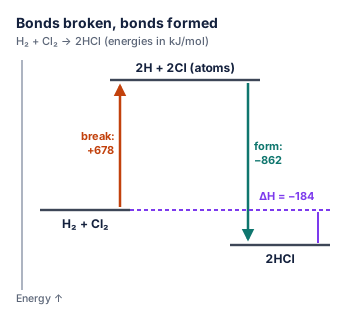
Worked example
Worked example: Hydrogen and chlorine
Question: Estimate ΔH for .
-
Bonds broken: one H–H and one Cl–Cl:
-
Bonds formed: two H–Cl:
-
Enthalpy change:
Exothermic: the H–Cl bonds are stronger in total than the bonds broken.
Worked example: Burning methane
Question: Estimate ΔH for .
-
Broken: 4 C–H and 2 O=O:
-
Formed: 2 C=O (in ) and 4 O–H (in 2 ):
-
Enthalpy change:
This agrees closely with the measured value for gaseous water.
Worked example: Making ammonia
Question: Estimate ΔH for and compare it with the measured value of −92 kJ/mol.
-
Broken: 1 N≡N and 3 H–H:
-
Formed: 2 contain 6 N–H:
-
Enthalpy change:
-
Within about 1 kJ/mol of the measured −92 kJ/mol. The difference comes from using an average N–H value.
Common mistake
Common mistake: Subtracting the wrong way round
It is broken − formed (reactants − products). This is the opposite order to the enthalpy-of-formation formula (products − reactants), because bond enthalpies are energies taken in. Check: forming strong bonds should make ΔH negative.
Common mistake: Forgetting the coefficients or missing bonds
In there are two O=O bonds to break, and two water molecules contain four O–H bonds. Draw every molecule and count every bond.
Common mistake: Using a single-bond value for a double bond
C=O, C=C and N≡N have their own values. Using C–O (358 kJ/mol) for the C=O in CO₂ gives a badly wrong answer.
Notation note
- Bond enthalpy is sometimes written or , e.g. kJ/mol.
- 1 pm (picometre) = m.
Remember this
Remember this
- Bond enthalpy: energy to break 1 mol of a bond in the gas phase (always positive).
- Breaking bonds is endothermic; forming bonds is exothermic.
- .
- Higher bond order: shorter and stronger (C–C 348, C=C 614, C≡C 839 kJ/mol).
- Results are estimates: values are averages and apply to gases.
Test yourself
Check your understanding before moving on.
Flashcards
Bond Enthalpies: Flashcards
- QuestionWhat is bond enthalpy?Answer
The energy needed to break one mole of a bond in gaseous molecules, forming gaseous atoms.
- QuestionIs breaking a bond endothermic or exothermic? And forming one?Answer
Breaking: endothermic (energy in). Forming: exothermic (energy out).
- QuestionGive the formula for estimating ΔH from bond enthalpies.Answer
ΔH ≈ Σ(bonds broken) − Σ(bonds formed)
- QuestionHow do bond length and strength change with bond order?Answer
Higher order: shorter and stronger. C–C 154 pm, 348 kJ/mol; C=C 134 pm, 614 kJ/mol; C≡C 120 pm, 839 kJ/mol.
- QuestionWhy is a C=C bond less than twice as strong as C–C?Answer
The second bond is a π bond, which is weaker than a σ bond.
- QuestionWhy are bond-enthalpy calculations only estimates?Answer
Most values are averages over many compounds, and they apply only to gases.
- QuestionEstimate ΔH for H₂ + Cl₂ → 2HCl (H–H 436, Cl–Cl 242, H–Cl 431 kJ/mol).Answer
(436 + 242) − 2 × 431 = −184 kJ/mol
- QuestionWhy is nitrogen gas so unreactive?Answer
The N≡N triple bond is very strong (945 kJ/mol).
- QuestionWhen is a reaction exothermic, in terms of bonds?Answer
When the bonds formed are stronger in total than the bonds broken.
- QuestionHow many O–H bonds are formed in CH₄ + 2O₂ → CO₂ + 2H₂O?Answer
Four (two in each water molecule).
Tip: press Space to flip and ← → to move between cards.
Quiz
Bond Enthalpies: Quiz
7 questions
Energy must be supplied to pull atoms apart, so bond breaking is endothermic; forming bonds releases the same energy. Bond enthalpies are positive.
Show answer
Answer: Breaking bonds requires energy
Energy must be supplied to pull atoms apart, so bond breaking is endothermic; forming bonds releases the same energy. Bond enthalpies are positive.
Higher bond order means a shorter, stronger bond: C≡C (120 pm, 839 kJ/mol) beats C=C and C–C.
Show answer
Answer: C≡C
Higher bond order means a shorter, stronger bond: C≡C (120 pm, 839 kJ/mol) beats C=C and C–C.
Broken: 436 + 193 = 629 kJ/mol. Formed: 2 × 366 = 732 kJ/mol. ΔH ≈ 629 − 732 = −103 kJ/mol. −263 forgets the factor of 2.
Show answer
Answer: −103 kJ/mol
Broken: 436 + 193 = 629 kJ/mol. Formed: 2 × 366 = 732 kJ/mol. ΔH ≈ 629 − 732 = −103 kJ/mol. −263 forgets the factor of 2.
Broken: 2 × 436 + 498 = 1370 kJ/mol. Formed: 4 O–H = 4 × 463 = 1852 kJ/mol. ΔH ≈ 1370 − 1852 = −482 kJ/mol.
Show answer
Answer: −482 kJ/mol
Broken: 2 × 436 + 498 = 1370 kJ/mol. Formed: 4 O–H = 4 × 463 = 1852 kJ/mol. ΔH ≈ 1370 − 1852 = −482 kJ/mol.
A C–H bond is slightly different in every molecule, so tables give averages; changes of state are also left out.
Show answer
Answer: Most bond enthalpies are averages, and apply to gases only
A C–H bond is slightly different in every molecule, so tables give averages; changes of state are also left out.
−9 = (436 + 151) − 2x, so 2x = 596 and x = 298 kJ/mol. 596 kJ/mol is the energy for two H–I bonds.
Show answer
Answer: 298 kJ/mol
−9 = (436 + 151) − 2x, so 2x = 596 and x = 298 kJ/mol. 596 kJ/mol is the energy for two H–I bonds.
Bonds broken total 2648 kJ/mol; bonds formed total 3450 kJ/mol. More energy is released than absorbed: ΔH ≈ −802 kJ/mol.
Show answer
Answer: The bonds in CO₂ and H₂O are stronger in total than those in CH₄ and O₂
Bonds broken total 2648 kJ/mol; bonds formed total 3450 kJ/mol. More energy is released than absorbed: ΔH ≈ −802 kJ/mol.
Notes and downloads
Worksheet
Bond Enthalpies Worksheet
8 questions on bond enthalpy, bond order and length, estimating ΔH from bonds broken and formed, and finding an unknown bond enthalpy. Answer key included.
References
- Brown, T. L.; LeMay, H. E., Jr.; Bursten, B. E.; Murphy, C. J.; Woodward, P. M.; Stoltzfus, M. W. Chemistry: The Central Science, 15th ed.; Pearson, 2022.
Practise this topic with flashcards and a quiz at chemistryclarity.com/chemistry/bond-enthalpies/
Spotted a mistake? Let us know and we'll fix it.