Worksheet
Energy, Heat and Work Worksheet
8 questions on forms and units of energy, heat versus temperature, gas expansion work and the first law of thermodynamics. Answer key included.
- Type
- Worksheet
- Level
- Beginner
- Format
- PDF, ready to print
Preview the questions
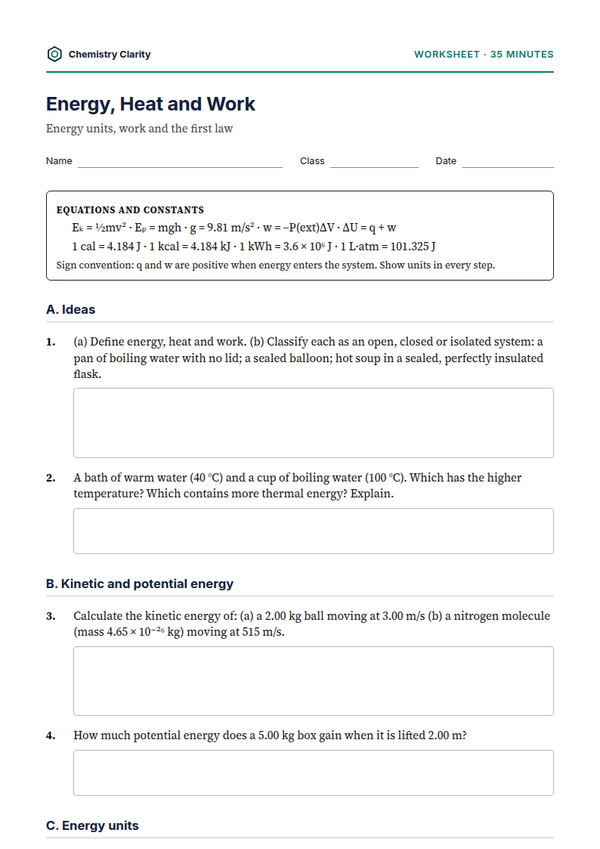
All the questions on this worksheet (about 35 minutes). Download the PDF to print it with space for working; the free answer key has full worked solutions.
A. Ideas
1.
(a) Define energy, heat and work. (b) Classify each as an open, closed or isolated system: a pan of boiling water with no lid; a sealed balloon; hot soup in a sealed, perfectly insulated flask.
2.
A bath of warm water (40 °C) and a cup of boiling water (100 °C). Which has the higher temperature? Which contains more thermal energy? Explain.
B. Kinetic and potential energy
3.
Calculate the kinetic energy of: (a) a 2.00 kg ball moving at 3.00 m/s (b) a nitrogen molecule (mass 4.65 × 10⁻²⁶ kg) moving at 515 m/s.
4.
How much potential energy does a 5.00 kg box gain when it is lifted 2.00 m?
C. Energy units
5.
Convert: (a) 520 kcal to kJ (b) 1200 kJ to kcal (c) 2.5 kWh to J
D. Work and the first law
6.
A gas is compressed from 10.0 L to 4.0 L by a constant external pressure of 2.00 atm. Calculate the work in joules and explain its sign.
7.
Calculate ΔU for each system: (a) loses 300. J of heat while 150. J of work is done on it (b) absorbs 500. J of heat and does 200. J of work (c) a gas in a rigid, sealed container absorbs 75 J of heat.
E. Challenge
8.
A gas in a cylinder with a piston absorbs 2.50 kJ of heat and expands from 1.00 L to 6.00 L against a constant external pressure of 1.00 atm. Calculate (a) the work done, in J (b) ΔU, in kJ. (c) Did the internal energy of the gas increase or decrease?