What is it?
Some reactions happen on their own once started (they are spontaneous); others need a continuous input of energy. Enthalpy alone cannot decide which: ice melts spontaneously at room temperature even though melting is endothermic. A second quantity is needed.
Entropy, , measures how spread out energy and matter are: the number of ways the particles and their energy can be arranged. Gases have high entropy, liquids less, and solids the least.
The second law of thermodynamics: in a spontaneous process, the total entropy of the universe increases.
Chemists combine enthalpy and entropy into the Gibbs free energy change:
where is the temperature in kelvin.
Key idea
At constant temperature and pressure, a reaction is spontaneous when is negative, at equilibrium when , and non-spontaneous (the reverse is spontaneous) when is positive. “Spontaneous” says nothing about speed: diamond turning into graphite is spontaneous, but immeasurably slow.
Why does it matter?
- Predicting reactions. tells chemists whether a reaction can go at all, and at what temperature it becomes possible, before they try it.
- Industry. Lime () is made by heating limestone above about 850 °C, the temperature at which for the decomposition becomes negative.
- Life and batteries. Cells couple reactions with negative (such as using ATP) to drive ones with positive ; a battery’s voltage is a direct measure of ().
How does it work?
1. Predicting the sign of ΔS
Entropy increases ( positive) when:
- a solid melts or a liquid boils (solid → liquid → gas);
- the number of moles of gas increases, for example ;
- a solid dissolves to form ions in solution (usually);
- the temperature rises.
Entropy decreases when gas molecules combine into fewer molecules, for example (4 mol of gas → 2 mol).
2. Calculating ΔS°
Unlike enthalpies of formation, absolute standard entropies, , can be measured for every substance, including elements (they are not zero). Then:
values are in J mol⁻¹ K⁻¹, so comes out in J/K. Convert it to kJ/K before combining it with in kJ.
3. The four cases
| ΔH | ΔS | ΔG = ΔH − TΔS | Spontaneous? |
|---|---|---|---|
| − | + | always negative | at all temperatures |
| + | − | always positive | never (the reverse is) |
| − | − | negative when T is low | at low temperature |
| + | + | negative when T is high | at high temperature |
In the last two cases, the reaction switches at the temperature where :
4. ΔG° and the equilibrium constant
The standard free energy change is linked to the equilibrium constant:
with = 8.314 J mol⁻¹ K⁻¹. A large negative means a large (products favoured); a positive means is less than 1.
Think of it like this
Think of a tidy bedroom. Left alone, it gets messier, because there are far more messy arrangements than tidy ones: that is entropy. Tidying it needs energy (an enthalpy cost). Whether the room ends up tidy depends on both: how much energy you put in, and how strongly “messiness” wins. Temperature sets how much weight entropy gets in the balance.
More precisely
is the maximum useful (non-expansion) work a process can do at constant temperature and pressure. The relation comes from the total entropy change: , so , and a negative is the same as an increase in the entropy of the universe. Using and at 298 K for other temperatures is an approximation, because both change a little with temperature.
Visualise it
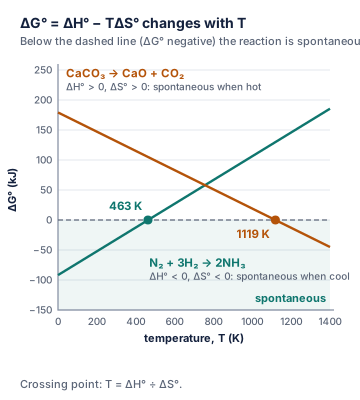
Worked example
Worked example: ΔS°, ΔG° and the switching temperature for ammonia synthesis
Question: For , = −91.8 kJ. Using (J mol⁻¹ K⁻¹): 191.6, 130.7, 192.8, find , at 298.15 K, and the temperature above which the reaction is no longer spontaneous.
-
(negative: 4 mol of gas become 2)
-
:
-
Spontaneous at 298 K. Switching temperature: 463 K. Above this, is positive.
Worked example: Why limestone must be heated
Question: For , find , and at 298.15 K, and the minimum temperature for decomposition. (Data in the note above.)
- +131.4 kJ: not spontaneous at room temperature.
- 1119 K (about 846 °C). Lime kilns run hotter than this.
Worked example: From ΔG° to K
Question: Estimate at 298.15 K for ammonia synthesis ( = −32.7 kJ = −3.27 × 10⁴ J).
- 5 × 10⁵: products are strongly favoured at 298 K (even though the reaction is too slow without a catalyst).
Common mistake
Common mistake: Mixing J and kJ
is usually in J/K but in kJ. Convert to kJ/K (divide by 1000) before calculating , or the entropy term will be 1000 times too large.
Common mistake: Using °C in ΔG = ΔH − TΔS
must be in kelvin. At 25 °C, use 298.15 K; using 25 would make the entropy term about twelve times too small.
Common mistake: Thinking spontaneous means fast
A negative says a reaction can happen, not how fast. Speed is kinetics (activation energy); a mixture of hydrogen and oxygen is spontaneous but does nothing until a spark starts it.
Notation note
- The degree sign (°) means standard conditions: 1 bar and, unless stated, 298.15 K.
- Entropy units: J mol⁻¹ K⁻¹ for , J/K for of a reaction as written.
- Some books use “feasible” or “thermodynamically favourable” instead of “spontaneous”.
Remember this
Remember this
- Entropy: gases high, solids low; ΔS is positive when moles of gas increase.
- , in J/K; convert to kJ/K.
- (T in K). Negative ΔG: spontaneous. Switching temperature .
- and .
Test yourself
Check your understanding before moving on.
Flashcards
Entropy and Gibbs Free Energy: Flashcards
- QuestionWhat is entropy?Answer
A measure of how spread out energy and matter are (the number of possible arrangements). Unit of S°: J mol⁻¹ K⁻¹.
- QuestionState the second law of thermodynamics.Answer
In a spontaneous process, the total entropy of the universe increases.
- QuestionWhen is ΔS of a reaction positive?Answer
When moles of gas increase, a solid melts or a liquid boils, or (usually) a solid dissolves.
- QuestionGibbs free energy equation?Answer
ΔG = ΔH − TΔS, with T in kelvin and ΔS converted to kJ/K.
- QuestionWhat does the sign of ΔG tell you?Answer
Negative: spontaneous. Zero: at equilibrium. Positive: not spontaneous (the reverse is).
- QuestionΔH negative and ΔS positive?Answer
ΔG is negative at all temperatures: always spontaneous.
- QuestionΔH positive and ΔS positive?Answer
Spontaneous only at high temperature, above T = ΔH ÷ ΔS (e.g. CaCO₃ → CaO + CO₂).
- QuestionΔH negative and ΔS negative?Answer
Spontaneous only at low temperature, below T = ΔH ÷ ΔS (e.g. N₂ + 3H₂ → 2NH₃).
- QuestionHow is ΔG° related to K?Answer
ΔG° = −RT ln K (R = 8.314 J mol⁻¹ K⁻¹). Negative ΔG° means K greater than 1.
- QuestionDoes a negative ΔG mean a reaction is fast?Answer
No. It means the reaction can happen; its speed depends on the activation energy.
Tip: press Space to flip and ← → to move between cards.
Quiz
Entropy and Gibbs Free Energy: Quiz
7 questions
3 mol of gas become 2 mol, so the entropy decreases. The others increase disorder or the moles of gas.
Show answer
Answer: 2SO₂(g) + O₂(g) → 2SO₃(g)
3 mol of gas become 2 mol, so the entropy decreases. The others increase disorder or the moles of gas.
T = ΔH ÷ ΔS = 50.0 kJ ÷ 0.200 kJ/K = 250. K. Above this, TΔS outweighs ΔH.
Show answer
Answer: 250. K
T = ΔH ÷ ΔS = 50.0 kJ ÷ 0.200 kJ/K = 250. K. Above this, TΔS outweighs ΔH.
ΔG = ΔH − TΔS = (negative) − (positive) is negative for every T.
Show answer
Answer: at all temperatures
ΔG = ΔH − TΔS = (negative) − (positive) is negative for every T.
ΔS = −0.200 kJ/K; ΔG = −100. kJ − (300. K)(−0.200 kJ/K) = −100. kJ + 60.0 kJ = −40.0 kJ. Forgetting to convert J to kJ gives the large wrong answer.
Show answer
Answer: −40.0 kJ
ΔS = −0.200 kJ/K; ΔG = −100. kJ − (300. K)(−0.200 kJ/K) = −100. kJ + 60.0 kJ = −40.0 kJ. Forgetting to convert J to kJ gives the large wrong answer.
ΔG° = −RT ln K: positive ΔG° means ln K is negative, so K is less than 1 (reactants favoured).
Show answer
Answer: less than 1
ΔG° = −RT ln K: positive ΔG° means ln K is negative, so K is less than 1 (reactants favoured).
For CaCO₃ → CaO + CO₂, ΔH = +179.2 kJ and ΔS = +160.2 J/K, so ΔG becomes negative above about 1119 K.
Show answer
Answer: ΔH and ΔS are both positive, so ΔG is only negative at high T
For CaCO₃ → CaO + CO₂, ΔH = +179.2 kJ and ΔS = +160.2 J/K, so ΔG becomes negative above about 1119 K.
That is the second law. Spontaneous reactions can be slow and can be endothermic (e.g. ice melting at 25 °C).
Show answer
Answer: it increases the total entropy of the universe
That is the second law. Spontaneous reactions can be slow and can be endothermic (e.g. ice melting at 25 °C).
Notes and downloads
Worksheet
Entropy and Gibbs Free Energy Worksheet
9 questions on predicting ΔS, calculating ΔS° and ΔG°, switching temperatures, ΔG° and K, and the link to cell voltage. Answer key included.
References
- Brown, T. L.; LeMay, H. E., Jr.; Bursten, B. E.; Murphy, C. J.; Woodward, P. M.; Stoltzfus, M. W. Chemistry: The Central Science, 15th ed.; Pearson, 2022.
Practise this topic with flashcards and a quiz at chemistryclarity.com/chemistry/gibbs-free-energy/
Spotted a mistake? Let us know and we'll fix it.