What is it?
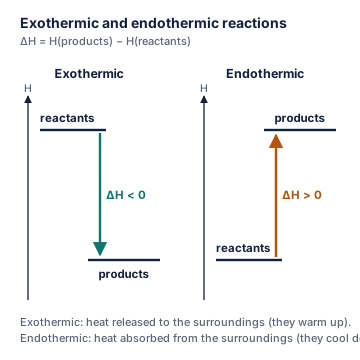
Chemical reactions almost always release or absorb heat. The heat change of a reaction at constant pressure is its enthalpy change, , usually given in kJ/mol.
- Exothermic reaction: heat is released to the surroundings, which warm up. is negative. Examples: combustion, neutralization, respiration.
- Endothermic reaction: heat is absorbed from the surroundings, which cool down. is positive. Examples: dissolving ammonium nitrate (instant cold packs), photosynthesis, thermal decomposition.
Key idea
. Negative: exothermic (heat out). Positive: endothermic (heat in). The sign is always from the point of view of the reaction (the system).
Why does it matter?
- Energy. Fuels are compared by the heat their combustion releases per gram or per mole.
- Food. The energy content of food (in kJ or kcal) is measured by burning it in a calorimeter.
- Safety and design. Chemists must know how much heat a reaction gives out to cool it safely, or how much to supply to keep it going.
How does it work?
1. Thermochemical equations
A thermochemical equation gives for the amounts in the balanced equation:
- Doubling the equation doubles .
- Reversing the equation changes the sign of .
- States matter: forming instead of releases less heat.
2. Specific heat capacity and q = mcΔT
The specific heat capacity, , is the heat needed to raise the temperature of 1 g of a substance by 1 °C (or 1 K). For water, J/(g·°C). The heat gained or lost is:
where is the mass in g and . A change of 1 °C equals a change of 1 K, so is the same on both scales.
3. Calorimetry
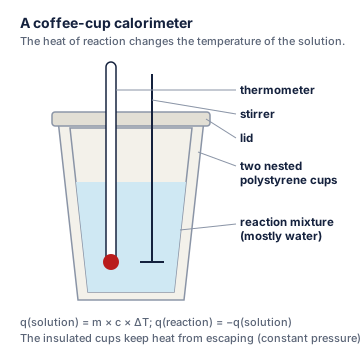
A calorimeter measures heat changes. In a simple coffee-cup calorimeter, a reaction happens in water inside insulated cups:
- Measure the temperature change of the solution.
- Calculate (assume the solution behaves like water: density 1.00 g/mL, = 4.184 J/(g·°C)).
- The reaction’s heat is the opposite: (heat lost by one is gained by the other).
- Divide by the moles that reacted: .
Think of it like this
Think of the reaction as a heater placed in a bath. You can’t see the heat directly, but the bath’s thermometer tells you: if the water warms, the “heater” gave heat out (exothermic); if the water cools, the reaction took heat in (endothermic).
More precisely
Enthalpy, , is defined as ; at constant pressure, the heat transferred equals . Coffee-cup calorimeters work at constant (atmospheric) pressure, so they measure directly. A bomb calorimeter works at constant volume, measures , and is used for combustion. Simple calorimeters lose some heat to the surroundings and the cups, so measured values are usually slightly smaller in size than accepted ones.
Visualise it
Worked example
Worked example: Heating water
Question: How much heat is needed to warm 250. g of water from 20.0 °C to 80.0 °C?
-
-
Substitute:
-
The units of g and °C cancel, leaving J.
Worked example: Enthalpy of neutralization
Question: 50.0 mL of 1.00 M HCl and 50.0 mL of 1.00 M NaOH, both at 21.0 °C, are mixed in a coffee-cup calorimeter. The temperature rises to 27.8 °C. Calculate ΔH per mole of water formed.
-
Mass of solution: 100.0 mL × 1.00 g/mL = 100. g;
-
Heat gained by the solution:
-
J (the reaction released this heat).
-
Moles of water formed: mol
-
Divide:
-
ΔT (6.8 °C) has 2 significant figures, so the answer has 2. It is negative: the reaction is exothermic.
Common mistake
Common mistake: Getting the sign wrong
If the solution warms up, the reaction gave out heat: and are negative, even though is positive.
Common mistake: Using only the mass of the solid
In , is the mass of the solution that changes temperature (mostly water), not the mass of the substance that reacted.
Common mistake: Forgetting to divide by moles
is the heat for this experiment (in J). is per mole (kJ/mol), so divide by the moles that reacted and convert J to kJ.
Notation note
- (with a degree sign) is a standard enthalpy change: 1 bar and a stated temperature, usually 25 °C.
- Units: c in J/(g·°C) = J/(g·K) = J g⁻¹ K⁻¹; ΔH in kJ/mol = kJ mol⁻¹.
- Some textbooks write as , with for specific heat.
Remember this
Remember this
- Exothermic: heat released, ΔH negative. Endothermic: heat absorbed, ΔH positive.
- ; for water J/(g·°C); ΔT in °C equals ΔT in K.
- Calorimetry: ; , in kJ/mol.
- Doubling an equation doubles ΔH; reversing it changes the sign.
Test yourself
Check your understanding before moving on.
Flashcards
Enthalpy and Calorimetry: Flashcards
- QuestionWhat is an exothermic reaction?Answer
A reaction that releases heat to the surroundings; ΔH is negative.
- QuestionWhat is an endothermic reaction?Answer
A reaction that absorbs heat from the surroundings; ΔH is positive.
- QuestionDefine ΔH.Answer
The enthalpy change: the heat change at constant pressure, ΔH = H(products) − H(reactants).
- QuestionWrite the equation for the heat gained or lost by a substance.Answer
- QuestionWhat is the specific heat capacity of water?Answer
4.184 J/(g·°C), the same as 4.184 J/(g·K)
- QuestionHeat needed to warm 250. g of water by 60.0 °C?Answer
(250. g)(4.184 J/(g·°C))(60.0 °C) = 6.28 × 10⁴ J = 62.8 kJ
- QuestionIn calorimetry, how is q(reaction) related to q(solution)?Answer
q(reaction) = −q(solution): heat lost by one is gained by the other.
- QuestionThe solution in a calorimeter warms up. Is the reaction exothermic or endothermic?Answer
Exothermic (ΔH negative): the reaction released heat to the solution.
- QuestionCH₄ + 2O₂ → CO₂ + 2H₂O has ΔH = −890.5 kJ. What is ΔH for the reverse reaction?Answer
+890.5 kJ (reversing changes the sign)
- QuestionWhy is ΔT the same in °C and in K?Answer
A degree Celsius and a kelvin are the same size; only the zero points differ.
Tip: press Space to flip and ← → to move between cards.
Quiz
Enthalpy and Calorimetry: Quiz
7 questions
The cold pack absorbs heat from its surroundings, so it feels cold: ΔH is positive. The others release heat.
Show answer
Answer: Dissolving ammonium nitrate in water (a cold pack)
The cold pack absorbs heat from its surroundings, so it feels cold: ΔH is positive. The others release heat.
Heat flows out of the reaction into the surroundings, so the products are lower in enthalpy: ΔH is negative.
Show answer
Answer: ΔH < 0 and the surroundings warm up
Heat flows out of the reaction into the surroundings, so the products are lower in enthalpy: ΔH is negative.
q = (40.0 g)(0.385 J/(g·°C))(50.0 °C) = 770. J. The answer 8.37 × 10³ J uses the specific heat of water.
Show answer
Answer: 770. J
q = (40.0 g)(0.385 J/(g·°C))(50.0 °C) = 770. J. The answer 8.37 × 10³ J uses the specific heat of water.
q(solution) = (100. g)(4.184 J/(g·°C))(6.8 °C) = 2845 J = +2.8 kJ, so q(reaction) = −2.8 kJ: the reaction released the heat.
Show answer
Answer: −2.8 kJ
q(solution) = (100. g)(4.184 J/(g·°C))(6.8 °C) = 2845 J = +2.8 kJ, so q(reaction) = −2.8 kJ: the reaction released the heat.
Doubling the equation doubles ΔH: 2 × (−890.5 kJ) = −1781.0 kJ.
Show answer
Answer: −1781.0 kJ
Doubling the equation doubles ΔH: 2 × (−890.5 kJ) = −1781.0 kJ.
Heat that escapes is not counted in q = mcΔT, so the measured heat change is a little too small.
Show answer
Answer: Some heat is lost to the surroundings and the cups
Heat that escapes is not counted in q = mcΔT, so the measured heat change is a little too small.
ΔH = −2.85 kJ ÷ 0.0500 mol = −57.0 kJ/mol. It is negative because heat was released.
Show answer
Answer: −57.0 kJ/mol
ΔH = −2.85 kJ ÷ 0.0500 mol = −57.0 kJ/mol. It is negative because heat was released.
Notes and downloads
Worksheet
Enthalpy and Calorimetry Worksheet
9 questions on exothermic and endothermic reactions, q = mcΔT, calorimetry and heat transfer. Answer key included.
References
- Brown, T. L.; LeMay, H. E., Jr.; Bursten, B. E.; Murphy, C. J.; Woodward, P. M.; Stoltzfus, M. W. Chemistry: The Central Science, 15th ed.; Pearson, 2022.
Practise this topic with flashcards and a quiz at chemistryclarity.com/chemistry/enthalpy/
Spotted a mistake? Let us know and we'll fix it.