What is it?
Temperature measures how hot or cold something is: in particle terms, how fast its particles are moving on average. Three scales are in common use:
- Celsius (°C): used in most of the world and in the laboratory. Water freezes at 0 °C and boils at 100 °C (at 1 atm).
- Fahrenheit (°F): used for everyday temperatures in the United States. Water freezes at 32 °F and boils at 212 °F.
- Kelvin (K): the SI unit of temperature, used in chemistry and physics calculations. It starts at absolute zero (0 K), the lowest possible temperature.
| °C | °F | K | |
|---|---|---|---|
| Absolute zero | −273.15 | −459.67 | 0 |
| Celsius equals Fahrenheit | −40 | −40 | 233.15 |
| Water freezes | 0 | 32 | 273.15 |
| Body temperature (about) | 37 | 98.6 | 310.15 |
| Water boils (1 atm) | 100 | 212 | 373.15 |
Key idea
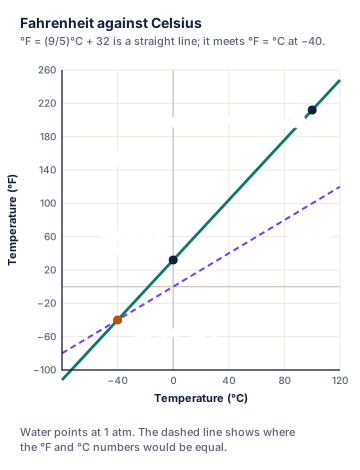
The Celsius and Fahrenheit scales give the same number at −40: −40 °C = −40 °F.
Why does it matter?
- Chemistry needs kelvin. The gas laws, reaction rates and thermodynamics all use absolute temperature. Using °C in the gas laws gives wrong answers.
- Data comes in different units. Recipes, weather reports and older US data often use °F, so you need to convert reliably.
- Checking answers. Knowing a few reference points (0 °C = 32 °F, 100 °C = 212 °F) lets you spot a wrong conversion at once.
How does it work?
1. Why the factor 9/5 and the 32?
Between freezing and boiling water there are 100 Celsius degrees (0 to 100) but 180 Fahrenheit degrees (32 to 212). So one Celsius degree is larger:
The +32 is there because the Fahrenheit scale puts the freezing point of water at 32, not 0.
2. Celsius to Fahrenheit
Multiply by 9/5 (1.8), then add 32:
3. Fahrenheit to Celsius
Do the reverse, in reverse order: subtract 32 first, then multiply by 5/9:
4. Kelvin
A kelvin is the same size as a Celsius degree; the scale is just shifted so that zero is absolute zero:
To go between °F and K, go through °C.
5. Where Celsius and Fahrenheit meet
Is there a temperature with the same number on both scales? Call that number and put it into the conversion formula for both and :
So −40 °C = −40 °F. On the graph below, this is where the conversion line crosses the line “°F = °C”. Above −40, the Fahrenheit number is always larger; below −40, the Celsius number is larger.
6. Temperature changes
A temperature change has no offset (the 32 and 273.15 cancel out):
- a change of 1 °C = a change of 1 K = a change of 1.8 °F
- e.g. warming by 10 °C is warming by 10 K, or by 18 °F
Think of it like this
Think of two rulers, one marked in centimetres and one in inches, but with their zeros at different places. To convert, you must allow for both the different size of the marks (the 9/5) and the different starting points (the 32). The kelvin “ruler” has marks the same size as Celsius, but its zero starts 273.15 marks lower.
More precisely
Since 2019 the kelvin has been defined by fixing the value of the Boltzmann constant; the Celsius scale is defined from it by , so 273.15 is exact. Under this definition, water at 1 atm freezes at almost exactly 0 °C and boils at about 99.97 °C, not exactly 100 °C. For school chemistry, 0 °C and 100 °C are used.
Visualise it
Worked example
Worked example: Celsius to Fahrenheit
Question: Room temperature is 25 °C. What is this in °F?
-
Multiply by 9/5, then add 32:
-
The units of °C cancel, leaving °F. Room temperature is .
Worked example: Fahrenheit to Celsius
Question: A normal body temperature is 98.6 °F. What is this in °C?
-
Subtract 32 first, then multiply by 5/9:
-
The units of °F cancel, leaving °C. Body temperature is .
Worked example: Fahrenheit to kelvin
Question: A lab is at 68 °F. What is this in kelvin?
-
Convert to °C first:
-
Then convert to kelvin:
-
The lab is at (293.15 K).
Common mistake
Common mistake: Adding 32 before multiplying
For °C to °F, multiply first, then add 32 °F. For 25 °C: (9 °F/5 °C)(25 °C) + 32 °F = 77 °F. Adding first would give (9/5)(25 + 32) = 102.6, which is wrong (and mixes °C with °F).
Common mistake: Forgetting to subtract 32 first
For °F to °C, subtract 32 °F before multiplying by 5/9. For 98.6 °F: (5 °C/9 °F)(98.6 °F − 32 °F) = 37.0 °C. Multiplying first would give (5/9)(98.6) − 32 = 22.8, which is wrong.
Common mistake: Writing °K
Kelvin temperatures have no degree sign: write 298 K, not 298 °K. Also, kelvin temperatures are never negative.
Common mistake: Converting a temperature change like a temperature
A rise of 10 °C is a rise of (1.8 °F/°C)(10 °C) = 18 °F, not 50 °F. Use only the factor 1.8 °F/°C for changes; don’t add 32 °F.
Notation note
- , and are the same temperature expressed on different scales.
- Some books write ; 1.8 and 9/5 are the same number.
- The unit is “kelvin” (lower-case k), with the symbol K: “300 kelvin”, not “300 degrees Kelvin”.
Remember this
Remember this
- °C → °F: multiply by 9/5, then add 32. °F → °C: subtract 32, then multiply by 5/9.
- K = °C + 273.15; no degree sign on K; kelvin is never negative.
- −40 °C = −40 °F: the only temperature where the two numbers agree.
- Checkpoints: 0 °C = 32 °F = 273.15 K; 100 °C = 212 °F = 373.15 K.
Test yourself
Check your understanding before moving on.
Flashcards
Temperature Scales: Flashcards
- QuestionHow do you convert °C to °F?Answer
Multiply by 9/5 (1.8), then add 32:
- QuestionHow do you convert °F to °C?Answer
Subtract 32, then multiply by 5/9:
- QuestionHow do you convert °C to K?Answer
Add 273.15:
- QuestionAt what temperature are the Celsius and Fahrenheit readings equal?Answer
−40: −40 °C = −40 °F
- QuestionWhat are the freezing and boiling points of water (1 atm) in °C, °F and K?Answer
Freezing: 0 °C = 32 °F = 273.15 K. Boiling: 100 °C = 212 °F = 373.15 K.
- QuestionWhat is absolute zero in K, °C and °F?Answer
0 K = −273.15 °C = −459.67 °F
- QuestionConvert 25 °C to °F.Answer
(9 °F/5 °C)(25 °C) + 32 °F = 77 °F
- QuestionWhy is the factor 9/5?Answer
Between freezing and boiling water there are 180 °F but only 100 °C: 180/100 = 9/5.
- QuestionA temperature rises by 10 °C. What is the rise in K and in °F?Answer
10 K and 18 °F (no offset for changes).
- QuestionIs it correct to write 300 °K?Answer
No. Kelvin has no degree sign: write 300 K.
Tip: press Space to flip and ← → to move between cards.
Quiz
Temperature Scales: Quiz
7 questions
(9 °F/5 °C)(100 °C) + 32 °F = 180 °F + 32 °F = 212 °F, the boiling point of water at 1 atm.
Show answer
Answer: 212 °F
(9 °F/5 °C)(100 °C) + 32 °F = 180 °F + 32 °F = 212 °F, the boiling point of water at 1 atm.
(5 °C/9 °F)(50 °F − 32 °F) = (5 °C/9 °F)(18 °F) = 10.0 °C. Multiplying by 5/9 before subtracting 32 gives the wrong value −4.2.
Show answer
Answer: 10.0 °C
(5 °C/9 °F)(50 °F − 32 °F) = (5 °C/9 °F)(18 °F) = 10.0 °C. Multiplying by 5/9 before subtracting 32 gives the wrong value −4.2.
Setting x = (9/5)x + 32 gives −(4/5)x = 32, so x = −40. Check: (9 °F/5 °C)(−40 °C) + 32 °F = −72 °F + 32 °F = −40 °F.
Show answer
Answer: −40
Setting x = (9/5)x + 32 gives −(4/5)x = 32, so x = −40. Check: (9 °F/5 °C)(−40 °C) + 32 °F = −72 °F + 32 °F = −40 °F.
25 °C + 273.15 = 298.15 K.
Show answer
Answer: 298.15 K
25 °C + 273.15 = 298.15 K.
77 K − 273.15 = −196.15 °C (about −196 °C).
Show answer
Answer: −196.15 °C
77 K − 273.15 = −196.15 °C (about −196 °C).
For a change, use only the size factor: (1.8 °F/°C)(20 °C) = 36 °F. The 32 is not added, because it cancels when you subtract two temperatures.
Show answer
Answer: 36 °F
For a change, use only the size factor: (1.8 °F/°C)(20 °C) = 36 °F. The 32 is not added, because it cancels when you subtract two temperatures.
A kelvin is the same size as a Celsius degree, is written without a degree sign, and water freezes at 273.15 K.
Show answer
Answer: It starts at absolute zero, so it has no negative values
A kelvin is the same size as a Celsius degree, is written without a degree sign, and water freezes at 273.15 K.
Notes and downloads
Worksheet
Temperature Scales Worksheet
9 questions on converting between °C, °F and K, temperature changes, and where the scales meet. Answer key included.
References
- Bureau International des Poids et Mesures (BIPM). The International System of Units (SI), 9th ed.; BIPM, 2019. Link
- Brown, T. L.; LeMay, H. E., Jr.; Bursten, B. E.; Murphy, C. J.; Woodward, P. M.; Stoltzfus, M. W. Chemistry: The Central Science, 15th ed.; Pearson, 2022.
Practise this topic with flashcards and a quiz at chemistryclarity.com/chemistry/temperature-scales/
Spotted a mistake? Let us know and we'll fix it.