What is it?
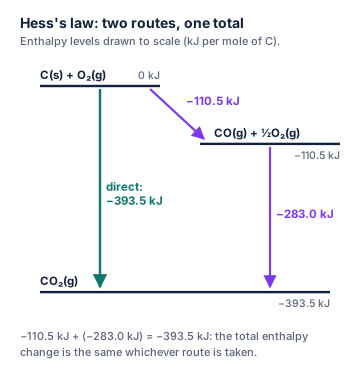
Hess’s law: the enthalpy change of a reaction is the same whatever route is taken from the reactants to the products. Enthalpy is a state function: it depends only on the start and end, not on the path.
This means you can find for a reaction that is hard to measure directly by adding up the values of other reactions that combine to give it.
Key idea
If equations add up to the target equation, their values add up to the target . Reverse an equation: change the sign of . Multiply an equation: multiply by the same number.
Why does it matter?
- Impossible measurements. The formation of CO from carbon can’t be measured cleanly, because some always forms. Hess’s law gets it from two easy combustions.
- Tables instead of experiments. With a table of enthalpies of formation, you can calculate for thousands of reactions without doing any of them.
- Energy planning. Fuel values, metabolic energy and industrial heat balances all rely on these calculations.
How does it work?
1. Combining equations
To reach a target equation:
- Write the given equations so that each target reactant is on the left and each target product is on the right; reverse an equation if needed (and change the sign of its ).
- Multiply equations so the amounts match the target (and multiply their ).
- Add the equations; substances that appear on both sides cancel. Add the values.
2. Standard enthalpy of formation
The standard enthalpy of formation, , is the enthalpy change when 1 mol of a compound forms from its elements in their standard states (the most stable form at 1 bar and 25 °C):
For an element in its standard state, such as , or C(graphite), .
| Substance | (kJ/mol) |
|---|---|
| −393.5 | |
| −110.5 | |
| −285.8 | |
| −241.8 | |
| −74.6 | |
| −277.6 | |
| , , C(graphite) | 0 |
3. ΔH from enthalpies of formation
where is each coefficient (in mol) in the balanced equation. “Products minus reactants.”
Think of it like this
Climbing a mountain: your change in height between the car park and the summit is the same whether you take the steep direct path or the long zig-zag trail. Enthalpy works the same way: only the start and the end matter.
More precisely
Hess’s law follows from the first law of thermodynamics (energy is conserved). The formation-enthalpy formula is Hess’s law applied to a two-step route: break the reactants down into their elements (the reverse of formation), then build the products from those elements. Average bond enthalpies give another estimate of , but because they are averages, the result is only approximate.
Visualise it
Worked example
Worked example: Combining equations
Question: Find for from:
(1) , kJ
(2) , kJ
-
Keep (1): it has C on the left, as in the target.
-
Reverse (2), so that CO is on the right: , kJ
-
Add: cancels, and on the left becomes 1 − ½ = ½ mol:
This matches of CO in the table.
Worked example: Using enthalpies of formation
Question: Calculate for the combustion of methane:
-
Products:
-
Reactants:
-
Subtract:
-
The mol units cancel in each product, leaving kJ for the reaction as written (−890.5 kJ per mole of ).
Common mistake
Common mistake: Forgetting to change the sign
When you reverse an equation, changes sign: if A → B has kJ, then B → A has kJ.
Common mistake: Forgetting the coefficients
Multiply each by its coefficient. In methane combustion there are 2 mol of water: 2 × (−285.8 kJ/mol) = −571.6 kJ.
Common mistake: Reactants minus products
The formula is products minus reactants. Reversing the order gives the right size with the wrong sign.
Common mistake: Mixing up the states of water
of (−285.8 kJ/mol) and of (−241.8 kJ/mol) differ by 44.0 kJ/mol, the enthalpy of vaporization. Use the state in the equation.
Notation note
- is read “standard enthalpy of formation”; the ° means standard conditions (1 bar, usually 25 °C).
- Σ (“sigma”) means “the sum of”.
- Equations may contain fractional coefficients (such as ½ ) when the target is “per mole” of one substance.
Remember this
Remember this
- Hess’s law: ΔH is the same by any route (enthalpy is a state function).
- Reverse an equation: change the sign of ΔH. Multiply it: multiply ΔH.
- = 1 mol of compound from elements in standard states; elements have .
- .
Test yourself
Check your understanding before moving on.
Flashcards
Hess's Law and Enthalpies of Formation: Flashcards
- QuestionState Hess's law.Answer
The enthalpy change of a reaction is the same whatever route is taken from reactants to products.
- QuestionWhy does Hess's law work?Answer
Enthalpy is a state function: it depends only on the start and end, not the path (energy is conserved).
- QuestionAn equation is reversed. What happens to ΔH?Answer
It changes sign.
- QuestionAn equation is multiplied by 3. What happens to ΔH?Answer
ΔH is multiplied by 3.
- QuestionDefine the standard enthalpy of formation, ΔHf°.Answer
The enthalpy change when 1 mol of a compound forms from its elements in their standard states (1 bar, usually 25 °C).
- QuestionWhat is ΔHf° of O₂(g)?Answer
0 kJ/mol: it is an element in its standard state.
- QuestionFormula for ΔH° from enthalpies of formation?Answer
- QuestionΔH° for CH₄ + 2O₂ → CO₂ + 2H₂O(l)? (ΔHf°: CH₄ −74.6, CO₂ −393.5, H₂O(l) −285.8 kJ/mol)Answer
[−393.5 kJ + 2(−285.8 kJ)] − (−74.6 kJ) = −890.5 kJ
- QuestionWhy do ΔHf° of H₂O(l) and H₂O(g) differ?Answer
By the enthalpy of vaporization: −241.8 kJ/mol − (−285.8 kJ/mol) = +44.0 kJ/mol.
- QuestionUse C + O₂ → CO₂ (−393.5 kJ) and CO + ½O₂ → CO₂ (−283.0 kJ) to find ΔH for C + ½O₂ → CO.Answer
−393.5 kJ + 283.0 kJ = −110.5 kJ (the second equation is reversed)
Tip: press Space to flip and ← → to move between cards.
Quiz
Hess's Law and Enthalpies of Formation: Quiz
7 questions
N₂(g) is an element in its standard state. O₃ is not the standard state of oxygen (O₂ is), so its ΔHf° is not zero.
Show answer
Answer: N₂(g)
N₂(g) is an element in its standard state. O₃ is not the standard state of oxygen (O₂ is), so its ΔHf° is not zero.
Reversing changes the sign (+50 kJ), and doubling multiplies by 2: +100 kJ.
Show answer
Answer: +100 kJ
Reversing changes the sign (+50 kJ), and doubling multiplies by 2: +100 kJ.
The two equations add directly (2NO cancels): +182.6 kJ + (−116.2 kJ) = +66.4 kJ.
Show answer
Answer: +66.4 kJ
The two equations add directly (2NO cancels): +182.6 kJ + (−116.2 kJ) = +66.4 kJ.
Products minus reactants, each multiplied by its coefficient n.
Show answer
Answer: Σ nΔHf°(products) − Σ nΔHf°(reactants)
Products minus reactants, each multiplied by its coefficient n.
ΔH° = (−84.0 kJ) − (+52.4 kJ + 0 kJ) = −136.4 kJ. H₂ is an element, so its ΔHf° is 0.
Show answer
Answer: −136.4 kJ
ΔH° = (−84.0 kJ) − (+52.4 kJ + 0 kJ) = −136.4 kJ. H₂ is an element, so its ΔHf° is 0.
Hess's law gets ΔH from two reactions that can be measured: the combustions of C and of CO.
Show answer
Answer: Some CO₂ always forms, so the heat cannot be measured cleanly
Hess's law gets ΔH from two reactions that can be measured: the combustions of C and of CO.
[−393.5 kJ + 2(−285.8 kJ)] − [−74.6 kJ + 2(0 kJ)] = −890.5 kJ. O₂ is an element, so it contributes 0.
Show answer
Answer: CH₄, CO₂ and H₂O (O₂ is zero)
[−393.5 kJ + 2(−285.8 kJ)] − [−74.6 kJ + 2(0 kJ)] = −890.5 kJ. O₂ is an element, so it contributes 0.
Notes and downloads
Worksheet
Hess's Law and Enthalpies of Formation Worksheet
9 questions on Hess's law, combining thermochemical equations and calculating ΔH from enthalpies of formation. Answer key included.
References
- Brown, T. L.; LeMay, H. E., Jr.; Bursten, B. E.; Murphy, C. J.; Woodward, P. M.; Stoltzfus, M. W. Chemistry: The Central Science, 15th ed.; Pearson, 2022.
Practise this topic with flashcards and a quiz at chemistryclarity.com/chemistry/hess-law/
Spotted a mistake? Let us know and we'll fix it.