What is it?
The gas laws describe how four quantities of a gas are related:
| Quantity | Symbol | Common units |
|---|---|---|
| Pressure | atm, kPa, mmHg | |
| Volume | L, mL | |
| Temperature | K (kelvin) only | |
| Amount | mol |
They all combine into a single equation, the ideal gas law:
where is the gas constant: or .
Key idea
Gas temperatures must always be in kelvin: (many courses use 273). Gas laws use kelvin because it starts from absolute zero, where the volume of an ideal gas would shrink to zero. If a temperature is given in °F, convert it to °C first: (see Temperature Scales).
Why does it matter?
- Everyday life: tyres lose pressure in winter, aerosol cans warn “do not heat”, and a sealed bag of crisps puffs up on a plane.
- Calculations: with you can turn a gas volume into moles and then use stoichiometry for reactions that make or use gases.
- Molar mass: measuring the mass and volume of a gas sample lets you identify the gas.
How does it work?
1. The simple gas laws
Each law keeps two quantities fixed and links the other two:
| Law | Fixed | Relationship | Equation |
|---|---|---|---|
| Boyle’s law | , | and inversely proportional | |
| Charles’s law | , | proportional to | |
| Gay-Lussac’s law | , | proportional to | |
| Avogadro’s law | , | proportional to |
2. Why gases behave this way
Gas particles move quickly and randomly, and pressure comes from their collisions with the container walls.
- Smaller volume (Boyle): the particles hit the walls more often, so pressure rises.
- Higher temperature (Gay-Lussac): the particles move faster and hit the walls harder and more often, so pressure rises. If the container can expand (Charles), the volume grows instead.
- More particles (Avogadro): more collisions, so at fixed pressure the gas takes up more space.
3. The combined gas law
When stays the same but , and all change:
Any unit of pressure or volume works here, as long as both sides use the same units. Temperature must be in kelvin.
4. The ideal gas law
works for a single state of a gas: give it any three of , , and and it finds the fourth. Choose to match your units:
- in atm, in L: use
- in kPa, in L: use
Molar volume: at 0 °C and 1 atm, one mole of any ideal gas occupies about 22.4 L. At 25 °C and 1 atm it is about 24.5 L.
Think of it like this
Picture a crowd of people moving around a room. Shrink the room (smaller V) or make everyone run faster (higher T), and they bump into the walls more often: that’s higher pressure. Add more people (more n) and, to keep the bumping the same, you need a bigger room.
More precisely
The ideal gas law assumes the particles have no volume and no attractions to each other. Real gases follow it closely at low pressure and high temperature, but deviate at high pressure and low temperature (especially near the point where they condense). “Standard temperature and pressure” (STP) is defined differently by different sources: 0 °C and 1 atm gives 22.4 L/mol, while the IUPAC definition of 0 °C and 1 bar (100 kPa) gives 22.7 L/mol. Check which one your course uses.
Visualise it
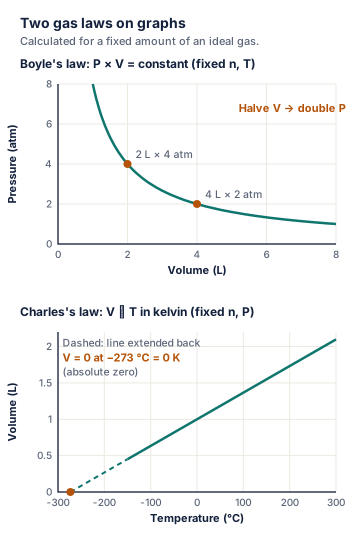
Worked example
Worked example: Boyle's law
Question: A gas occupies 2.0 L at 1.0 atm. It is compressed to 0.50 L at constant temperature. What is the new pressure?
-
, so:
-
The units of L cancel, leaving atm. : the volume became 4 times smaller, so the pressure became 4 times larger.
Worked example: Charles's law
Question: A balloon holds 3.00 L of gas at 27 °C. What is its volume at 127 °C, at the same pressure?
-
Convert to kelvin: and
-
Rearrange and substitute:
-
The units of K cancel, leaving L.
Worked example: The ideal gas law
Question: What volume does 0.500 mol of gas occupy at 25 °C and 1.00 atm?
-
Convert to kelvin:
-
Pressure is in atm, so use . Rearrange and substitute:
-
The units of mol, K and atm cancel, leaving L.
Common mistake
Common mistake: Using degrees Celsius
Heating a gas from 100 °C to 200 °C does not double its volume. In kelvin it goes from 373 K to 473 K, so the volume increases by a factor of only about 1.27.
Common mistake: Mixing units with R
With , pressure must be in atm and volume in L. With , use kPa and L. Convert first: 1 atm = 101.325 kPa = 760 mmHg; 1 L = 1000 mL.
Common mistake: Flipping the relationship in Boyle's law
Pressure and volume are inversely proportional: when one goes up, the other goes down. Check that your answer makes sense.
Notation note
- Pressure may be given in atm, kPa, mmHg, torr (1 torr = 1 mmHg) or bar (1 bar = 100 kPa).
- Subscripts 1 and 2 mean “before” and “after” a change.
- Some books write (“V is proportional to T”).
Remember this
Remember this
- Always use kelvin: K = °C + 273.15.
- Boyle ; Charles constant; Gay-Lussac constant; Avogadro constant.
- Combined: ; ideal: .
- or ; about 22.4 L/mol at 0 °C and 1 atm.
Test yourself
Check your understanding before moving on.
Flashcards
The Gas Laws: Flashcards
- QuestionState Boyle's law.Answer
At constant n and T, pressure is inversely proportional to volume:
- QuestionState Charles's law.Answer
At constant n and P, volume is proportional to kelvin temperature:
- QuestionState Gay-Lussac's law.Answer
At constant n and V, pressure is proportional to kelvin temperature:
- QuestionState Avogadro's law.Answer
At constant P and T, volume is proportional to the number of moles:
- QuestionWrite the ideal gas law.Answer
- QuestionGive two values of the gas constant R.Answer
0.08206 L·atm/(mol·K) and 8.314 L·kPa/(mol·K)
- QuestionConvert 25 °C to kelvin.Answer
25 °C + 273.15 = 298.15 K (about 298 K)
- QuestionWhy must gas law temperatures be in kelvin?Answer
Kelvin starts at absolute zero, so V and P are proportional to it. In °C, doubling the number does not double the temperature.
- QuestionWhat volume does 1 mol of ideal gas occupy at 0 °C and 1 atm?Answer
About 22.4 L
- QuestionWrite the combined gas law.Answer
Tip: press Space to flip and ← → to move between cards.
Quiz
The Gas Laws: Quiz
7 questions
Boyle's law: P × V stays constant, so halving V doubles P.
Show answer
Answer: It doubles
Boyle's law: P × V stays constant, so halving V doubles P.
Use kelvin: 100 °C = 373 K and 200 °C = 473 K. V₂/V₁ = 473 K ÷ 373 K = 1.27 (the units cancel). Doubling the Celsius number does not double the temperature.
Show answer
Answer: 1.27
Use kelvin: 100 °C = 373 K and 200 °C = 473 K. V₂/V₁ = 473 K ÷ 373 K = 1.27 (the units cancel). Doubling the Celsius number does not double the temperature.
Gas laws need an absolute scale that starts at zero. Even if both temperatures are in °C, the ratio is wrong.
Show answer
Answer: Kelvin
Gas laws need an absolute scale that starts at zero. Even if both temperatures are in °C, the ratio is wrong.
Gay-Lussac: T₁ = 27 °C + 273 = 300 K and T₂ = 327 °C + 273 = 600 K. P₂ = 1.00 atm × (600 K ÷ 300 K) = 2.00 atm. (Using °C would give 12.1 atm, which is wrong.)
Show answer
Answer: 2.00 atm
Gay-Lussac: T₁ = 27 °C + 273 = 300 K and T₂ = 327 °C + 273 = 600 K. P₂ = 1.00 atm × (600 K ÷ 300 K) = 2.00 atm. (Using °C would give 12.1 atm, which is wrong.)
T = 27 °C + 273.15 = 300.15 K. P = nRT/V = (0.200 mol × 8.314 L·kPa/(mol·K) × 300.15 K) ÷ 10.0 L = 49.9 kPa. The units of mol, K and L cancel, leaving kPa.
Show answer
Answer: 49.9 kPa
T = 27 °C + 273.15 = 300.15 K. P = nRT/V = (0.200 mol × 8.314 L·kPa/(mol·K) × 300.15 K) ÷ 10.0 L = 49.9 kPa. The units of mol, K and L cancel, leaving kPa.
Avogadro's law: equal moles of ideal gases at the same T and P occupy equal volumes, whatever the gas.
Show answer
Answer: the same volume
Avogadro's law: equal moles of ideal gases at the same T and P occupy equal volumes, whatever the gas.
Then the particles are far apart and fast, so their own volume and the attractions between them matter least.
Show answer
Answer: Low pressure and high temperature
Then the particles are far apart and fast, so their own volume and the attractions between them matter least.
Notes and downloads
Worksheet
Gas Laws Worksheet
9 questions on Boyle's, Charles's and Gay-Lussac's laws, the combined gas law and PV = nRT. Answer key included.
References
- Brown, T. L.; LeMay, H. E., Jr.; Bursten, B. E.; Murphy, C. J.; Woodward, P. M.; Stoltzfus, M. W. Chemistry: The Central Science, 15th ed.; Pearson, 2022.
Practise this topic with flashcards and a quiz at chemistryclarity.com/chemistry/gas-laws/
Spotted a mistake? Let us know and we'll fix it.