What is it?
A measurement is a number with a unit: “5” means nothing, but “5 g” or “5 L” does. Scientists use the SI (Système International), built on seven base units:
| Quantity | Unit | Symbol |
|---|---|---|
| Length | metre | m |
| Mass | kilogram | kg |
| Time | second | s |
| Temperature | kelvin | K |
| Amount of substance | mole | mol |
| Electric current | ampere | A |
| Luminous intensity | candela | cd |
Every other unit is derived from these: area (m²), volume (m³), speed (m/s), density (kg/m³), energy (joule, J = kg·m²/s²) and pressure (pascal, Pa = N/m²).
Key idea
To convert a unit, multiply by a conversion factor: a fraction equal to 1, such as . Arrange it so the unit you don’t want cancels and the unit you want is left. This method is called dimensional analysis.
Why does it matter?
- Data comes in many units. Labs use mL, g and °C; equations often need L, kg and K.
- Units catch mistakes. If the units don’t cancel to the answer’s unit, the setup is wrong, before you even press a calculator key.
- Real consequences. Unit errors have wrecked spacecraft and caused medication overdoses. Writing units on every number prevents them.
How does it work?
1. Metric prefixes
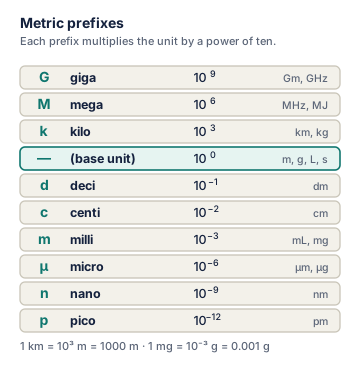
A prefix multiplies a unit by a power of ten. The most useful in chemistry:
| Prefix | Symbol | Factor |
|---|---|---|
| kilo | k | |
| deci | d | |
| centi | c | |
| milli | m | |
| micro | μ | |
| nano | n |
So 1 km = 1000 m, 1 mL = 0.001 L and 1 nm = m.
2. Conversion factors
Any equality gives two conversion factors. From 1 L = 1000 mL:
Choose the one with the unit you want to remove in the denominator.
3. Squared and cubed units
Square or cube the whole conversion factor, number and unit:
- 1 m = 100 cm, so 1 m² = (100 cm)² = cm² and 1 m³ = (100 cm)³ = cm³
- 1 mL = 1 cm³ and 1 L = 1000 cm³ = 1 dm³
4. Density as a conversion factor
Density links mass and volume: . A density of 13.6 g/mL means , which converts volume into mass (or, flipped, mass into volume).
Think of it like this
Converting units is like changing money. 50 dollars is still the same amount of money when you express it in cents (5000 cents); only the number and the unit change, together. A conversion factor is the exchange rate.
More precisely
The litre is not an SI unit, but it is accepted for use with the SI: 1 L = 1 dm³ exactly. The kilogram is the only base unit whose name already contains a prefix, so prefixes are attached to “gram” instead (mg, not μkg). Since 2019, all seven base units are defined by fixing the values of physical constants.
Visualise it
Worked example
Worked example: A one-step conversion
Question: Convert 350 mL to litres.
-
Use 1 L = 1000 mL, with mL in the denominator so it cancels:
-
The answer is 0.350 L.
Worked example: Converting two units at once
Question: A car travels at 72 km/h. What is this speed in m/s?
-
Convert km to m (top) and h to s (bottom):
-
km and h cancel, leaving m/s: 20 m/s.
Worked example: A cubed unit
Question: The density of a liquid is 1.20 g/cm³. What is it in kg/m³?
-
Convert g to kg, and cm³ to m³ using :
-
The density is kg/m³.
Worked example: Using density
Question: Mercury has a density of 13.6 g/mL. What is the mass of 15.0 mL of mercury?
Common mistake
Common mistake: Using the conversion factor upside down
gives 350 000 mL²/L, which is clearly wrong: the units don’t cancel. If the units don’t work out, flip the factor.
Common mistake: Forgetting to square or cube the factor
1 m² is not 100 cm². It is (100 cm)² = 10 000 cm², because both the length and the width are converted.
Common mistake: Mixing up m (milli) and M (mega)
Symbols are case-sensitive: 1 mg is a thousandth of a gram, but 1 Mg is a million grams. Likewise, “m” alone means metre, and “M” in chemistry also means mol/L.
Notation note
- Units can be written with a slash or with negative powers: g/cm³ = g cm⁻³; J/(mol·K) = J mol⁻¹ K⁻¹.
- A space separates the number and the unit: 5.0 g, not 5.0g. Percent and degree signs follow the same rule in SI style (25 °C).
Remember this
Remember this
- Seven SI base units: m, kg, s, K, mol, A, cd. Everything else is derived.
- k = 10³, c = 10⁻², m = 10⁻³, μ = 10⁻⁶, n = 10⁻⁹.
- Multiply by conversion factors (fractions equal to 1) so unwanted units cancel.
- Square or cube the whole factor for areas and volumes; 1 mL = 1 cm³; 1 L = 1 dm³.
Test yourself
Check your understanding before moving on.
Flashcards
SI Units and Unit Conversions: Flashcards
- QuestionWhat is the SI base unit of mass?Answer
The kilogram, kg.
- QuestionName the SI base units for length, time, temperature and amount of substance.Answer
metre (m), second (s), kelvin (K), mole (mol)
- QuestionWhat does the prefix milli (m) mean?Answer
: 1 mL = 0.001 L
- QuestionWhat does the prefix micro (μ) mean?Answer
: 1 μg = g
- QuestionWhat is a conversion factor?Answer
A fraction equal to 1, made from an equality, e.g. .
- QuestionHow many cm³ are in 1 mL?Answer
1 cm³ (1 mL = 1 cm³)
- QuestionHow many cm² are in 1 m²?Answer
cm², because (100 cm)² = 10 000 cm²
- QuestionConvert 350 mL to L.Answer
350 mL × (1 L / 1000 mL) = 0.350 L
- QuestionConvert 72 km/h to m/s.Answer
72 km/h × (1000 m / 1 km) × (1 h / 3600 s) = 20 m/s
- QuestionHow do you know a conversion factor is the right way up?Answer
The unit you want to remove must cancel: it goes in the denominator of the factor.
Tip: press Space to flip and ← → to move between cards.
Quiz
SI Units and Unit Conversions: Quiz
7 questions
The SI base unit of temperature is the kelvin. The base unit of mass is the kilogram (not the gram); the litre and °C are accepted but not base units.
Show answer
Answer: kelvin
The SI base unit of temperature is the kelvin. The base unit of mass is the kilogram (not the gram); the litre and °C are accepted but not base units.
2.5 km × (1000 m / 1 km) = 2500 m (or 2.5 × 10³ m). The km units cancel.
Show answer
Answer: 2500 m
2.5 km × (1000 m / 1 km) = 2500 m (or 2.5 × 10³ m). The km units cancel.
45 mg × (1 g / 1000 mg) = 0.045 g. The mg units cancel.
Show answer
Answer: 0.045 g
45 mg × (1 g / 1000 mg) = 0.045 g. The mg units cancel.
1 m = 100 cm, so 1 m³ = (100 cm)³ = 1 000 000 cm³ (10⁶ cm³). The factor must be cubed.
Show answer
Answer: 1 000 000 cm³
1 m = 100 cm, so 1 m³ = (100 cm)³ = 1 000 000 cm³ (10⁶ cm³). The factor must be cubed.
mL must be in the denominator to cancel, leaving L: 350 mL × (1 L / 1000 mL) = 0.350 L.
Show answer
Answer: 350 mL × (1 L / 1000 mL)
mL must be in the denominator to cancel, leaving L: 350 mL × (1 L / 1000 mL) = 0.350 L.
72 km/h × (1000 m / 1 km) × (1 h / 3600 s) = 20 m/s. Both km and h cancel.
Show answer
Answer: 20 m/s
72 km/h × (1000 m / 1 km) × (1 h / 3600 s) = 20 m/s. Both km and h cancel.
68.0 g × (1 mL / 13.6 g) = 5.00 mL. The density is flipped so that g cancels.
Show answer
Answer: 5.00 mL
68.0 g × (1 mL / 13.6 g) = 5.00 mL. The density is flipped so that g cancels.
Notes and downloads
Worksheet
SI Units and Unit Conversions Worksheet
9 questions on SI base units, metric prefixes and converting units with conversion factors, including areas, volumes and density. Answer key included.
References
- Bureau International des Poids et Mesures (BIPM). The International System of Units (SI), 9th ed.; BIPM, 2019. Link
- Brown, T. L.; LeMay, H. E., Jr.; Bursten, B. E.; Murphy, C. J.; Woodward, P. M.; Stoltzfus, M. W. Chemistry: The Central Science, 15th ed.; Pearson, 2022.
Practise this topic with flashcards and a quiz at chemistryclarity.com/chemistry/unit-conversions/
Spotted a mistake? Let us know and we'll fix it.