What is it?
The lattice enthalpy of an ionic compound is the enthalpy change when 1 mol of the solid forms from its gaseous ions, under standard conditions:
It is always exothermic (negative): oppositely charged ions attract, so energy is released as they come together. The more negative the lattice enthalpy, the stronger the ionic bonding.
Lattice enthalpy can’t be measured directly: you can’t collect a mole of separate gaseous ions and let them crash together. Instead it is calculated with a Born–Haber cycle, an application of Hess’s law that builds the solid from its elements by two routes.
Key idea
Lattice enthalpy measures the strength of an ionic lattice. It is found indirectly: the enthalpy of formation equals the sum of all the steps that turn the elements into gaseous ions and then into the solid, so the one unknown step can be calculated.
Why does it matter?
- Properties of ionic solids. A more negative lattice enthalpy goes with a higher melting point and greater hardness: MgO melts at about 2800 °C, NaCl at 801 °C.
- Testing the ionic model. Comparing a Born–Haber value with one calculated from a purely ionic model shows how ionic a compound really is.
- Dissolving. Whether a salt dissolves, and whether its solution warms or cools, depends on the balance between lattice enthalpy and the hydration of the ions (see Electrolytes and Dissolving).
- Why formulas are what they are. Born–Haber cycles explain why magnesium forms , not MgCl, even though removing a second electron costs a lot of energy.
How does it work?
1. The steps
Every step is per mole of the compound, under standard conditions:
| Step | Name | Sign |
|---|---|---|
| enthalpy of sublimation of the metal | + | |
| enthalpy of atomization of the non-metal (half the bond enthalpy) | + | |
| first ionization energy (IE) | + | |
| first electron affinity (EA) | − | |
| lattice enthalpy | − | |
| enthalpy of formation | usually − |
- The metal step is sublimation: solid sodium is a metallic lattice of ions held by delocalized electrons, so energy is needed to turn it directly into free gaseous atoms.
- Enthalpies of atomization of the non-metal are always per mole of atoms formed, so for it is half the Cl–Cl bond enthalpy (242.6 kJ/mol ÷ 2 = 121.3 kJ/mol).
- A first electron affinity is usually exothermic: the nucleus attracts the incoming electron. A second electron affinity () is endothermic: the electron is pushed away by the negative ion.
2. Using the cycle
By Hess’s law, the direct route (formation) equals the indirect route (all the other steps):
Rearrange to find whichever value is unknown, usually the lattice enthalpy:
Multiply each step by the number of times it happens: for , Mg loses two electrons (IE₁ + IE₂), and two Cl atoms each form and each gain an electron.
3. What makes a lattice strong?
The attraction between two ions follows Coulomb’s law, so the lattice enthalpy gets more negative with:
- Higher charges on the ions (the product of the charges).
- Smaller ions (the ions can get closer together).
| Compound | Ions | (kJ/mol, approx.) |
|---|---|---|
| NaF | , | −923 |
| NaCl | , | −787 |
| NaBr | , | −747 |
| NaI | , | −704 |
| , 2 | −2522 | |
| MgO | , | about −3800 |
Down Group 17 the halide ion gets bigger, so the lattice enthalpy gets less negative. MgO, with 2+ and 2− ions that are both small, has a lattice enthalpy almost five times that of NaCl.
Think of it like this
Think of a Born–Haber cycle as working out the cost of one item on a shopping receipt when only the total is printed. You know the total (the enthalpy of formation) and the price of every other item (sublimation, atomization, ionization, electron affinity), so the missing price (the lattice enthalpy) is the total minus everything else.
More precisely
Lattice enthalpy can also be calculated from a model that treats the solid as perfect spherical ions (the Born–Landé equation). For the alkali metal halides, the model and the Born–Haber values agree within a few percent, so these compounds are close to purely ionic. For silver halides such as AgI, the Born–Haber value is noticeably more negative than the model predicts: the large, polarizable iodide ion shares some electron density with , so the bonding has partial covalent character. The cycle is named after Max Born and Fritz Haber, who devised it in 1919.
Visualise it
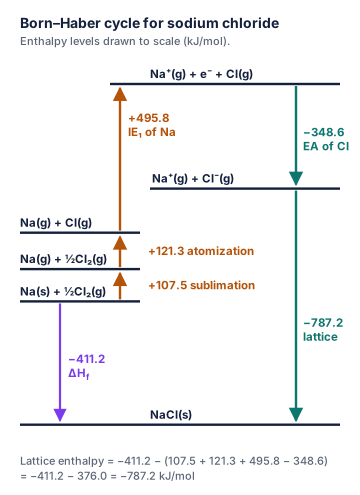
Worked example
Worked example: The lattice enthalpy of sodium chloride
Question: Use the data to calculate the lattice enthalpy of NaCl.
kJ/mol · sublimation of Na kJ/mol · atomization of ½ kJ/mol · IE₁(Na) kJ/mol · EA₁(Cl) kJ/mol
-
Add the steps that turn the elements into gaseous ions:
-
Subtract this from the enthalpy of formation:
Worked example: A 2+ ion: magnesium chloride
Question: Calculate the lattice enthalpy of .
kJ/mol · sublimation of Mg kJ/mol · IE₁(Mg) kJ/mol · IE₂(Mg) kJ/mol · atomization of ½ kJ/mol · EA₁(Cl) kJ/mol
-
Count each step: one Mg atom loses two electrons; two Cl atoms form, and each gains one electron.
-
The two chlorine steps:
-
All the steps to the gaseous ions:
-
Lattice enthalpy:
Removing the second electron from Mg costs 1450.7 kJ/mol, but the lattice with ions is so much stronger that is still very stable.
Common mistake
Common mistake: Mixing up the sign conventions
This lesson defines lattice enthalpy as forming the lattice from gaseous ions (negative). Some books define it as breaking the lattice into gaseous ions (positive, the “lattice dissociation enthalpy”). The size is the same; check which definition a question uses before writing the sign.
Common mistake: Using the whole bond enthalpy
Atomization makes one mole of atoms. For NaCl you need only one Cl atom, so use half the Cl–Cl bond enthalpy (121.3 kJ/mol, not 242.6 kJ/mol). For you need two Cl atoms: 2 × 121.3 kJ/mol, which equals the full bond enthalpy.
Common mistake: Forgetting the second ionization energy
To make you need IE₁ and IE₂. To make you need the first electron affinity (exothermic) and the second (endothermic).
Notation note
- is the standard lattice enthalpy; the standard enthalpy of formation; the enthalpy of sublimation (of the metal); the enthalpy of atomization (of the non-metal).
- IE and EA values are per mole of atoms or ions, in kJ/mol.
- In the figure, up arrows are endothermic (+) and down arrows are exothermic (−).
Remember this
Remember this
- Lattice enthalpy: 1 mol of ionic solid from its gaseous ions; exothermic; more negative = stronger lattice.
- Born–Haber cycle: = sublimation + atomization + IEs + EAs + (Hess’s law).
- Count every step: half the bond enthalpy per non-metal atom; IE₁ + IE₂ for a 2+ ion.
- Higher ion charges and smaller ions give more negative lattice enthalpies.
Test yourself
Check your understanding before moving on.
Flashcards
Lattice Enthalpy and Born–Haber Cycles: Flashcards
- QuestionDefine lattice enthalpy (formation convention).Answer
The enthalpy change when 1 mol of an ionic solid forms from its gaseous ions under standard conditions. It is always exothermic (negative).
- QuestionWhy can't lattice enthalpy be measured directly?Answer
You cannot collect a mole of separate gaseous ions and combine them. It is calculated with a Born–Haber cycle (Hess's law).
- QuestionWhat is the enthalpy of atomization of chlorine?Answer
The enthalpy change to form 1 mol of Cl(g) atoms from Cl₂(g): half the Cl–Cl bond enthalpy, +121.3 kJ/mol.
- QuestionIs a first electron affinity usually exothermic or endothermic?Answer
Exothermic (negative): the nucleus attracts the incoming electron. For Cl, EA₁ = −348.6 kJ/mol.
- QuestionWhy is the second electron affinity of oxygen endothermic?Answer
The electron is being added to an ion that is already negative (O⁻), so it is repelled; energy must be put in.
- QuestionWrite the Born–Haber equation for lattice enthalpy.Answer
ΔH(latt) = ΔHf − (sublimation of the metal + atomization of the non-metal + ionization energies + electron affinities).
- QuestionWhich ionization energies are needed to form Mg²⁺(g)?Answer
Both the first and the second: IE₁ + IE₂ = 737.7 kJ/mol + 1450.7 kJ/mol.
- QuestionName two factors that make a lattice enthalpy more negative.Answer
Higher charges on the ions, and smaller ions (which can get closer together).
- QuestionPut NaF, NaCl, NaBr and NaI in order of decreasingly negative lattice enthalpy.Answer
NaF (−923) > NaCl (−787) > NaBr (−747) > NaI (−704) kJ/mol: the halide ion gets larger down the group.
- QuestionWhat does it mean if a Born–Haber lattice enthalpy is more negative than the ionic-model value?Answer
The bonding has some covalent character (for example in AgI), so it is stronger than pure ionic attraction predicts.
- QuestionWhat is the enthalpy of sublimation of sodium?Answer
The enthalpy change for Na(s) → Na(g), +107.5 kJ/mol: the energy to break up the metallic lattice into free gaseous atoms.
Tip: press Space to flip and ← → to move between cards.
Quiz
Lattice Enthalpy and Born–Haber Cycles: Quiz
7 questions
Lattice enthalpy starts from gaseous ions and forms 1 mol of solid. The first equation is the enthalpy of formation; the third is the dissociation convention.
Show answer
Answer: K⁺(g) + Cl⁻(g) → KCl(s)
Lattice enthalpy starts from gaseous ions and forms 1 mol of solid. The first equation is the enthalpy of formation; the third is the dissociation convention.
The nucleus attracts the added electron, releasing energy. Sublimation, atomization and ionization need energy, and adding a second electron to O⁻ is endothermic.
Show answer
Answer: First electron affinity of the non-metal
The nucleus attracts the added electron, releasing energy. Sublimation, atomization and ionization need energy, and adding a second electron to O⁻ is endothermic.
NaCl needs one Cl atom, so half a mole of Cl₂ is atomized: 242.6 kJ/mol ÷ 2 = +121.3 kJ/mol.
Show answer
Answer: +121.3 kJ/mol
NaCl needs one Cl atom, so half a mole of Cl₂ is atomized: 242.6 kJ/mol ÷ 2 = +121.3 kJ/mol.
Mg²⁺ and O²⁻ have double charges and are small, so the attraction is far stronger (about −3800 kJ/mol, compared with −787 kJ/mol for NaCl).
Show answer
Answer: MgO
Mg²⁺ and O²⁻ have double charges and are small, so the attraction is far stronger (about −3800 kJ/mol, compared with −787 kJ/mol for NaCl).
ΔH(latt) = −411.2 kJ/mol − 376.0 kJ/mol = −787.2 kJ/mol.
Show answer
Answer: −787.2 kJ/mol
ΔH(latt) = −411.2 kJ/mol − 376.0 kJ/mol = −787.2 kJ/mol.
Mg must lose two electrons (IE₁ then IE₂), and two Cl atoms must each form and each gain one electron.
Show answer
Answer: IE₁ + IE₂ (Mg), 2 × atomization of Cl, 2 × EA(Cl)
Mg must lose two electrons (IE₁ then IE₂), and two Cl atoms must each form and each gain one electron.
The large, polarizable I⁻ ion shares some electron density with Ag⁺, adding covalent bonding to the ionic attraction.
Show answer
Answer: AgI has some covalent character
The large, polarizable I⁻ ion shares some electron density with Ag⁺, adding covalent bonding to the ionic attraction.
Notes and downloads
Worksheet
Lattice Enthalpy and Born–Haber Cycles Worksheet
8 questions on lattice enthalpy, the steps of a Born–Haber cycle, calculating lattice enthalpy and electron affinity, and trends in lattice strength. Answer key included.
References
- Brown, T. L.; LeMay, H. E., Jr.; Bursten, B. E.; Murphy, C. J.; Woodward, P. M.; Stoltzfus, M. W. Chemistry: The Central Science, 15th ed.; Pearson, 2022.
Practise this topic with flashcards and a quiz at chemistryclarity.com/chemistry/born-haber-cycles/
Spotted a mistake? Let us know and we'll fix it.