Worksheet
Lattice Enthalpy and Born–Haber Cycles Worksheet
8 questions on lattice enthalpy, the steps of a Born–Haber cycle, calculating lattice enthalpy and electron affinity, and trends in lattice strength. Answer key included.
- Type
- Worksheet
- Level
- Intermediate
- Format
- PDF, ready to print
Preview the questions
All the questions on this worksheet (about 45 minutes). Download the PDF to print it with space for working; the free answer key has full worked solutions.
A. Definitions
1.
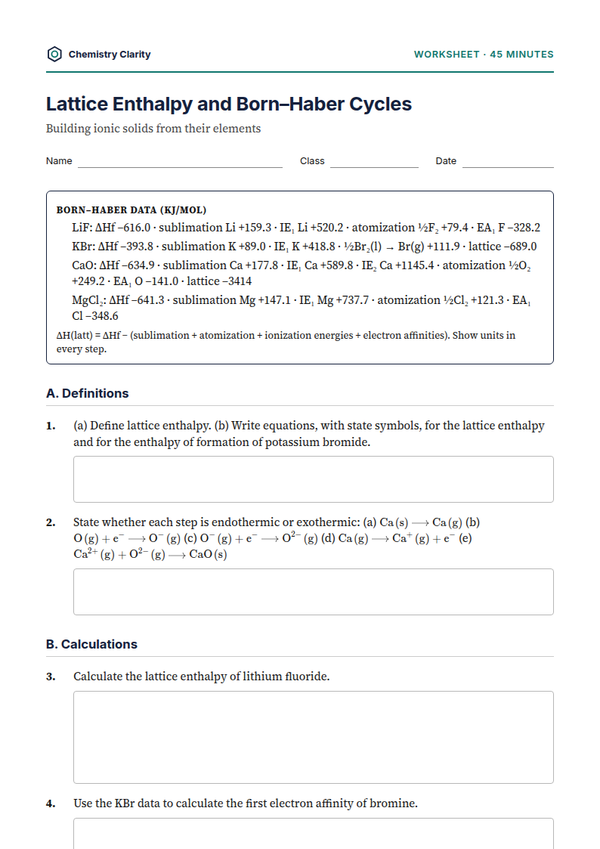
(a) Define lattice enthalpy. (b) Write equations, with state symbols, for the lattice enthalpy and for the enthalpy of formation of potassium bromide.
2.
State whether each step is endothermic or exothermic: (a) (b) (c) (d) (e)
B. Calculations
3.
Calculate the lattice enthalpy of lithium fluoride.
4.
Use the KBr data to calculate the first electron affinity of bromine.
C. Trends
5.
Put KCl, CaO, NaCl and MgO in order of increasingly negative lattice enthalpy. Explain your order.
6.
(a) Use the CaO data to calculate the second electron affinity of oxygen. (b) Explain why it has this sign.
D. Challenge
7.
The lattice enthalpy of the hypothetical compound MgCl (containing ) is estimated to be −753.0 kJ/mol. (a) Calculate for MgCl. (b) Calculate for . (c) Explain why magnesium chloride is , not MgCl.
8.
For NaCl, the Born–Haber lattice enthalpy and the value calculated from a purely ionic model agree within about 2 %. For silver iodide, the Born–Haber value is much more negative than the model predicts. Explain both observations.