What is it?
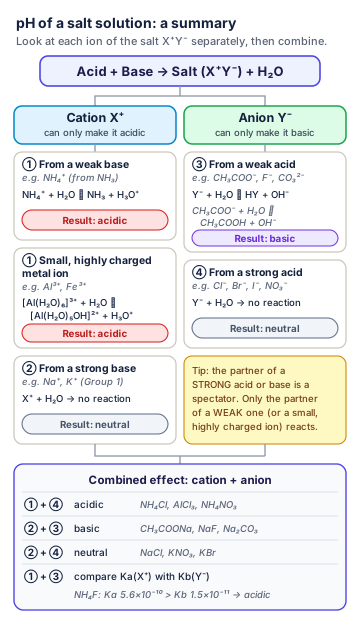
A salt is the ionic compound formed when an acid neutralizes a base. You might expect every salt solution to be neutral, but many are not:
- Sodium chloride solution has pH 7.
- Sodium ethanoate (sodium acetate) solution is basic.
- Ammonium chloride solution is acidic.
The reason is that some ions react with water. This reaction is called hydrolysis.
- The conjugate base of a weak acid (such as or ) takes a proton from water, making :
- The conjugate acid of a weak base (such as ) gives a proton to water, making :
- The conjugates of strong acids and bases (, , , ) are far too weak to react with water: they are neutral.
Key idea
Look at where the salt came from. The “parent” that is stronger wins. Strong acid + strong base gives a neutral salt; strong acid + weak base gives an acidic salt; weak acid + strong base gives a basic salt.
Why does it matter?
- Titration end points. At the equivalence point of a weak acid–strong base titration, the solution contains only the salt, so the pH is above 7. This decides which indicator to use.
- Everyday chemistry. Baking soda and washing soda solutions are basic; ammonium salts in fertilizers make soil more acidic.
- Medicine and biology. Many drugs are given as salts, and their pH in solution affects how they are absorbed.
How does it work?
1. Predicting acidic, basic or neutral
| Salt made from | Example | Ion that hydrolyses | Solution |
|---|---|---|---|
| Strong acid + strong base | NaCl, KNO₃ | none | neutral, pH 7 |
| Strong acid + weak base | NH₄Cl | acidic, pH below 7 | |
| Weak acid + strong base | CH₃COONa, NaF | , | basic, pH above 7 |
(For a salt of a weak acid and a weak base, compare of the cation with of the anion.)
2. Ka × Kb = Kw
For any conjugate acid–base pair in water:
So the weaker the acid, the stronger its conjugate base. You can find for from for ethanoic acid, and for from for ammonia.
3. Calculating the pH of a salt solution
Treat the hydrolysing ion as a weak base (or weak acid) and use the same method as for weak acids:
- Find (or ) of the ion from .
- Set up the equilibrium: (or ), and if is small.
- Convert to pH.
Think of it like this
Think of a tug of war between two teams, the parent acid and the parent base. If both teams are strong, they cancel and the rope doesn’t move (neutral). If one is strong and the other weak, the strong side’s partner (the conjugate ion of the weak side) still pulls a little: the solution leans towards the weak parent’s opposite.
More precisely
Small, highly charged metal ions such as and also make solutions acidic: the hydrated ion, e.g. , releases a proton from one of its water molecules. The relationship can also be written at 25 °C. increases with temperature, so neutral pH is slightly below 7 in hot water.
Visualise it
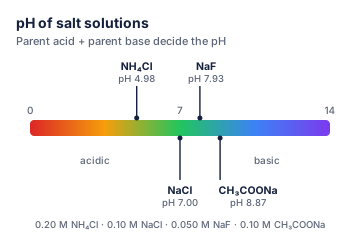
Applying the chart to four solutions gives these pH values:
Worked example
Worked example: Acidic, basic or neutral?
Question: Predict whether solutions of (a) KNO₃ (b) NH₄NO₃ (c) Na₂CO₃ (d) KF are acidic, basic or neutral.
- (a) From (strong) and (strong): neutral.
- (b) comes from (weak base); is neutral: acidic.
- (c) comes from a weak acid; is neutral: basic.
- (d) comes from HF (weak acid): basic.
Worked example: Finding Kb from Ka
Question: Find for the ethanoate ion, given .
Worked example: pH of a basic salt
Question: Calculate the pH of 0.10 mol/L sodium ethanoate.
-
is a weak base with . Let :
-
Check: is far below 5 % of 0.10 mol/L, so the approximation holds.
-
pOH and pH:
Worked example: pH of an acidic salt
Question: Calculate the pH of 0.20 mol/L ammonium chloride. ()
-
-
Let :
-
Common mistake
Common mistake: Assuming every salt is neutral
“Salt” does not mean “neutral”. Only salts of a strong acid and a strong base give pH 7. Check the parents of both ions.
Common mistake: Using Ka of the parent acid directly
The base in a sodium ethanoate solution is , not ethanoic acid. Convert first: .
Common mistake: Forgetting to convert pOH to pH
For a basic salt, the calculation gives and pOH. Finish with pH = 14.00 − pOH.
Notation note
- Hydrolysis is shown with equilibrium arrows (⇌) because only a small fraction of the ions react.
- Units: and are written without units (they are ratios of concentrations relative to 1 mol/L).
Remember this
Remember this
- Strong acid + strong base → neutral salt; strong acid + weak base → acidic; weak acid + strong base → basic.
- Conjugates of strong acids and bases (, , , ) don’t hydrolyse.
- at 25 °C.
- pH of a salt: find K of the hydrolysing ion, then , then pH.
Test yourself
Check your understanding before moving on.
Flashcards
Acid–Base Properties of Salts: Flashcards
- QuestionWhat is hydrolysis of a salt?Answer
The reaction of an ion with water, producing H₃O⁺ or OH⁻ and changing the pH.
- QuestionIs a salt of a strong acid and a strong base acidic, basic or neutral?Answer
Neutral (pH 7), e.g. NaCl, KNO₃.
- QuestionIs a salt of a strong acid and a weak base acidic, basic or neutral?Answer
Acidic, e.g. NH₄Cl: NH₄⁺ gives H⁺ to water.
- QuestionIs a salt of a weak acid and a strong base acidic, basic or neutral?Answer
Basic, e.g. CH₃COONa: CH₃COO⁻ takes H⁺ from water, forming OH⁻.
- QuestionWhich ions do not hydrolyse?Answer
Conjugates of strong acids and bases: Cl⁻, Br⁻, I⁻, NO₃⁻, Na⁺, K⁺ (and other Group 1 ions).
- QuestionState the relationship between Ka and Kb for a conjugate pair.Answer
at 25 °C
- QuestionKa of ethanoic acid is 1.8 × 10⁻⁵. What is Kb of the ethanoate ion?Answer
1.0 × 10⁻¹⁴ ÷ 1.8 × 10⁻⁵ = 5.6 × 10⁻¹⁰
- QuestionWhy is the pH at the equivalence point of a weak acid–strong base titration above 7?Answer
The solution contains the salt of the weak acid, whose anion is a weak base.
- QuestionWhy are solutions of Al³⁺ or Fe³⁺ salts acidic?Answer
The small, highly charged hydrated ions release H⁺ from their attached water molecules.
- QuestionOutline how to calculate the pH of 0.10 mol/L sodium ethanoate.Answer
Kb = Kw/Ka → [OH⁻] ≈ √(Kb × C) → pOH → pH = 14.00 − pOH (answer 8.87).
Tip: press Space to flip and ← → to move between cards.
Quiz
Acid–Base Properties of Salts: Quiz
7 questions
CO₃²⁻ is the conjugate base of a weak acid, so it takes protons from water and forms OH⁻. K⁺ is neutral.
Show answer
Answer: K₂CO₃
CO₃²⁻ is the conjugate base of a weak acid, so it takes protons from water and forms OH⁻. K⁺ is neutral.
NH₄⁺ is the conjugate acid of the weak base NH₃ and donates a proton to water. Cl⁻ is neutral.
Show answer
Answer: NH₄Cl
NH₄⁺ is the conjugate acid of the weak base NH₃ and donates a proton to water. Cl⁻ is neutral.
Both ions come from a strong base and a strong acid, so they are far too weak to react with water.
Show answer
Answer: Neither Na⁺ nor Cl⁻ reacts with water to change [H⁺] or [OH⁻]
Both ions come from a strong base and a strong acid, so they are far too weak to react with water.
Kb = Kw ÷ Ka = 1.0 × 10⁻¹⁴ ÷ 4.9 × 10⁻¹⁰ = 2.0 × 10⁻⁵. A very weak acid has a fairly strong conjugate base.
Show answer
Answer: 2.0 × 10⁻⁵
Kb = Kw ÷ Ka = 1.0 × 10⁻¹⁴ ÷ 4.9 × 10⁻¹⁰ = 2.0 × 10⁻⁵. A very weak acid has a fairly strong conjugate base.
[OH⁻] ≈ √(2.0 × 10⁻⁵ × 0.10) = 1.41 × 10⁻³ mol/L, pOH = 2.85, pH = 14.00 − 2.85 = 11.15. 2.85 is the pOH.
Show answer
Answer: 11.15
[OH⁻] ≈ √(2.0 × 10⁻⁵ × 0.10) = 1.41 × 10⁻³ mol/L, pOH = 2.85, pH = 14.00 − 2.85 = 11.15. 2.85 is the pOH.
At equivalence the solution contains sodium ethanoate, a basic salt, so the pH is above 7 (about 8.7 for 0.050 mol/L).
Show answer
Answer: 9
At equivalence the solution contains sodium ethanoate, a basic salt, so the pH is above 7 (about 8.7 for 0.050 mol/L).
NH₄Cl is acidic; NaCl is neutral; CH₃COO⁻ (Kb 5.6 × 10⁻¹⁰) is a weaker base than CN⁻ (Kb 2.0 × 10⁻⁵), so NaCN has the highest pH.
Show answer
Answer: NH₄Cl, NaCl, CH₃COONa, NaCN
NH₄Cl is acidic; NaCl is neutral; CH₃COO⁻ (Kb 5.6 × 10⁻¹⁰) is a weaker base than CN⁻ (Kb 2.0 × 10⁻⁵), so NaCN has the highest pH.
Notes and downloads
Worksheet
Acid–Base Properties of Salts Worksheet
8 questions on predicting acidic, basic and neutral salts, Ka × Kb = Kw, and calculating the pH of salt solutions and titration equivalence points. Answer key included.
References
- Brown, T. L.; LeMay, H. E., Jr.; Bursten, B. E.; Murphy, C. J.; Woodward, P. M.; Stoltzfus, M. W. Chemistry: The Central Science, 15th ed.; Pearson, 2022.
Practise this topic with flashcards and a quiz at chemistryclarity.com/chemistry/acid-base-properties-of-salts/
Spotted a mistake? Let us know and we'll fix it.