What is it?
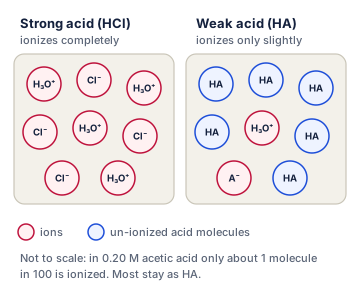
A weak acid gives up its proton to water only partly. At any moment most of its molecules are still intact, and only a small fraction are ionized:
The acid dissociation constant, , measures how far this goes:
The larger , the stronger the acid. Chemists often use : the smaller the pKa, the stronger the acid.
Key idea
A weak acid sets up an equilibrium. Because only a little of it ionizes, its pH is higher (less acidic) than a strong acid of the same concentration.
Why does it matter?
- Most acids are weak. Vinegar (acetic acid), citrus fruits (citric acid), and the acids in many medicines and foods are weak acids.
- Biology runs on weak acids and bases. Amino acids, the phosphate groups in DNA and the carbonic acid in blood all behave as weak acids or bases.
- Ka is the key to buffers and titrations, the next two lessons.
How does it work?
1. Comparing acid strength
| Acid | (25 °C) | pKa |
|---|---|---|
| Hydrofluoric acid, | 3.17 | |
| Formic acid, | 3.74 | |
| Acetic acid, | 4.74 | |
| Hydrocyanic acid, | 9.31 |
HF is the strongest of these weak acids; HCN is the weakest.
2. Calculating the pH of a weak acid
Use an ICE table (Initial, Change, Equilibrium). For an acid of initial concentration , let = amount that ionizes:
| Initial | 0 | 0 | |
| Change | |||
| Equilibrium |
So . When the acid is weak, is tiny compared with , so , and:
Check the approximation: if is less than 5% of , it is acceptable. Otherwise, solve the quadratic equation instead.
3. Percent ionization
4. Weak bases
Weak bases work the same way with and . For ammonia, , and . For a conjugate acid–base pair, .
Think of it like this
Imagine a dance hall where couples (HA) can split up (H⁺ and A⁻) and pair up again. With a strong acid, every couple splits and nobody pairs again. With a weak acid, couples keep splitting and re-forming, but at any moment almost all are still together. Ka tells you how many are split at any moment.
More precisely
Ka values depend on temperature (the table is for 25 °C). The “5% rule” is a convention, not a law: it keeps the error in small. A weak acid ionizes more (as a percentage) when it is more dilute, even though its pH rises. Strictly, equilibrium constants use activities, not concentrations, but concentrations work well for dilute solutions.
Visualise it
Worked example
Worked example: pH of a weak acid
Question: Calculate the pH and percent ionization of 0.20 M acetic acid. ()
- M
- Check: is about 0.9% of 0.20, below 5%, so the approximation is fine.
- pH = −log(1.9 × 10⁻³) = 2.72; percent ionization ≈ 0.9%
Compare: 0.20 M HCl (strong) has pH 0.70.
Worked example: Ka from a measured pH
Question: A 0.10 M solution of a weak acid has pH 3.00. Calculate .
- M
- M
- 1.0 × 10⁻⁵
Worked example: pH of a weak base
Question: Calculate the pH of 0.20 M ammonia. ()
- M
- pOH = 2.72, so pH = 14.00 − 2.72 = 11.28
Common mistake
Common mistake: Treating a weak acid like a strong acid
For 0.20 M acetic acid, is not 0.20 M. That would give pH 0.70 instead of 2.72. Only strong acids ionize completely.
Common mistake: Mixing up Ka and pKa
A larger Ka means a stronger acid, but a smaller pKa means a stronger acid. Check which one you are comparing.
Common mistake: Using the approximation without checking
If is more than 5% of the starting concentration (for example with fairly strong weak acids such as HF, or very dilute solutions), the shortcut is not accurate enough, so solve the quadratic.
Notation note
- is also called the acidity constant or acid ionization constant.
- Pure liquid water is left out of the expression.
- Some courses write instead of including water; the expression is the same.
Remember this
Remember this
- Weak acids ionize only partly: .
- ; larger Ka (smaller pKa) = stronger acid.
- Shortcut: , valid if under 5% ionizes.
- Weak bases: same method with Kb and OH⁻; .
Test yourself
Check your understanding before moving on.
Flashcards
Weak Acids and Ka: Flashcards
- QuestionWhat is a weak acid?Answer
An acid that ionizes only partly in water, setting up an equilibrium:
- QuestionWrite the expression for .Answer
- QuestionWhich is the stronger acid: pKa 3.2 or pKa 4.7?Answer
pKa 3.2. A smaller pKa means a larger Ka and a stronger acid.
- QuestionWhat is the shortcut for in a weak acid solution?Answer
- QuestionWhen is the shortcut acceptable?Answer
When less than 5% of the acid ionizes ( < 5% of ).
- QuestionWhat does ICE stand for?Answer
Initial, Change, Equilibrium.
- QuestionWhat is the pH of 0.20 M acetic acid ()?Answer
M, so pH = 2.72
- QuestionHow are Ka and Kb related for a conjugate pair?Answer
(at 25 °C)
- QuestionDoes a weak acid ionize more or less (as a percentage) when diluted?Answer
More. Percent ionization increases on dilution, even though the pH rises.
Tip: press Space to flip and ← → to move between cards.
Quiz
Weak Acids and Ka: Quiz
7 questions
The largest Ka means the greatest extent of ionization, so HF is the strongest of these weak acids.
Show answer
Answer: HF,
The largest Ka means the greatest extent of ionization, so HF is the strongest of these weak acids.
pKa = −log(1.8 × 10⁻⁵) = 4.74.
Show answer
Answer: 4.74
pKa = −log(1.8 × 10⁻⁵) = 4.74.
M, so pH = 2.72. The answer 0.70 treats acetic acid as a strong acid.
Show answer
Answer: 2.72
M, so pH = 2.72. The answer 0.70 treats acetic acid as a strong acid.
M; .
Show answer
Answer:
M; .
M, pOH = 2.72, pH = 14.00 − 2.72 = 11.28. The answer 2.72 reports the pOH.
Show answer
Answer: 11.28
M, pOH = 2.72, pH = 14.00 − 2.72 = 11.28. The answer 2.72 reports the pOH.
at 25 °C.
Show answer
Answer:
at 25 °C.
For a weak acid, x is usually tiny compared with C (under 5%), so C − x ≈ C. Always check this.
Show answer
Answer: Because only a small fraction of a weak acid ionizes
For a weak acid, x is usually tiny compared with C (under 5%), so C − x ≈ C. Always check this.
Notes and downloads
Worksheet
Weak Acids and Ka Worksheet
8 questions on Ka, pKa, weak acid and weak base pH, and finding Ka from a measured pH. Answer key included.
References
- Brown, T. L.; LeMay, H. E., Jr.; Bursten, B. E.; Murphy, C. J.; Woodward, P. M.; Stoltzfus, M. W. Chemistry: The Central Science, 15th ed.; Pearson, 2022.
Practise this topic with flashcards and a quiz at chemistryclarity.com/chemistry/weak-acids/
Spotted a mistake? Let us know and we'll fix it.