Worksheet
Acid–Base Properties of Salts Worksheet
8 questions on predicting acidic, basic and neutral salts, Ka × Kb = Kw, and calculating the pH of salt solutions and titration equivalence points. Answer key included.
- Type
- Worksheet
- Level
- Intermediate
- Format
- PDF, ready to print
Preview the questions
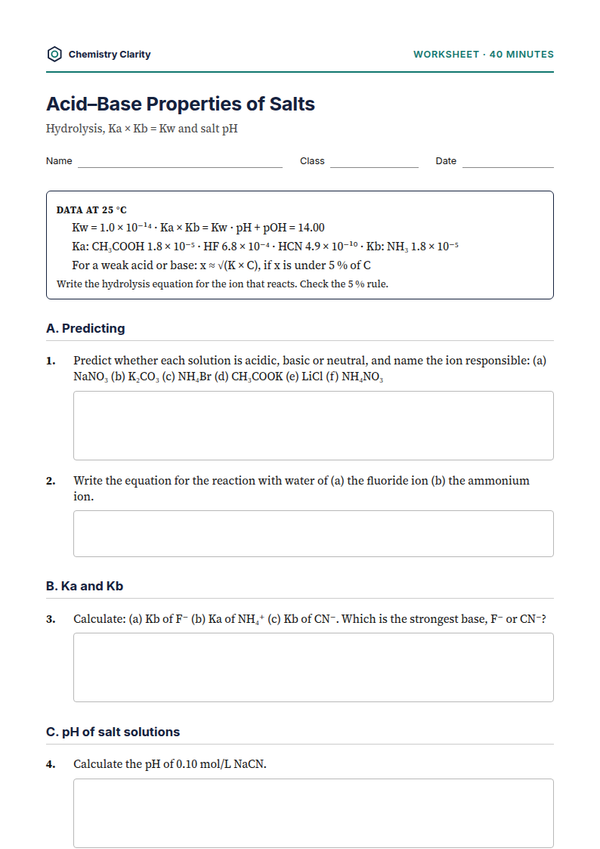
All the questions on this worksheet (about 40 minutes). Download the PDF to print it with space for working; the free answer key has full worked solutions.
A. Predicting
1.
Predict whether each solution is acidic, basic or neutral, and name the ion responsible: (a) NaNO₃ (b) K₂CO₃ (c) NH₄Br (d) CH₃COOK (e) LiCl (f) NH₄NO₃
2.
Write the equation for the reaction with water of (a) the fluoride ion (b) the ammonium ion.
B. Ka and Kb
3.
Calculate: (a) Kb of F⁻ (b) Ka of NH₄⁺ (c) Kb of CN⁻. Which is the strongest base, F⁻ or CN⁻?
C. pH of salt solutions
4.
Calculate the pH of 0.10 mol/L NaCN.
5.
Calculate the pH of 0.050 mol/L NH₄NO₃.
6.
Calculate the pH of 0.25 mol/L potassium ethanoate, CH₃COOK.
D. Titrations
7.
25.00 mL of 0.100 mol/L ethanoic acid is titrated with 0.100 mol/L NaOH. (a) What volume of NaOH reaches the equivalence point? (b) What is the concentration of ethanoate at that point? (c) Calculate the pH at the equivalence point and suggest a suitable indicator.
E. Challenge
8.
Explain why a solution of aluminium chloride, AlCl₃, is acidic even though Cl⁻ is neutral.