What is it?
A buffer is a solution that resists changes in pH when small amounts of acid or base are added.
A buffer contains both members of a conjugate pair in similar amounts:
- a weak acid and its conjugate base, such as acetic acid () with acetate ions (, from sodium acetate); or
- a weak base and its conjugate acid, such as ammonia () with ammonium ions (, from ammonium chloride).
Key idea
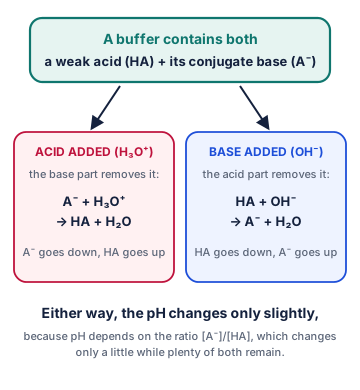
A buffer contains a “base part” that neutralizes added acid and an “acid part” that neutralizes added base, so the pH changes only a little.
Why does it matter?
- Your blood is a buffer. Carbonic acid and hydrogen carbonate (/) help keep blood pH between about 7.35 and 7.45.
- Biology and medicine depend on buffers. Enzymes work only within narrow pH ranges, so cells, lab experiments and many medicines are buffered.
- Chemistry and industry use them to keep reactions, food products, cosmetics and analytical tests at a steady pH.
How does it work?
1. How a buffer neutralizes added acid or base
Using HA for the weak acid and A⁻ for its conjugate base:
- Acid added: . The added is used up.
- Base added: . The added is used up.
Each time, a strong acid or base is replaced by a weak one, so the pH barely moves.
2. Calculating buffer pH: the Henderson–Hasselbalch equation
- If , then and pH = pKa.
- More base than acid gives a pH above the pKa; more acid gives a pH below it.
3. Choosing a buffer
Choose a weak acid whose pKa is close to the pH you want (within about ±1). Acetic acid/acetate (pKa 4.74) buffers around pH 4–6; ammonium/ammonia (pKa 9.25) buffers around pH 8–10.
4. Buffer capacity
A buffer works only while it still has plenty of both HA and A⁻. More concentrated buffers can absorb more acid or base before the pH changes sharply. This is called buffer capacity.
Think of it like this
A buffer is like a goalkeeper and a defender on the same team. Whichever way the “attack” comes (extra acid or extra base), one of them blocks it. But if too many shots come at once, the defence is overwhelmed: that’s exceeding the buffer capacity.
More precisely
The Henderson–Hasselbalch equation is an approximation. It works best when both [HA] and [A⁻] are much larger than [H₃O⁺] and their ratio is between about 0.1 and 10. For calculations after adding acid or base, it is fine to use moles instead of concentrations in the ratio, because both are in the same volume.
Visualise it
Worked example
Worked example: pH of a buffer
Question: A buffer contains 0.20 M sodium acetate and 0.10 M acetic acid. What is its pH? (pKa = 4.74)
5.04
Worked example: Adding acid to a buffer
Question: 1.00 L of buffer contains 0.10 mol acetic acid and 0.10 mol sodium acetate (pH 4.74). What is the pH after adding 0.010 mol HCl? Compare with adding the same HCl to 1.00 L of pure water.
- The acetate removes the added acid:
- New amounts: acetate 0.10 − 0.010 = 0.09 mol; acetic acid 0.10 + 0.010 = 0.11 mol
- 4.65
Compare: the buffer’s pH falls by only 0.09. In pure water, 0.010 M HCl would drop the pH from 7.00 to 2.00, a change of 5 units.
Worked example: A basic buffer
Question: What is the pH of a buffer containing 0.20 M ammonia and 0.10 M ammonium chloride? (pKa of = 9.25)
Here the weak acid is and its conjugate base is :
9.55
Common mistake
Common mistake: Thinking any acid and base make a buffer
A strong acid with its salt (for example HCl with NaCl) is not a buffer: is too weak a base to remove added acid. A buffer needs a weak acid with its conjugate base (or a weak base with its conjugate acid).
Common mistake: Putting the ratio upside down
In Henderson–Hasselbalch, the base (A⁻) goes on top: log([A⁻]/[HA]). More base should raise the pH above the pKa.
Common mistake: Thinking buffers keep pH perfectly constant
Buffers reduce pH changes; they don’t prevent them. Add enough acid or base and the buffer is used up, after which the pH changes sharply.
Notation note
- Henderson–Hasselbalch is sometimes written as pH = pKa + log([base]/[acid]) or pH = pKa + log([salt]/[acid]).
- For basic buffers, some courses use pOH = pKb + log([BH⁺]/[B]); it gives the same answer.
Remember this
Remember this
- Buffer = weak acid + its conjugate base (or weak base + conjugate acid).
- A⁻ removes added acid; HA removes added base.
- pH = pKa + log([A⁻]/[HA]); equal amounts give pH = pKa.
- Choose a buffer with pKa close to the pH you need.
Test yourself
Check your understanding before moving on.
Flashcards
Buffers: Flashcards
- QuestionWhat is a buffer?Answer
A solution that resists changes in pH when small amounts of acid or base are added.
- QuestionWhat does a buffer contain?Answer
A weak acid and its conjugate base (or a weak base and its conjugate acid), in similar amounts.
- QuestionHow does a buffer remove added acid?Answer
The conjugate base reacts with it:
- QuestionHow does a buffer remove added base?Answer
The weak acid reacts with it:
- QuestionWrite the Henderson–Hasselbalch equation.Answer
- QuestionWhat is the pH of a buffer with equal concentrations of HA and A⁻?Answer
pH = pKa (because log 1 = 0).
- QuestionHow do you choose a weak acid for a buffer at a particular pH?Answer
Pick one whose pKa is close to (within about 1 unit of) the target pH.
- QuestionIs HCl + NaCl a buffer?Answer
No. Cl⁻ is too weak a base to remove added acid. A buffer needs a weak acid and its conjugate base.
- QuestionWhat is buffer capacity?Answer
How much acid or base a buffer can absorb before its pH changes sharply. Higher concentrations give a larger capacity.
Tip: press Space to flip and ← → to move between cards.
Quiz
Buffers: Quiz
7 questions
A buffer needs a weak acid and its conjugate base. Acetic acid is weak and acetate is its conjugate base. HCl/NaCl does not buffer because Cl⁻ is too weak a base.
Show answer
Answer: Acetic acid and sodium acetate
A buffer needs a weak acid and its conjugate base. Acetic acid is weak and acetate is its conjugate base. HCl/NaCl does not buffer because Cl⁻ is too weak a base.
With [A⁻] = [HA], log(1) = 0, so pH = pKa = 4.74.
Show answer
Answer: 4.74
With [A⁻] = [HA], log(1) = 0, so pH = pKa = 4.74.
pH = 4.74 + log(0.20/0.10) = 4.74 + 0.30 = 5.04. The answer 4.44 puts the ratio upside down.
Show answer
Answer: 5.04
pH = 4.74 + log(0.20/0.10) = 4.74 + 0.30 = 5.04. The answer 4.44 puts the ratio upside down.
pH = 4.74 + log(0.10/0.20) = 4.74 − 0.30 = 4.44. More acid than base gives a pH below the pKa.
Show answer
Answer: 4.44
pH = 4.74 + log(0.10/0.20) = 4.74 − 0.30 = 4.44. More acid than base gives a pH below the pKa.
OH⁻ reacts with acetic acid: HA = 0.09 mol, A⁻ = 0.11 mol. pH = 4.74 + log(0.11/0.09) = 4.83. The pH rises only slightly.
Show answer
Answer: 4.83
OH⁻ reacts with acetic acid: HA = 0.09 mol, A⁻ = 0.11 mol. pH = 4.74 + log(0.11/0.09) = 4.83. The pH rises only slightly.
Choose a pair whose pKa is within about 1 unit of the target pH. 9.25 is close to 9.5.
Show answer
Answer: Ammonium/ammonia (pKa 9.25)
Choose a pair whose pKa is within about 1 unit of the target pH. 9.25 is close to 9.5.
. The base part of the buffer neutralizes added acid; the acid part neutralizes added base.
Show answer
Answer: The conjugate base, A⁻
. The base part of the buffer neutralizes added acid; the acid part neutralizes added base.
Notes and downloads
Worksheet
Buffers Worksheet
8 questions on how buffers work, Henderson–Hasselbalch calculations and adding acid to a buffer. Answer key included.
References
- Brown, T. L.; LeMay, H. E., Jr.; Bursten, B. E.; Murphy, C. J.; Woodward, P. M.; Stoltzfus, M. W. Chemistry: The Central Science, 15th ed.; Pearson, 2022.
Practise this topic with flashcards and a quiz at chemistryclarity.com/chemistry/buffers/
Spotted a mistake? Let us know and we'll fix it.