What is it?
pH is a number that tells you how acidic or basic a solution is. It is based on the concentration of hydronium ions, :
where is the concentration in mol/L.
At 25 °C:
- pH < 7: acidic
- pH = 7: neutral
- pH > 7: basic (also called alkaline)
Key idea
The pH scale is logarithmic: each change of 1 pH unit means a 10-fold change in . A solution at pH 3 has 1000 times more than one at pH 6.
Why does it matter?
- Living things depend on it. Human blood is kept between about pH 7.35 and 7.45; a change of a few tenths can be dangerous.
- Chemistry depends on it. The speed and outcome of many reactions, and how well many substances dissolve, change with pH.
- Everyday life depends on it. Soil pH affects which crops grow, swimming pools and drinking water are kept within set pH ranges, and many food and cleaning products are designed around their pH.
How does it work?
1. Water always contains a little H₃O⁺ and OH⁻
Water reacts with itself very slightly:
At 25 °C, the product of the two concentrations is always the same constant, :
In pure water both concentrations are M, so the pH is 7.00. Adding acid raises and lowers , and adding base does the opposite.
2. pOH and the link between pH and pOH
and, at 25 °C,
3. Strong acids and bases
A strong acid ionizes completely, so equals the acid’s concentration (for acids that give one , such as HCl and HNO₃). Likewise, for a strong base, comes straight from its concentration, remembering how many OH⁻ each formula unit releases (2 for ).
4. Going back from pH to concentration
Think of it like this
Think of prices that each have one more zero: 10, 100, 1,000, 10,000. Each step is ten times the last. The pH scale counts those zeros: each step down in pH means ten times more H₃O⁺. So pH 4 isn’t twice as acidic as pH 8. It has 10,000 times more H₃O⁺.
More precisely
changes with temperature, so neutral water has pH 7.00 only at 25 °C (at higher temperatures, neutral pH is a little lower). pH can also be below 0 or above 14 for very concentrated acids or bases. For very dilute acids, the from water itself can’t be ignored: M HCl is slightly acidic, not pH 8. Strictly, pH is defined using activity rather than concentration, but concentration works well for dilute solutions.
Visualise it
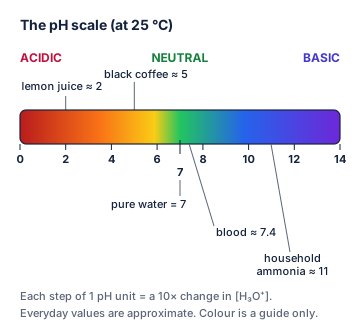
Worked example
Worked example: pH of a strong acid
Question: What is the pH of 0.050 M hydrochloric acid?
- HCl is a strong acid, so M.
Worked example: pH of a strong base
Question: What is the pH of 0.020 M calcium hydroxide, ?
- Each releases two ions: M
Worked example: Concentration from pH
Question: A solution has pH 4.50. What is ?
M
Common mistake
Common mistake: Thinking the pH scale is linear
pH 4 is not twice as acidic as pH 8. Each pH unit is a factor of 10, so the difference is = 10,000 times.
Common mistake: Forgetting the number of OH⁻ ions
For or , is twice the concentration of the base. Using 0.020 M instead of 0.040 M in the example gives pH 12.30 instead of 12.60.
Common mistake: Mixing up pH and pOH
For a base, you usually calculate pOH first from , then convert: pH = 14.00 − pOH. Reporting the pOH as the pH is a very common slip.
Notation note
- and are used interchangeably in pH calculations.
- Significant figures: the number of decimal places in a pH equals the number of significant figures in the concentration. 0.050 M (2 s.f.) gives pH 1.30 (2 decimal places).
- “log” here means the base-10 logarithm (the “log” key on a calculator, not “ln”).
Remember this
Remember this
- pH = −log[H₃O⁺]; [H₃O⁺] = 10⁻ᵖᴴ.
- At 25 °C: pH < 7 acidic, = 7 neutral, > 7 basic; pH + pOH = 14.00.
- 1 pH unit = 10× change in [H₃O⁺].
- Strong acids/bases: concentration of H₃O⁺ or OH⁻ comes straight from the formula (count the OH⁻!).
Test yourself
Check your understanding before moving on.
Flashcards
pH: Flashcards
- QuestionWhat is the definition of pH?Answer
- QuestionAt 25 °C, what pH values are acidic, neutral and basic?Answer
Below 7 acidic, exactly 7 neutral, above 7 basic.
- QuestionWhat is at 25 °C?Answer
- QuestionWhat is the relationship between pH and pOH at 25 °C?Answer
pH + pOH = 14.00
- QuestionHow many times more does a pH 3 solution have than a pH 6 solution?Answer
1000 times (): each pH unit is a factor of 10.
- QuestionWhat is the pH of 0.010 M HCl?Answer
- QuestionWhat is the pH of 0.0010 M NaOH?Answer
pOH = 3.00, so pH = 14.00 − 3.00 = 11.00
- QuestionHow do you find from the pH?Answer
- QuestionWhat is in 0.020 M ?Answer
0.040 M: each formula unit releases two ions.
- QuestionHow many decimal places should a pH have?Answer
As many as the significant figures in the concentration (0.050 M → pH 1.30).
Tip: press Space to flip and ← → to move between cards.
Quiz
pH: Quiz
7 questions
At 25 °C, pH above 7 is basic, below 7 is acidic, and exactly 7 is neutral.
Show answer
Answer: basic
At 25 °C, pH above 7 is basic, below 7 is acidic, and exactly 7 is neutral.
Strong acid, so M and pH = −log(0.0025) = 2.60. The answer 11.40 is the pOH.
Show answer
Answer: 2.60
Strong acid, so M and pH = −log(0.0025) = 2.60. The answer 11.40 is the pOH.
M, so pOH = −log(0.15) = 0.82, and pH = 14.00 − 0.82 = 13.18. The answer 0.82 reports the pOH as the pH.
Show answer
Answer: 13.18
M, so pOH = −log(0.15) = 0.82, and pH = 14.00 − 0.82 = 13.18. The answer 0.82 reports the pOH as the pH.
A difference of 4 pH units is a factor of = 10,000, and the lower pH has the higher .
Show answer
Answer: A has 10,000 times more
A difference of 4 pH units is a factor of = 10,000, and the lower pH has the higher .
pOH = −log(2.5 × 10⁻⁴) = 3.60, so pH = 14.00 − 3.60 = 10.40. (Equivalently, M.)
Show answer
Answer: 10.40
pOH = −log(2.5 × 10⁻⁴) = 3.60, so pH = 14.00 − 3.60 = 10.40. (Equivalently, M.)
Each gives two : M, pOH = 1.40, pH = 12.60. The answer 12.30 forgets the factor of 2.
Show answer
Answer: 12.60
Each gives two : M, pOH = 1.40, pH = 12.60. The answer 12.30 forgets the factor of 2.
Diluting 10 times gives 0.010 M HCl, and pH = −log(0.010) = 2.00. A 10-fold dilution of a strong acid raises the pH by 1.
Show answer
Answer: 2.00
Diluting 10 times gives 0.010 M HCl, and pH = −log(0.010) = 2.00. A 10-fold dilution of a strong acid raises the pH by 1.
Notes and downloads
Worksheet
pH Worksheet
9 questions on the pH scale and pH calculations for strong acids and bases. Answer key included.
References
- Brown, T. L.; LeMay, H. E., Jr.; Bursten, B. E.; Murphy, C. J.; Woodward, P. M.; Stoltzfus, M. W. Chemistry: The Central Science, 15th ed.; Pearson, 2022.
Practise this topic with flashcards and a quiz at chemistryclarity.com/chemistry/ph/
Spotted a mistake? Let us know and we'll fix it.