What is it?
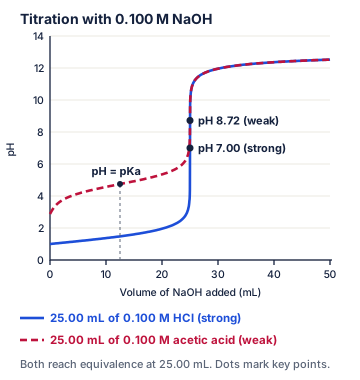
In a titration, a solution of known concentration (the titrant, often NaOH) is added gradually to a measured volume of another solution (for example an acid). A titration curve is a graph of the pH of the mixture against the volume of titrant added.
Key points on the curve:
- Equivalence point: exactly enough base has been added to react with all the acid (moles of OH⁻ = moles of acid H⁺ available).
- Half-equivalence point (weak acids): half the acid has been neutralized.
- End point: where an indicator changes colour. A good indicator makes the end point match the equivalence point.
Key idea
Near the equivalence point the pH changes very sharply: one drop can move it by several units. That jump is what makes titrations so precise.
Why does it matter?
- Finding unknown concentrations: titrations are one of the most accurate ways to measure how much acid or base a sample contains, from vinegar to medicines.
- Measuring pKa: the half-equivalence point of a weak acid titration gives its pKa directly.
- Choosing the right indicator: the shape of the curve tells you which indicator will change colour at the right moment.
How does it work?
1. Strong acid + strong base
- The pH starts low (for 0.100 M HCl, pH 1.00) and rises slowly.
- Near equivalence, it rises steeply, passing through pH 7.00 at the equivalence point (the salt formed, such as NaCl, is neutral).
- After equivalence, excess OH⁻ makes the pH level off at a high value.
2. Weak acid + strong base
- The pH starts higher (0.100 M acetic acid: pH 2.88), because a weak acid ionizes only partly.
- A flatter buffer region follows, where the solution contains both the weak acid and its conjugate base.
- At the half-equivalence point, [HA] = [A⁻], so pH = pKa (4.74 for acetic acid).
- The equivalence point is above 7 (here pH 8.72), because the conjugate base (acetate) is weakly basic.
3. Choosing an indicator
Pick an indicator whose colour-change range lies within the steep part of the curve:
| Indicator | Changes colour between pH (approx.) | Suits |
|---|---|---|
| Methyl orange | 3.1 – 4.4 | strong acid + weak base |
| Bromothymol blue | 6.0 – 7.6 | strong acid + strong base |
| Phenolphthalein | 8.2 – 10.0 | weak acid + strong base (also strong + strong) |
Think of it like this
Filling a bucket that has a hidden tipping point: for a long time each cup of water barely changes anything, then suddenly one cup tips it over. In a titration, the equivalence point is the tipping point, and the indicator is the alarm that goes off when it tips.
More precisely
For a strong acid–strong base titration the steep jump is so large that phenolphthalein and bromothymol blue both work well. For a weak acid–weak base titration there is no sharp jump, so indicators are unreliable and a pH meter is used. The equivalence point of a strong acid–weak base titration (e.g. HCl with ammonia) is below 7, because the conjugate acid () is weakly acidic.
Visualise it
Worked example
Worked example: Equivalence volume and pH before equivalence
Question: 25.00 mL of 0.100 M HCl is titrated with 0.100 M NaOH. (a) What volume of NaOH reaches equivalence? (b) What is the pH after 12.50 mL of NaOH has been added?
- Moles of HCl = 0.100 × 0.02500 = 0.00250 mol, so NaOH needed = 0.00250 mol; volume = 0.00250 ÷ 0.100 = 25.0 mL
- After 12.50 mL: NaOH added = 0.00125 mol; HCl left = 0.00250 − 0.00125 = 0.00125 mol
- Total volume = 37.50 mL, so M and pH = 1.48
Worked example: pH at the half-equivalence and equivalence points of a weak acid
Question: 25.00 mL of 0.100 M acetic acid is titrated with 0.100 M NaOH. Find the pH (a) at the half-equivalence point and (b) at the equivalence point. (, pKa = 4.74)
- Half-equivalence (12.50 mL): [HA] = [A⁻], so pH = pKa = 4.74
- Equivalence (25.00 mL): all the acid has become acetate: 0.00250 mol in 50.00 mL = 0.0500 M
- Acetate is a weak base: , so M
- pOH = 5.28, pH = 8.72
Common mistake
Common mistake: Assuming every equivalence point is at pH 7
Only strong acid + strong base titrations reach equivalence at pH 7. Weak acid + strong base: above 7. Strong acid + weak base: below 7.
Common mistake: Confusing equivalence with neutral
“Equivalence” means the moles of acid and base match the balanced equation, not that the solution is neutral.
Common mistake: Choosing an indicator outside the steep region
Methyl orange changes colour around pH 3–4, well before the equivalence point of a weak acid titration (pH 8.72), so it would give an end point that is far too early.
Notation note
- The solution in the burette is the titrant; the solution being measured is the analyte.
- Some courses use “end point” and “equivalence point” interchangeably; strictly, the end point is where the indicator changes.
Remember this
Remember this
- Equivalence: moles of base = moles of acid (from the balanced equation).
- Strong + strong: equivalence at pH 7. Weak acid + strong base: above 7. Strong acid + weak base: below 7.
- Half-equivalence of a weak acid: pH = pKa.
- Choose an indicator that changes colour within the steep jump.
Test yourself
Check your understanding before moving on.
Flashcards
Titration Curves: Flashcards
- QuestionWhat is a titration curve?Answer
A graph of the pH of the mixture against the volume of titrant added.
- QuestionWhat is the equivalence point?Answer
The point where just enough titrant has been added to react completely with the analyte, according to the balanced equation.
- QuestionWhat is the pH at the equivalence point of a strong acid–strong base titration?Answer
7.00 (at 25 °C), because the salt formed is neutral.
- QuestionIs the equivalence point of a weak acid–strong base titration above or below 7?Answer
Above 7, because the conjugate base of the weak acid is weakly basic.
- QuestionWhat is the pH at the half-equivalence point of a weak acid titration?Answer
pH = pKa, because [HA] = [A⁻] there.
- QuestionWhat is the end point?Answer
The point where the indicator changes colour. Ideally it matches the equivalence point.
- QuestionWhich indicator suits a weak acid–strong base titration?Answer
Phenolphthalein (changes around pH 8.2–10.0), within the steep jump.
- QuestionIs the equivalence point of a strong acid–weak base titration above or below 7?Answer
Below 7, because the conjugate acid of the weak base is weakly acidic.
- QuestionWhy are titrations so precise near the equivalence point?Answer
The pH changes very steeply there, so a single drop causes a large, easily seen change.
Tip: press Space to flip and ← → to move between cards.
Quiz
Titration Curves: Quiz
7 questions
Strong acid + strong base gives a neutral salt (NaCl), so the equivalence point is at pH 7.00 (25 °C).
Show answer
Answer: 7.00
Strong acid + strong base gives a neutral salt (NaCl), so the equivalence point is at pH 7.00 (25 °C).
At equivalence the solution contains acetate, a weak base, so the pH is above 7 (8.72 for 0.100 M solutions).
Show answer
Answer: above 7
At equivalence the solution contains acetate, a weak base, so the pH is above 7 (8.72 for 0.100 M solutions).
Half the acid has been converted to its conjugate base, so [HA] = [A⁻] and pH = pKa + log(1) = pKa.
Show answer
Answer: the pKa of the acid
Half the acid has been converted to its conjugate base, so [HA] = [A⁻] and pH = pKa + log(1) = pKa.
Moles HCl = 0.100 × 0.02500 = 0.00250 mol; volume NaOH = 0.00250 ÷ 0.100 = 0.0250 L = 25.0 mL.
Show answer
Answer: 25.0 mL
Moles HCl = 0.100 × 0.02500 = 0.00250 mol; volume NaOH = 0.00250 ÷ 0.100 = 0.0250 L = 25.0 mL.
HCl left = 0.00250 − 0.00125 = 0.00125 mol in 37.50 mL: [H₃O⁺] = 0.0333 M, pH = 1.48. The answer 1.30 forgets that the volume has increased.
Show answer
Answer: 1.48
HCl left = 0.00250 − 0.00125 = 0.00125 mol in 37.50 mL: [H₃O⁺] = 0.0333 M, pH = 1.48. The answer 1.30 forgets that the volume has increased.
The equivalence point is at about pH 8.7, inside the steep jump where phenolphthalein changes colour. Methyl orange would change far too early.
Show answer
Answer: Phenolphthalein (pH 8.2–10.0)
The equivalence point is at about pH 8.7, inside the steep jump where phenolphthalein changes colour. Methyl orange would change far too early.
A weak acid releases fewer H₃O⁺ ions than a strong acid of the same concentration (pH 2.88 vs 1.00).
Show answer
Answer: Acetic acid ionizes only partly
A weak acid releases fewer H₃O⁺ ions than a strong acid of the same concentration (pH 2.88 vs 1.00).
Notes and downloads
Worksheet
Titration Curves Worksheet
8 questions on equivalence points, pH during a strong acid titration, half-equivalence and indicators. Answer key included.
References
- Brown, T. L.; LeMay, H. E., Jr.; Bursten, B. E.; Murphy, C. J.; Woodward, P. M.; Stoltzfus, M. W. Chemistry: The Central Science, 15th ed.; Pearson, 2022.
Practise this topic with flashcards and a quiz at chemistryclarity.com/chemistry/titration-curves/
Spotted a mistake? Let us know and we'll fix it.