The fever tree
Malaria, one of the world’s great killers, was treated for three centuries with the bark of the cinchona tree from the Andes. In the 1630s Jesuit missionaries in Peru learned that the powdered bark cured fevers and brought it to Europe, where “Jesuit’s bark” became one of the most valuable medicines of its time. The bark’s strength varied enormously, however, and so did the results.
Isolation and an accidental industry
In 1820 the French pharmacists Pierre Joseph Pelletier and Joseph Bienaimé Caventou isolated the active alkaloid, quinine. For the first time doctors could give a known dose, and factories began producing pure quinine salts.
Demand for quinine soared as Europeans moved into malarial regions, and chemists dreamed of making it artificially. In 1856 an 18-year-old student, William Henry Perkin, tried to make quinine by oxidizing a coal-tar chemical. He failed, but obtained a brilliant purple dye, mauveine, the first synthetic dye. His discovery launched the synthetic dye industry, and with it much of the modern chemical and pharmaceutical industry.
A tricky structure
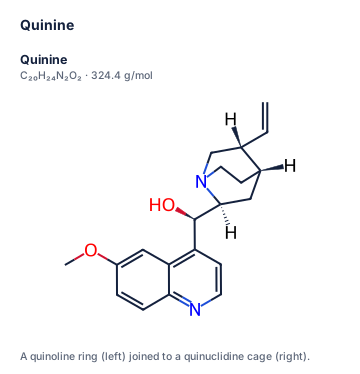
Quinine has two ring systems: an aromatic quinoline and a cage-shaped quinuclidine, joined by a carbon carrying an –OH group. It has four stereocentres, and only one of the 16 possible stereoisomers is quinine. Working out how its atoms are connected took until 1908; a formal synthesis by Woodward and Doering followed in 1944, and a fully stereoselective synthesis only in 2001.
Key idea
Quinine shows why stereochemistry matters: its stereoisomer quinidine has the same atoms and bonds but a different 3D arrangement at two carbons, and it is used for a different purpose, as a heart drug.
Why tonic water glows
Quinine absorbs ultraviolet light and re-emits it as blue fluorescence. Hold a glass of tonic water under a UV lamp and it glows blue. Because its fluorescence is so reliable, quinine sulfate is used as a standard in fluorescence spectroscopy, a close relative of the absorbance measurements in the lesson on Beer’s law.
How it fights malaria
Inside red blood cells the malaria parasite digests haemoglobin, releasing toxic haem, which it normally locks away as harmless crystals. Quinine is thought to block this crystallization, so the parasite is poisoned by its own waste. Quinine was later the model for synthetic drugs such as chloroquine (1934).
More precisely
For severe malaria, injectable artesunate (a derivative of artemisinin) has replaced quinine as the first choice because it is more effective and safer, but quinine is still used where artesunate is not available. In tonic water the quinine concentration is far too low to treat or prevent malaria.
Timeline
- 1630sJesuit missionaries in Peru learn of the fever-treating bark and bring "Jesuit's bark" to Europe.
- 1742Carl Linnaeus names the tree Cinchona, after a legend about the Countess of Chinchón.
- 1820Pelletier and Caventou isolate quinine from cinchona bark, allowing accurate doses.
- 1856William Henry Perkin, aged 18, tries to synthesize quinine and instead discovers mauveine, the first synthetic dye.
- 1865Charles Ledger smuggles high-yield cinchona seeds out of Bolivia; Dutch plantations on Java later dominate world supply.
- 1908Paul Rabe establishes how the atoms of quinine are connected.
- 1944Robert Burns Woodward and William Doering complete a formal total synthesis of quinine.
- 2001Gilbert Stork completes the first fully stereoselective total synthesis.
Sources and further reading
Explore next
1972 Artemisinin isolated
Artemisinin: An Ancient Text and a Modern Malaria Drug
How a 1600-year-old prescription led to a Nobel Prize and saved millions of lives.
How Tu Youyou's team found artemisinin in sweet wormwood using a clue from a fourth-century Chinese text, why its peroxide bridge kills malaria parasites, and how it is made today.
1804 Morphine isolated from opium
Morphine: The Gift of the Poppy
The first alkaloid ever isolated from a plant, still one of the most important painkillers in medicine.
From opium in ancient Mesopotamia to Sertürner's isolation of morphine in 1804, its complex structure (1925) and synthesis (1952), how it relieves pain, and why it is addictive.
Spotted a mistake? Let us know and we'll fix it.