Ancient medicine, modern molecule
People have used the opium poppy to relieve pain and induce sleep for more than 5000 years. Opium is the dried milky latex from the unripe seed pod, a complex mixture of about two dozen alkaloids. Its strength varied from batch to batch, so doses were unpredictable and often dangerous.
In 1804 a young German pharmacist’s apprentice, Friedrich Sertürner, isolated the main active compound by extracting opium and precipitating it with ammonia. He tested it on himself and three friends, who fell into a deep sleep, and named it morphium after Morpheus, the Greek god of dreams. It was the first alkaloid ever isolated from a plant, and it showed for the first time that a plant medicine’s effect could come from a single pure chemical. Pure morphine meant reliable doses, and the invention of the hypodermic syringe in 1853 made it the standard treatment for severe pain.
Key idea
Alkaloids are nitrogen-containing natural products that are usually basic (the nitrogen can accept a proton). That is why Sertürner could extract morphine with acid and precipitate it with a base: the same acid–base chemistry used today to purify alkaloids such as morphine, quinine, caffeine and nicotine.
A difficult structure
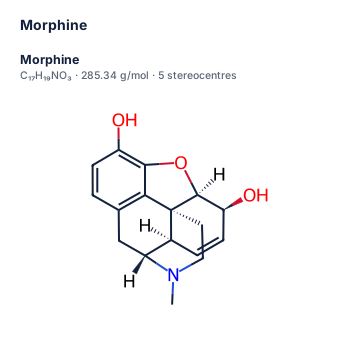
Morphine’s formula was known by the 1840s, but its three-dimensional structure took another 80 years. It has five fused rings, a phenol (–OH on the benzene ring), a second alcohol group, an ether bridge, a C=C double bond and a basic tertiary amine, with five stereocentres. Robert Robinson proposed the correct structure in 1925, and Marshall Gates synthesized it in 1952. Even today it is cheaper to extract morphine from poppies than to make it.
How it works, and the risks
Morphine binds to μ-opioid receptors in the brain and spinal cord, the same receptors used by the body’s own pain-relieving peptides (enkephalins and endorphins, discovered in the 1970s). Activating them blocks pain signals and produces euphoria. Repeated use leads to tolerance (larger doses are needed) and dependence, and an overdose stops breathing.
Small changes to the molecule change its properties dramatically. Methylating the phenol –OH gives codeine, a milder painkiller; acetylating both –OH groups gives heroin (diacetylmorphine), which crosses into the brain faster and is even more addictive.
More precisely
Morphine remains on the World Health Organization’s list of essential medicines, and access to it for cancer and end-of-life pain is still very unequal around the world. At the same time, the misuse of opioids, especially synthetic ones such as fentanyl, is a major public-health crisis. Chemists continue to search for painkillers that act on opioid receptors without causing addiction or breathing problems.
Timeline
- c. 3400 BCEThe opium poppy is cultivated in Mesopotamia; Sumerian records refer to it as the "joy plant".
- 1804Pharmacist's apprentice Friedrich Sertürner isolates the active principle of opium, the first alkaloid isolated from any plant; he names it after Morpheus.
- 1817Sertürner publishes a fuller account, showing that morphine is a base that forms salts with acids.
- 1827Merck (Darmstadt) begins commercial production of morphine.
- 1853The hypodermic syringe is introduced, allowing morphine to be injected for fast pain relief.
- 1898Bayer markets diacetylmorphine as "Heroin", which proves even more addictive.
- 1925John Gulland and Robert Robinson propose the correct structure of morphine (Robinson later wins the 1947 Nobel Prize in Chemistry for work on alkaloids).
- 1952Marshall Gates completes the first total synthesis of morphine.
- 1973Opioid receptors in the brain are identified.
- 1975The body's own opioid peptides (enkephalins) are discovered.
Sources and further reading
Explore next
1897 Aspirin first made in pure form
Aspirin: From Willow Bark to Wonder Drug
How a folk remedy for fever became one of the most widely used medicines in the world.
The 3500-year journey of aspirin: willow bark, salicin and salicylic acid, Bayer's acetylated version of 1897, and how its mechanism was finally explained in 1971.
1820 Quinine isolated from cinchona bark
Quinine: The Gift of the Cinchona Tree
The bark that treated malaria for 300 years, and the failed synthesis that started the chemical industry.
Cinchona bark from the Andes, the isolation of quinine in 1820, Perkin's accidental discovery of the first synthetic dye in 1856, the long road to its synthesis, and why tonic water glows.
Spotted a mistake? Let us know and we'll fix it.