What is it?
A functional group is an atom or a small group of atoms that gives a family of organic compounds its typical reactions and properties. The rest of the molecule, a carbon chain written R, mostly just comes along for the ride.
Ethanol () and propan-1-ol () have different chains, but both contain the –OH group, so both are alcohols and react in the same ways.
| Family | Group | Name ending (example) |
|---|---|---|
| Alkene | C=C | -ene (ethene) |
| Alcohol | –OH | -ol (ethanol) |
| Haloalkane | –F, –Cl, –Br, –I | fluoro-, chloro-, bromo-, iodo- (chloroethane) |
| Aldehyde | –CHO | -al (ethanal) |
| Ketone | C=O inside the chain | -one (propanone) |
| Carboxylic acid | –COOH | -oic acid (ethanoic acid) |
| Ester | –COO– | -oate (ethyl ethanoate) |
| Amine | –NH₂ | -amine (ethanamine) |
| Amide | –CONH₂ | -amide (ethanamide) |
Key idea
Learn the functional group and you can predict the chemistry: every alcohol behaves like an alcohol, every acid like an acid. The name of a compound = the stem for the number of carbons (meth-, eth-, prop-…) + the ending for its functional group.
Why does it matter?
- Prediction. There are millions of organic compounds but only a few dozen functional groups, so the groups organize the whole subject.
- Everyday life. Esters give fruits their smells; ethanoic acid makes vinegar sour; propanone (acetone) is a common solvent.
- Biology and medicine. Amino acids carry an amine and a carboxylic acid group; proteins are held together by amide links; most medicines contain several functional groups.
How does it work?
1. Naming compounds with a functional group
- Find the longest carbon chain that contains the functional group, and take its stem.
- Number the chain so that the functional group gets the lowest locant.
- Add the ending, with its locant before it: is propan-1-ol and is propan-2-ol.
Aldehydes and carboxylic acids are always at the end of the chain (carbon 1), so they need no locant: propanal, propanoic acid. The carbon of the –CHO or –COOH group counts as part of the chain: ethanoic acid, , has two carbons.
2. Naming esters
An ester forms from a carboxylic acid and an alcohol. Its name has two words: the alkyl group from the alcohol, then the acid name with -oic acid changed to -oate:
- ethanol + ethanoic acid → ethyl ethanoate,
- methanol + propanoic acid → methyl propanoate,
3. Functional groups and boiling points
Groups with an O–H or N–H bond (alcohols, carboxylic acids, amines) can form hydrogen bonds between molecules, so they boil much higher than hydrocarbons of similar mass:
| Compound | Molar mass | Boiling point |
|---|---|---|
| propane, | 44.09 g/mol | −42 °C |
| methoxymethane, | 46.07 g/mol | −24 °C |
| ethanol, | 46.07 g/mol | 78 °C |
Methoxymethane (an ether) is polar but has no O–H bond; ethanol has one and boils about 100 °C higher. The same groups also make small molecules soluble in water, because they can hydrogen-bond to water molecules.
4. Functional group isomers
Ethanol and methoxymethane are both : the same formula, but a different functional group, so they are different compounds with different properties. Likewise, can be propanal (an aldehyde) or propanone (a ketone).
5. A key reaction: esterification
A carboxylic acid and an alcohol, warmed with a few drops of concentrated sulfuric acid as a catalyst, form an ester and water:
The reaction is reversible and reaches equilibrium, so the yield is usually well below 100 %.
Think of it like this
Think of a toolkit with interchangeable heads. The carbon chain is the handle: short or long, it feels much the same. The functional group is the head: a screwdriver head and a hammer head do completely different jobs, whatever handle they are fitted to.
More precisely
Many functional groups are linked by redox reactions. Oxidizing a primary alcohol (–OH on an end carbon) gives an aldehyde and then a carboxylic acid: ethanol → ethanal → ethanoic acid, which is why wine left open turns to vinegar. A secondary alcohol (such as propan-2-ol) oxidizes to a ketone (propanone). When one molecule contains several groups, the IUPAC rules give priority to one of them for the ending (in order: acid, ester, aldehyde, ketone, alcohol, amine), and the others are named as prefixes.
Visualise it
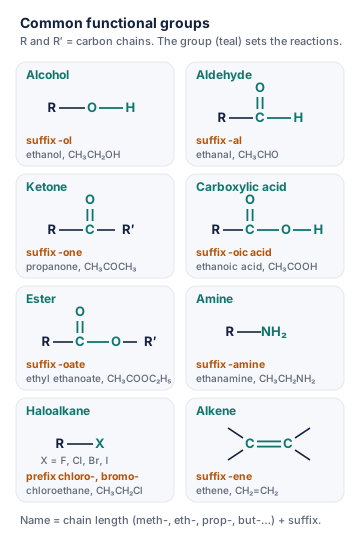
Worked example
Worked example: Identifying and naming
Question: Name each compound and give its family: (a) (b) (c)
- (a) –OH on carbon 1 of a 3-carbon chain: an alcohol, propan-1-ol.
- (b) C=O on the middle carbon of a 3-carbon chain: a ketone, propanone. (The C=O cannot be at the end, or it would be an aldehyde, so no locant is needed.)
- (c) –COOH at the end of a 3-carbon chain (counting the COOH carbon): a carboxylic acid, propanoic acid.
Worked example: Naming an ester and writing its equation
Question: Name the ester formed from methanol and propanoic acid, and write the equation.
-
The alkyl group comes from the alcohol: methanol gives methyl.
-
The acid part: propanoic acid gives propanoate.
-
Name: methyl propanoate.
-
Equation (checked: 4 C, 10 H, 3 O on each side):
Worked example: Percent yield of an esterification
Question: 6.00 g of ethanoic acid reacts with excess ethanol, and 5.28 g of ethyl ethanoate is collected. Find the percent yield. ( = 60.05 g/mol; = 88.10 g/mol; 1 mol acid gives 1 mol ester)
- (1 : 1 ratio)
- Theoretical yield:
- Percent yield 60.0 %
- The yield is well below 100 % because esterification is reversible and reaches equilibrium.
Common mistake
Common mistake: Naming esters backwards
The alcohol part comes first and ends in -yl; the acid part comes second and ends in -oate. is methyl ethanoate (from methanol + ethanoic acid), not ethyl methanoate.
Common mistake: Forgetting to count the functional-group carbon
In the COOH carbon is part of the chain: two carbons, so it is ethanoic acid, not methanoic acid. The same applies to the CHO carbon of aldehydes.
Common mistake: Confusing –CHO and –OH
(ethanal) is an aldehyde with a C=O double bond; it is not an alcohol, even though it contains O and H. An alcohol has the O bonded to H: –O–H.
Notation note
- Common names you will meet: acetic acid = ethanoic acid; acetone = propanone; acetaldehyde = ethanal; formaldehyde = methanal; ethyl acetate = ethyl ethanoate; isopropyl alcohol = propan-2-ol.
- In condensed formulas, –CHO means an aldehyde group, –COOH a carboxylic acid group and –COO– an ester link.
- R and R′ stand for carbon chains, which may be the same or different.
Remember this
Remember this
- Functional group = the reactive part of the molecule; it decides the family, the name ending and the chemistry.
- Endings: -ene, -ol, -al, -one, -oic acid, -oate, -amine, -amide; halogens are prefixes (chloro-).
- Number the chain so the functional group gets the lowest locant; -al and -oic acid are always carbon 1.
- O–H and N–H groups hydrogen-bond: higher boiling points and better water solubility.
- Acid + alcohol ⇌ ester + water (acid catalyst); ester name = alkyl (from alcohol) + -oate (from acid).
Test yourself
Check your understanding before moving on.
Flashcards
Functional Groups: Flashcards
- QuestionWhat is a functional group?Answer
An atom or group of atoms that gives a family of organic compounds its typical reactions and properties.
- QuestionAlcohol: group and name ending?Answer
–OH; ending -ol (ethanol, CH₃CH₂OH).
- QuestionAldehyde vs ketone?Answer
Both have C=O. Aldehyde: at the end of the chain, –CHO, ending -al (ethanal). Ketone: inside the chain, ending -one (propanone).
- QuestionCarboxylic acid: group and name ending?Answer
–COOH; ending -oic acid (ethanoic acid, CH₃COOH). The COOH carbon counts in the chain.
- QuestionHow is an ester named?Answer
Alkyl group from the alcohol + acid name ending in -oate: ethanol + ethanoic acid → ethyl ethanoate.
- QuestionAmine: group and name ending?Answer
–NH₂; ending -amine (ethanamine, CH₃CH₂NH₂).
- QuestionWhy does ethanol (78 °C) boil far higher than methoxymethane (−24 °C), with the same formula?Answer
Ethanol has an O–H bond, so its molecules form hydrogen bonds with each other; methoxymethane has no O–H.
- QuestionEsterification: the general equation?Answer
Carboxylic acid + alcohol ⇌ ester + water (acid catalyst, e.g. a few drops of concentrated H₂SO₄).
- QuestionGive two functional group isomers of C₃H₆O.Answer
Propanal (aldehyde, CH₃CH₂CHO) and propanone (ketone, CH₃COCH₃).
- QuestionWhat does oxidizing a primary alcohol give?Answer
An aldehyde, then a carboxylic acid: ethanol → ethanal → ethanoic acid.
Tip: press Space to flip and ← → to move between cards.
Quiz
Functional Groups: Quiz
7 questions
It contains an –OH group bonded to a carbon chain: ethanol, an alcohol.
Show answer
Answer: alcohol
It contains an –OH group bonded to a carbon chain: ethanol, an alcohol.
–CHO is an aldehyde group (ending -al). The chain has 3 carbons including the CHO carbon: propanal.
Show answer
Answer: propanal
–CHO is an aldehyde group (ending -al). The chain has 3 carbons including the CHO carbon: propanal.
The alcohol part comes first (ethanol → ethyl) and the acid part second (methanoic acid → methanoate).
Show answer
Answer: ethyl methanoate
The alcohol part comes first (ethanol → ethyl) and the acid part second (methanoic acid → methanoate).
Only ethanol has an O–H bond, so only ethanol forms hydrogen bonds between its molecules (78 °C, against −24 °C for methoxymethane and −42 °C for propane).
Show answer
Answer: ethanol, CH₃CH₂OH
Only ethanol has an O–H bond, so only ethanol forms hydrogen bonds between its molecules (78 °C, against −24 °C for methoxymethane and −42 °C for propane).
Both are C₃H₆O with different functional groups (aldehyde and ketone). Ethanol and propan-1-ol differ by CH₂; the acid and the ester have different formulas; butane and 2-methylpropane are chain isomers in the same family.
Show answer
Answer: propanal and propanone
Both are C₃H₆O with different functional groups (aldehyde and ketone). Ethanol and propan-1-ol differ by CH₂; the acid and the ester have different formulas; butane and 2-methylpropane are chain isomers in the same family.
The –OH is on carbon 2 when the chain is numbered from the nearer end (not 3).
Show answer
Answer: butan-2-ol
The –OH is on carbon 2 when the chain is numbered from the nearer end (not 3).
In CH₃COCH₂CH₃ (butanone) the C=O carbon has a carbon on each side. The others are an aldehyde, an ester and a carboxylic acid.
Show answer
Answer: CH₃COCH₂CH₃
In CH₃COCH₂CH₃ (butanone) the C=O carbon has a carbon on each side. The others are an aldehyde, an ester and a carboxylic acid.
Notes and downloads
Worksheet
Functional Groups Worksheet
9 questions on identifying and naming functional groups, isomers, boiling points, esters and an esterification yield. Answer key included.
References
- Brown, T. L.; LeMay, H. E., Jr.; Bursten, B. E.; Murphy, C. J.; Woodward, P. M.; Stoltzfus, M. W. Chemistry: The Central Science, 15th ed.; Pearson, 2022.
Practise this topic with flashcards and a quiz at chemistryclarity.com/chemistry/functional-groups/
Spotted a mistake? Let us know and we'll fix it.