A desperate search
By the 1960s the malaria parasite Plasmodium falciparum had become resistant to chloroquine, the main antimalarial drug. In 1967 China set up a secret national programme, Project 523, to find new treatments. In 1969 a young pharmaceutical chemist, Tu Youyou, was put in charge of a research group and told to search traditional Chinese medicine for leads.
Her team collected more than 2000 traditional recipes and tested hundreds of plant extracts against malaria in mice. An extract of qinghao (sweet wormwood, Artemisia annua) looked promising at first, but the results were inconsistent.
The clue in a fourth-century book
Tu went back to the ancient literature. In a handbook of emergency prescriptions written by Ge Hong around 340 CE, she read that qinghao should be soaked in cold water, wrung out, and the juice drunk. The usual method was to boil herbs. Perhaps, she reasoned, heat destroyed the active compound.
She changed the extraction: instead of hot ethanol, her team used diethyl ether, which boils at only 35 °C. In October 1971, extract number 191 cleared the parasites completely from infected mice and monkeys. In 1972 the team isolated the pure compound, qinghaosu, now called artemisinin.
Key idea
Chemistry turned a vague traditional remedy into a reliable drug: a low-temperature, non-polar extraction protected a fragile molecule, and purification gave a single compound whose dose could be controlled.
A molecule with a weak link
Artemisinin, , is a sesquiterpene lactone (a cyclic ester), but its most unusual feature is an endoperoxide bridge: two oxygen atoms bonded to each other, O–O, inside a ring. In a peroxide, each of these oxygens has an oxidation number of −1, and the O–O bond is weak.
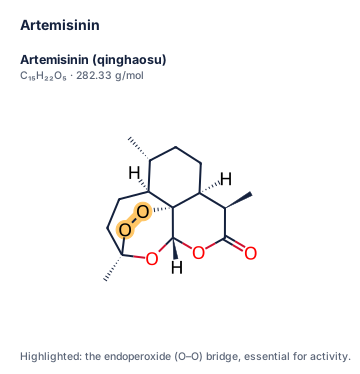
Inside red blood cells, the parasite digests haemoglobin and releases haem containing iron(II). The accepted model is that breaks the O–O bond (a redox reaction), producing highly reactive radicals that damage the parasite’s proteins. That explains why molecules without the peroxide bridge are inactive, and why the extraction had to avoid heat.
Worked example: Counting oxygen
Question: What is the percentage by mass of oxygen in artemisinin? (C 12.01, H 1.008, O 16.00 g/mol)
- 28.3 %
From plant to medicine
Artemisinin acts fast but is cleared from the body within hours, and it dissolves poorly in water. Chemists therefore made derivatives: reducing the lactone gives dihydroartemisinin (1973), and from it come artemether (an ether) and water-soluble artesunate (an ester), which can be injected in severe malaria. To prevent resistance, these are given with a longer-acting partner drug, as artemisinin-based combination therapies (ACTs), the standard treatment recommended by the World Health Organization.
Supply was a problem: the plant contains only a small percentage of artemisinin by dry mass. Since 2013, part of the world’s supply has been made semi-synthetically from artemisinic acid produced by genetically engineered yeast.
More precisely
Malaria still kills around 600 000 people a year, most of them young children in Africa (WHO World Malaria Report). Partial resistance to artemisinin, first reported in western Cambodia around 2008, is now being watched closely, which is why ACTs always combine two drugs with different mechanisms. The exact way artemisinin kills parasites is still being studied; the iron-activated peroxide model is the most widely accepted.
Timeline
- c. 340Ge Hong's handbook of emergency prescriptions advises soaking a handful of qinghao in water, wringing out the juice and drinking it for fevers.
- 1960sMalaria parasites become resistant to chloroquine in Southeast Asia, causing heavy losses during the Vietnam War.
- 1967China launches a secret national malaria research programme, Project 523.
- 1969Tu Youyou is appointed to lead a research group in the project and begins screening traditional remedies.
- 1971A low-temperature ether extract of qinghao completely clears malaria parasites in mice and monkeys.
- 1972The pure active compound, artemisinin, is isolated; the team tests the extract on themselves for safety, then on patients.
- 1973Dihydroartemisinin, a more potent derivative, is made by reducing artemisinin.
- 1977The structure of artemisinin, with its unusual peroxide bridge, is published.
- 2000sThe World Health Organization recommends artemisinin-based combination therapies as first-line treatment for falciparum malaria.
- 2013Large-scale semi-synthetic production begins from artemisinic acid made by engineered yeast.
- 2015Tu Youyou receives half of the Nobel Prize in Physiology or Medicine.
Sources and further reading
Explore next
Tu Youyou
born 1930
Tu Youyou (born 1930) led the team that discovered artemisinin in 1971–1972, inspired by an ancient Chinese text, and won the 2015 Nobel Prize in Physiology or Medicine.
1820 Quinine isolated from cinchona bark
Quinine: The Gift of the Cinchona Tree
The bark that treated malaria for 300 years, and the failed synthesis that started the chemical industry.
Cinchona bark from the Andes, the isolation of quinine in 1820, Perkin's accidental discovery of the first synthetic dye in 1856, the long road to its synthesis, and why tonic water glows.
Spotted a mistake? Let us know and we'll fix it.